
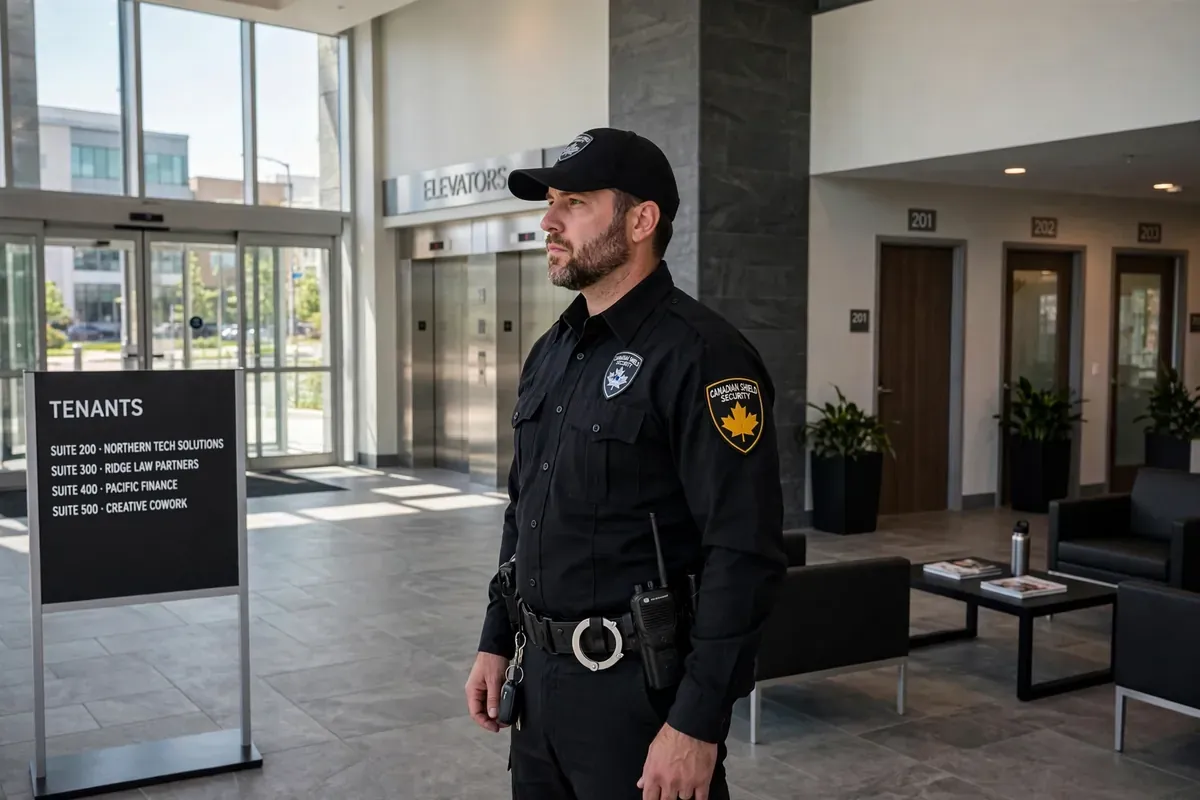
A property manager overseeing a 12-tenant office building near Jasper Avenue (T5J) gets a 6:10 a.m. call: a contractor propped the loading door open overnight, and one suite was entered. Each tenant assumed the landlord handled the door. The landlord assumed tenants handled their suites.
Multi-tenant building security Edmonton managers need starts with deciding who secures what. Canadian Shield Security provides guards licensed under the Security Services and Investigators Act (Alberta) (SSIA) for lobbies, patrols and after-hours cover.
This guide explains who is responsible for shared and private space, what Alberta law requires, which coverage options fit, and how to roll out a plan. It suits managers across Downtown (T5J), South Edmonton (T6H) and West Edmonton (T6M).
Quick answer: Multi-tenant building security in Edmonton works best when the landlord secures shared areas and each tenant secures its own suite. Licensed guards under the Security Services and Investigators Act (Alberta) cover lobbies and after-hours patrols, supported by visitor and access control and a lease that spells out who pays for it.
What Multi-Tenant Building Security Edmonton Managers Must Cover
A multi-tenant building has five zones to secure: the main lobby, loading dock, parkade, stairwells and roof, and the private suites. Shared zones belong to the landlord, so gaps there become your problem, whoever caused them.
| Area | Typical risk | First-line control |
|---|---|---|
| Main lobby | Tailgating and unknown visitors | Front-desk guard and visitor log |
| Loading dock | Propped doors, after-hours deliveries | Door alarm and patrol checks |
| Parkade | Vehicle break-ins, staff walking alone | Patrol, lighting and escorts |
| Stairwells and roof | Unauthorized access | Fob audits and lock checks |
| Private suites | After-hours entry | Tenant locks and alarm response |
Downtown towers near Jasper Avenue (T5J) face steady visitor traffic and contractor access. Office buildings in South Edmonton (T6H) and West Edmonton (T6M) have quieter days but emptier evenings, which is when propped doors and tailgating go unnoticed.
Tenant mix adds complexity. A medical office, a law firm and a coffee shop may share one lobby but face different risks and keep different hours. A single policy rarely fits everyone, so set building-wide rules and let tenants add their own.

Who Is Responsible for Security in a Multi-Tenant Building
Responsibility is shared: the landlord answers for common areas, each tenant answers for its own suite and workers, and Alberta law can hold more than one party accountable at once.
Under Alberta's Occupiers' Liability Act, more than one occupier can exist at the same premises, including the owner, the property manager and a tenant. Each owes visitors reasonable care. Alberta's OHS guidance adds that owners must keep buildings from endangering workers and share any hazard they identify.
Guards add a licensing layer. Under the Security Services and Investigators Act (Alberta), anyone paid to guard or patrol property needs a security service worker licence, valid for two years. See the Alberta security licence rules and keep licence details on file.
| Law | Applies to | What it means for your building |
|---|---|---|
| Occupiers' Liability Act | Owner, manager and tenants | Reasonable care for visitors; more than one occupier is possible |
| OHS Act, owner duties | Building owner | Maintain the building safely and share known hazards with all parties |
| OHS Code Part 27 | Every tenant that employs workers | Each tenant needs its own violence and harassment prevention plan |
| SSIA (Alberta) | Any guard or patrol you hire | Licence valid 2 years; keep copies on file |
| PIPA (Alberta) | Cameras and visitor logs | Notice, secure storage, destroy when no longer needed |
Compliance alert: Prime contractor rules apply mainly to construction and oil and gas sites, so most office landlords are not required to appoint one. Cameras collect personal information, and the privacy commissioner's video surveillance guidelines call for a stated purpose, a posted notice with a contact, and secure storage.
Which Security Setup Fits Your Building
A lobby guard suits buildings with heavy visitor traffic, while after-hours mobile patrol and alarm response suit smaller buildings that empty by 6 p.m. Many managers combine both.
Our commercial building security service covers lobbies and patrols, and our concierge security option adds a hospitality-style front desk. Costs below are Edmonton market estimates and vary by shift and site.
Costs spread across tenants. A 24-hour single post at $32-$45 per hour totals $5,376-$7,560 per week, or $448-$630 per tenant in a 12-tenant building. Many commercial leases recover security through operating charges, so confirm your lease wording first.
| Setup | Best for | Estimated cost |
|---|---|---|
| Weekday lobby guard, 40 hours | Busy office buildings | $1,280-$1,800 per week |
| Evening lobby guard, 20 hours | Buildings with late tenants | $640-$900 per week |
| 24-hour single post, 168 hours | Towers with round-the-clock use | $5,376-$7,560 per week |
| Mobile patrol and alarm response | After-hours cover | Quoted per site after assessment |

How to Roll Out a Shared Security Plan, Step by Step
Roll out a shared plan in six steps, starting with a written map of who controls each area. Clear ownership prevents the finger-pointing that follows an incident.
- Map shared and private areas, and name who controls each one. Walk the building with the lease in hand and list every lobby, dock, parkade, stairwell, roof, and suite, then assign one responsible party to each.
- Put responsibilities in writing in a lease schedule or building security protocol. Spell out who locks what, who pays for shared coverage, and how costs are recovered, so no one discovers a gap after an incident.
- Set access rules: visitor sign-in, after-hours fob use and quarterly fob audits. Decide who may enter after hours, require sign-in at the lobby, and audit fobs and keys every quarter so lost cards stop working.
- Choose coverage and write post orders (written guard instructions). Pick the guard or patrol mix that fits your traffic and budget, then put the duties, routes, and escalation steps in written post orders.
- Brief every tenant on how to report incidents and who to call. Give each tenant a one-page summary covering incident reporting, emergency contacts, and what to do when something looks wrong.
- Review the incident log monthly and adjust coverage. Read the log every month, look for patterns like repeated propped doors, and add or cut guard hours before the next review.
Post orders should state who may enter after hours, how deliveries are checked, how to handle a tenant dispute, and when to phone 911. Give each tenant a one-page summary so reporting stays consistent across suites.
When to Call a Professional Security Company
Call a licensed security company when incidents repeat, tenants complain about safety, or after-hours access cannot be tracked. Two or more incidents in a quarter, or one forced entry, is a clear signal.
Our guide to office building security in Edmonton covers single-tenant towers, and our commercial property security guide covers the wider picture. Managers weighing technology can read how access control works with guards.
Document every incident the same day. A dated log of what happened, who was notified and what changed afterward is your best evidence that the building took reasonable care, and it helps insurers and tenants alike.
Keeping a Multi-Tenant Building Secure Year-Round
Review access and incidents monthly, and refresh the whole plan once a year. Tenant turnover is a common source of drift, so collect fobs and keys at every move-out and re-key where needed.
Seasons change risk. Winter brings loitering in lobbies and frozen door hardware, while summer brings open doors and propped loading docks. A short security audit each spring and fall catches both.
Track three numbers: incidents per month, after-hours door alarms, and tenant safety complaints. If incidents fall for two quarters, hold coverage steady. If they rise, add guard hours before the next review.
Winter tip: Edmonton winters reach -40C -- this affects patrol vehicle performance, camera operation, and lock mechanisms. Cold also draws people into warm vestibules, so set clear lobby and parkade entrance rules before January.
Honest limits: For active criminal incidents, call 911 first. SSIA-licensed security guards are trained to observe and report. They do not replace police authority or emergency services, and they should not enter a tenant's suite unless the lease or tenant allows it. Use the Edmonton Police Service non-emergency line, 780-423-4567, for non-urgent reports.
Conclusion
Dependable multi-tenant building security Edmonton properties can sustain rests on three habits: clear ownership of every area, licensed guards where traffic is highest, and a monthly review. Small steps, such as fob audits and propped-door alarms, prevent the incidents that damage tenant trust.
If your building in T5J, T6H or Sherwood Park wants a second opinion, our team will walk the site with you and explain every option in plain terms through a free site assessment and consultation.
Canadian Shield Security serves Edmonton 24/7. Free consultation -- no hidden fees. Call 1 (800) 326-7879.
Frequently Asked Questions About Multi-Tenant Building Security in Edmonton
Do security guards in Edmonton multi-tenant buildings need a licence?
Yes. Under the Security Services and Investigators Act (Alberta), anyone paid to guard or patrol property needs a security service worker licence, valid for two years. This applies to lobby guards, concierge-style guards and patrol guards alike. Ask your provider for licence details and keep copies on file with building management.
How much does multi-tenant building security cost in Edmonton?
Licensed guard coverage typically costs $32 to $45 per hour. A 40-hour weekday lobby post runs about $1,280 to $1,800 weekly, and a 24-hour single post runs $5,376 to $7,560. Mobile patrol is quoted per site after a free assessment. Many leases recover these costs through operating charges.
Does Canadian Shield Security cover multi-tenant buildings in St. Albert and Leduc?
Yes. Canadian Shield Security serves commercial buildings across Edmonton, including St. Albert, Leduc, Sherwood Park, Beaumont, Stony Plain and Spruce Grove. Coverage runs 24/7, 365 days a year, including holidays. Call 1 (800) 326-7879 to book a free site assessment and receive a custom quote for your building.
Who pays for security in a multi-tenant commercial building?
It depends on your lease. Landlords usually arrange security for shared areas and often recover the cost from tenants through operating charges, while each tenant secures its own suite. Read the lease clauses on common area costs, and agree the split in writing before adding guard hours. Confirm details with a lawyer.
Can a lobby guard refuse entry to a tenant's visitor?
Yes, within the building's rules. Guards act on the owner's instructions, so they can check visitor lists, ask for identification and refuse entry to people without permission. They have no police powers and may use only reasonable force. If a visitor refuses to leave or turns violent, call 911.
