
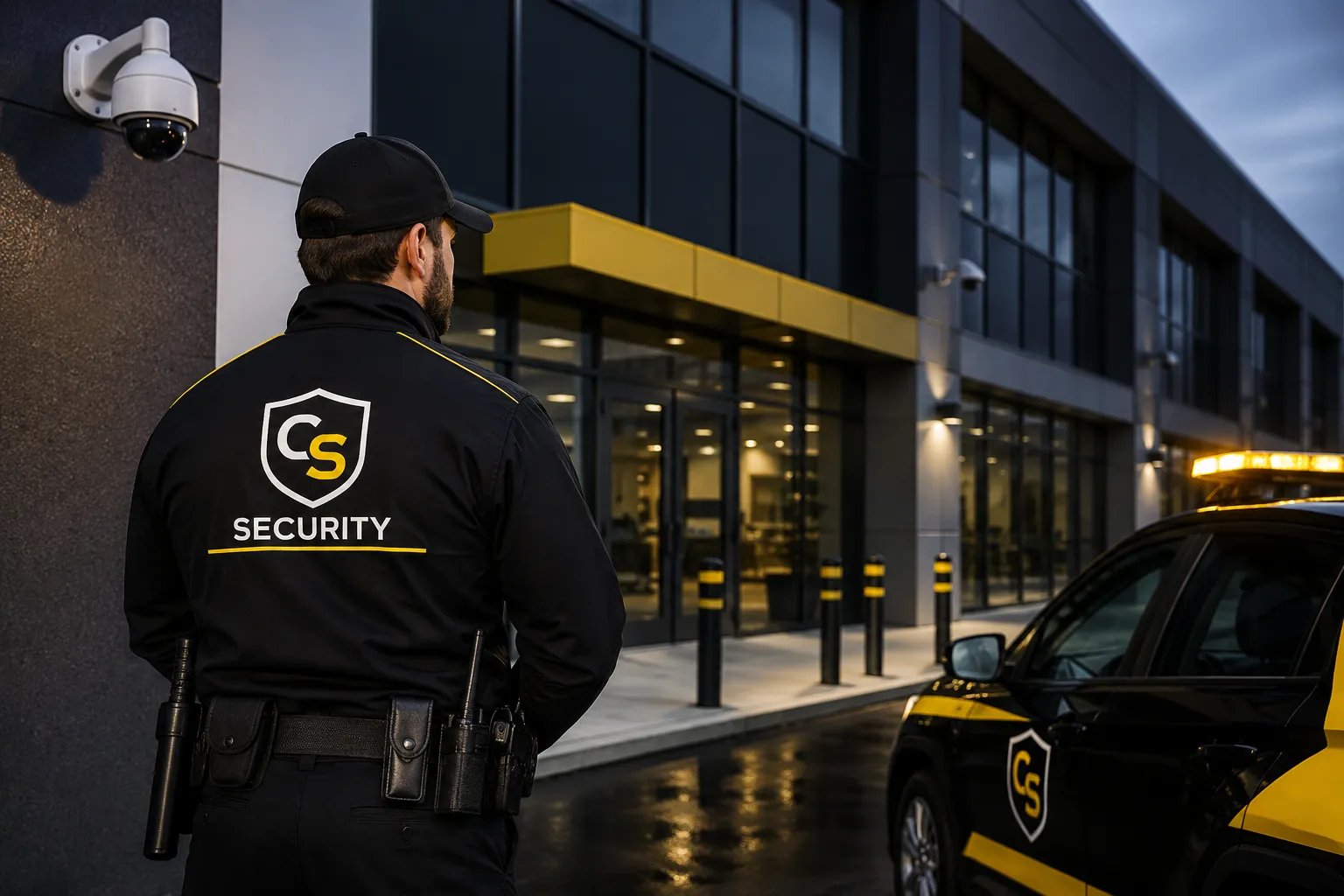
A property manager overseeing three office buildings in Edmonton's T6H corridor started fielding tenant complaints about after-hours parkade break-ins. A site walkthrough found no on-site guard coverage after 6pm, a single unmonitored loading entrance, and cameras pointed at the wrong angle entirely. Canadian Shield Security added evening patrol coverage and repositioned two cameras. Complaints stopped within a month.
This guide covers commercial building security for Edmonton property owners and managers: what a complete security plan includes, how to choose between guard coverage models, and what local rules like the City of Edmonton's alarm permit bylaw actually require.
Whether you manage a Downtown office tower, a T6H business park, or a retail plaza near West Edmonton Mall, the fundamentals are the same. Use this guide as a starting point, then follow the links throughout to deeper guides for your specific property type.
|
Commercial property security in Edmonton combines licensed on-site or mobile patrol guards, access control at entry points, CCTV monitoring, and a documented emergency response plan. Under the Security Services and Investigators Act, every guard must be SSIA-licensed, and any monitored alarm system requires a City of Edmonton permit under Bylaw 10922. |
What Commercial Property Security Actually Includes in Edmonton
Commercial property security is not one product. It is a layered combination of people, physical design and technology, built around the specific risks a property faces rather than a single generic package.
For most Edmonton commercial buildings, that layering means licensed guards or mobile patrol for presence and response, access control to manage who enters, CCTV to document activity, and a written emergency response plan every tenant and staff member understands.
Skipping any one layer creates a predictable gap. Cameras without a guard response plan just record incidents instead of preventing them. Guards without access control are managing an unmanageable number of entry points.

The right combination also depends on who is on the property and when. A building with daytime-only tenants has a very different risk window than a 24-hour distribution centre or a retail plaza that stays open into the evening.
Property managers new to commercial security often start with cameras alone because they feel like the fastest fix. In practice, a short consultation to map out all four layers together usually costs less over a year than adding pieces one at a time after each new incident.
On-Site Guards vs Mobile Patrol: Choosing the Right Coverage
On-site guards make sense for properties with continuous foot traffic, a staffed reception desk, or tenants who expect a visible presence during business hours, such as Downtown office towers and multi-tenant retail buildings.
Mobile patrol suits lower-traffic properties better, such as smaller T6H office parks or after-hours coverage for a building that already has daytime staff. Scheduled, unpredictable rounds cost less than continuous staffing while still deterring after-hours activity.
Many Edmonton properties use both: on-site coverage during business hours, handed off to mobile patrol overnight and on weekends. A security risk assessment is the fastest way to determine which mix actually fits your property's traffic and risk profile.
Coverage decisions should also account for seasonal shifts. A property that feels adequately covered in summer daylight can have a very different risk profile once Edmonton's early winter darkness sets in well before the end of a typical business day.
Whichever model you choose, every guard on an Edmonton commercial property must hold a valid licence under the Security Services and Investigators Act. Ask any prospective provider to confirm licensing before a contract is signed, not after coverage begins.
CPTED and Access Control: The Physical Security Layer
Crime Prevention Through Environmental Design, known as CPTED, shapes how a property's physical layout either supports or undermines security. Lighting, sightlines and landscaping all affect how easily a guard, camera or passerby can spot a problem before it escalates.
Access control narrows down how many ways someone can enter a property unsupervised. Key cards, visitor sign-in and locked after-hours entrances all reduce the number of points a guard or camera needs to actively monitor.
For multi-tenant buildings, access control also protects tenants from each other's visitors. Restricting elevator access by floor or requiring escort for after-hours contractor access are common, low-cost CPTED-aligned fixes.
Parkades and loading docks deserve particular attention in a CPTED review. These areas combine poor natural surveillance with high-value targets, from tenant vehicles to delivery goods, making them a recurring source of incidents across Edmonton commercial properties.
A CPTED review does not need to be expensive to be effective. Repositioning a single light fixture or trimming landscaping that blocks a camera's view often closes a meaningful gap for a fraction of the cost of adding new hardware.
CCTV, Alarm Systems and the City of Edmonton Alarm Permit
CCTV documents what happened and supports guard response, but footage alone does not stop an incident in progress. Cameras work best paired with monitored alarms and a guard or patrol response plan, not as a standalone solution.
Under City of Edmonton Bylaw 10922, any monitored alarm system in a commercial building requires a valid Alarm Systems Permit from Edmonton Police Service. Operating without one can mean a fine and a delayed police response when the alarm actually triggers.
Property managers switching alarm providers should confirm the existing permit transfers or gets reissued, since permits are tied to the alarm system rather than automatically following a change in monitoring company.
Repeated false alarms also carry a cost under the same bylaw, with fees attached to police response after a system's grace period has passed. Regular testing and clear staff training on arming and disarming procedures reduce this risk significantly.
What Different Edmonton Commercial Properties Need
An office building, a retail plaza and a bank branch face different risks even a few blocks apart, which is why a generic security package rarely fits any of them well.
Industrial and warehouse properties on the edge of the city, closer to Nisku and Acheson, add equipment theft and perimeter fencing to the list, risks a Downtown office tower rarely has to plan around at all.
|
Property Type |
Primary Risk Focus |
Related Guide |
|
Office buildings (T6H, T5J) |
After-hours access, tenant safety, reception coverage |
Office Building Security Guide |
|
Retail (West Edmonton Mall area, T6M) |
Shrinkage, loss prevention, high foot traffic |
Retail Theft Prevention Guide |
|
Downtown offices (T5J) |
After-hours crime, Jasper Avenue corridor risk |
Downtown Office Security Guide |
|
Banks and financial branches |
Use-of-force limits, access control, RCMP coordination |
Bank Security Guide |
Retail properties near West Edmonton Mall face shrinkage and loss prevention pressure that office towers rarely see. The loss prevention strategies guide covers that gap in more depth than a general property security plan can.
Building a Security Budget for Your Property
Most Edmonton commercial properties spend between $600 and $2,500 per month on baseline security, scaling up with square footage, coverage hours, and whether CCTV or access control hardware is included.
Budgeting for a free consultation and site assessment first, before committing to a specific coverage model, prevents overspending on guard hours a lower-risk property does not actually need.
Condo and commercial insurance providers increasingly factor documented security measures into premiums. A written security plan and recent risk assessment can support a stronger renewal conversation, not just a safer building.
Multi-building portfolios often find savings by standardizing post orders and reporting formats across properties, even when coverage hours differ. Reviewing all buildings under one plan also makes it easier to spot which property is genuinely under-protected.
Getting Started: From Assessment to Contract
The right starting point for any Edmonton commercial property is a free site assessment and consultation, not a guard contract signed sight unseen based on square footage alone.
From there, a written proposal should specify coverage hours, guard versus patrol mix, reporting frequency, and cost, all tied to the specific risks found during the walkthrough rather than a standard package.

Guards and cameras deter and document. They do not replace police response to an active crime in progress. For anything involving a break-in underway or a threat to safety, call Edmonton Police Service first, then your security provider.
Once a plan is in place, revisit it annually or after any major tenant change, renovation, or incident. A security plan built for last year's building is only a starting point, not a permanent fixture.
Conclusion
Commercial property security in Edmonton works best as a layered plan: licensed guards or patrol, CPTED-aligned access control, CCTV, and full compliance with SSIA and the City's alarm permit bylaw, all sized to your property's actual risk.
Canadian Shield Security offers a free consultation and site assessment for Edmonton commercial properties, with SSIA-licensed guards and no hidden fees. Explore the linked guides above for your specific property type, or book a walkthrough to start building your plan.
Property managers comparing providers should ask the same questions of every quote: licensing, reporting frequency, coverage hours and what happens after normal business hours end. A clear answer to all four is a stronger signal than price alone.
|
Canadian Shield Security serves Edmonton 24/7. Free consultation, no hidden fees. Call 1 (800) 326-7879. |
Frequently Asked Questions
Are commercial security guards in Edmonton required to be licensed?
Yes. Every Canadian Shield Security guard assigned to a commercial property holds a valid licence under the Security Services and Investigators Act (Alberta), plus a completed background check. Property managers should ask to see licence credentials for any guard on-site, and confirm the licence number against Alberta Security Programs records before signing a service contract.
How much does commercial property security cost in Edmonton?
Commercial property security in Edmonton typically runs $28 to $45 per hour for on-site guards, or $600 to $2,000 per month for scheduled mobile patrol, depending on building size and coverage hours. Canadian Shield Security offers a free consultation and site assessment to build a custom quote for your specific property.
Does Canadian Shield Security cover properties near West Edmonton Mall and T6H?
Yes. Canadian Shield Security protects commercial properties across Edmonton, including Downtown (T5J), South Edmonton (T6H) office parks and the West Edmonton Mall area (T6M), plus Sherwood Park, St. Albert and Leduc. Coverage plans are adjusted for each area's traffic patterns, tenant mix and after-hours risk.
What does a typical commercial property security plan include?
A commercial property security plan typically combines on-site or mobile patrol guards, access control at entry points, CCTV monitoring support, and a documented emergency response procedure. Larger properties often add a CPTED review to address lighting and sightline gaps that cameras and guards alone cannot fully solve.
Do Edmonton commercial buildings need an alarm permit?
Yes. Under City of Edmonton Bylaw 10922, any monitored alarm system in a commercial building requires a valid Alarm Systems Permit from Edmonton Police Service, currently a 30 dollar fee. Operating an unpermitted alarm system can result in a fine and delayed police response to triggered alarms.
