
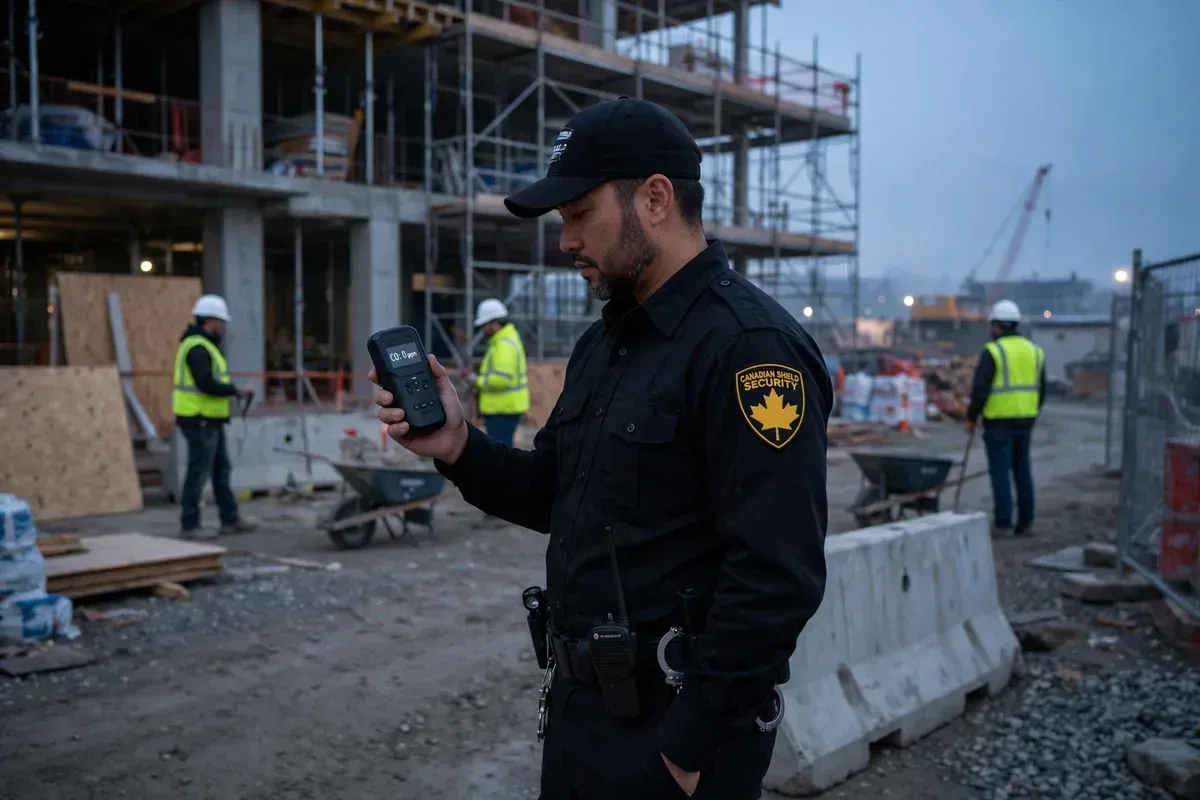
A branch manager at a Downtown Edmonton T5J bank location discovered during a routine internal review that a newly assigned lobby guard had never been briefed on the panic button locations or the branch's specific robbery response protocol. The gap had existed for three weeks before anyone caught it, unnoticed through two full shift rotations.
Bank security sits at an unusual intersection. The bank itself answers to federal oversight, while every guard standing in the lobby answers to Alberta's provincial licensing law. Our bank security services are built around both layers at once, not just one.
This guide covers what actually applies to an Edmonton bank branch's physical security, from the federal guideline banks operate under to the SSIA licence every guard must hold regardless of who regulates the institution itself.
|
Bank security in Edmonton combines federal oversight with provincial licensing. The Office of the Superintendent of Financial Institutions requires banks to maintain a physical security program, while any guard staffing a branch must hold an SSIA licence under Alberta law. Guards are trained to comply during a robbery, never to physically intervene. |
What Security Requirements Apply to Banks Operating in Edmonton?
Bank security in Edmonton operates under two separate layers of oversight. The bank as an institution is federally regulated, most commonly by the Office of the Superintendent of Financial Institutions, which sets expectations for the bank's overall security program. The guards physically staffing the branch answer to a completely different, provincial framework.
This split surprises some branch managers who assume federal regulation of the bank automatically covers guard licensing too. It does not. A federally chartered bank operating in Edmonton still needs any on-site guard to be individually licensed under Alberta law, the same as a retail store or office tower would.
The confusion usually surfaces during a security review or an insurance renewal, when someone asks who actually confirmed the guard's licence status. Federal regulation of the institution and provincial licensing of the individual guard are tracked by completely different bodies, and neither one automatically checks the other.
|
Confirm with any security provider whether they understand this dual framework. A provider unfamiliar with OSFI expectations may still provide excellent guards, but they should not be advising on the bank's overall security program. |
OSFI's Security Expectations for Federally Regulated Banks
The Office of the Superintendent of Financial Institutions issued an Integrity and Security Guideline that applies to all federally regulated financial institutions, including banks operating branches in Edmonton. It expects an annual threat assessment covering physical premises, personnel, and technology, along with documented security precautions appropriate to that assessment.
This guideline sets expectations at the institutional level, not a checklist of specific hardware or guard hours for each branch. A bank's head office typically translates these expectations into branch-level policy, which is where a local security provider's on-the-ground experience with Edmonton branch layouts becomes useful.
A branch manager rarely deals with OSFI directly. What actually reaches the branch level is an internal security policy document written by head office compliance staff, translating the federal guideline into specific rules about guard hours, alarm testing frequency, and cash handling limits for that location.
SSIA Licensing Still Applies to Bank Security Guards
Every guard working an Edmonton bank branch, whether stationed in the lobby, at the entrance, or on a mobile patrol route covering multiple branches overnight, must hold a valid licence under the Security Services and Investigators Act (Alberta). Canadian Shield Security confirms this licensing and runs background checks before assigning anyone to a financial institution post.
Bank posts typically call for guards with additional training beyond the SSIA minimum, given the elevated robbery risk compared to a typical retail or office assignment. This usually includes specific de-escalation and compliance training focused on how to behave during an active robbery rather than general patrol duties.
Turnover matters more at a bank post than almost anywhere else a guard works. A branch that rotates through unfamiliar guards regularly loses the benefit of a guard who actually knows the layout, the panic button locations, and the staff by name, all of which matter far more during an actual incident than during a quiet Tuesday shift.
What a Bank Security Guard Can and Cannot Do During a Robbery
A bank security guard's role during an active robbery is to prioritize employee and customer safety over confrontation. Standard industry guidance, echoed in Canadian Shield Security's own training, directs guards to comply with a robber's demands, avoid physical intervention, and focus on observing details useful to police afterward.
This is not a passive role. A guard trained this way is actively managing the scene, keeping customers calm, staying alert to the robber's movements, and preparing an accurate account the moment it is safe to do so. It is simply not a role built around physical confrontation, because resisting an armed robber measurably increases injury risk to everyone in the branch.
This guidance holds regardless of how experienced or physically capable a given guard is. The math on armed robbery response has been studied extensively across the banking industry for decades, and it consistently favours compliance over resistance as the safer path for both staff and customers.
|
Under Criminal Code sections 25 and 26, any use of force must be reasonable and proportionate. During an armed robbery, the safest and most legally sound response for an unarmed guard is compliance and observation, not physical intervention. |
Access Control and Teller Safety Best Practices
Most Edmonton bank branches use a combination of vestibule access control, teller-line barriers, and time-delay safes to slow down and discourage robbery attempts before they start. A guard stationed in the lobby adds a visible deterrent layer on top of this physical design.
Duress alarms at each teller station, tested on a regular schedule rather than only during initial installation, remain one of the most consistently underused tools in branch security. A guard's post orders should include confirming these alarms are tested, not just assuming the branch's own staff will report a fault.
Vestibule access control, the small entry area with a second locked door common at Downtown Edmonton branches, deserves regular review too. These systems occasionally get propped or bypassed during busy periods, quietly undoing a layer of security that took real cost to install in the first place.
Cash handling limits at the teller line, kept low enough that a robbery yields a limited payout, work alongside these physical measures rather than replacing them. None of these layers function well in isolation, they are designed to work together as a system.
Bank Branch Security Layers Compared
|
Layer |
What It Covers |
Who Manages It |
|
OSFI security program |
Institutional-level threat assessment and policy |
Bank head office, federal oversight |
|
SSIA-licensed guard |
On-site presence, compliance training, observation |
Security provider, provincial licensing |
|
Physical access control |
Vestibule locks, time-delay safes, teller barriers |
Branch facilities, bank-installed |
|
Duress alarms |
Silent alert to police during an active incident |
Branch staff and guard, tested regularly |
Who Responds to a Bank Robbery in Edmonton?
Edmonton Police Service is the first responder for an active bank robbery within city limits, since Edmonton maintains its own municipal police force rather than relying on the RCMP for local policing. A guard's duress alarm and 911 call go directly to Edmonton Police Service dispatch.
The RCMP can still become involved after the fact, particularly if an investigation connects to organized financial crime spanning multiple provinces or jurisdictions outside Edmonton Police Service's area. This handoff happens between the two police agencies and does not require any action from branch staff or security guards.
A guard's job in the moments after a robbery is straightforward regardless of which agency ultimately investigates: preserve the scene, keep staff and customers calm, and provide police with the clearest possible account once officers arrive. Which agency takes over long-term is a decision made well above the branch level.
How Canadian Shield Security Supports Edmonton Bank Branches
Canadian Shield Security provides SSIA-licensed guards trained specifically for financial institution posts across Downtown T5J locations, Sherwood Park, St. Albert, and greater Edmonton. Every guard completes compliance and observation training before working a bank assignment, not just standard on-site guard onboarding.
A free consultation and site assessment reviews a branch's existing access control, alarm testing schedule, and guard post orders, then identifies specific gaps rather than proposing a generic security package that ignores what the branch already has in place.
Branches switching providers after discovering a gap like an unbriefed guard usually want the same thing: confirmation that whoever staffs their lobby next actually knows the panic button locations, the robbery response protocol, and the branch's specific layout before their first shift, not after.
Conclusion
Bank security in Edmonton works across two layers that rarely get discussed together: the federal oversight a bank operates under, and the provincial SSIA licence every guard in the lobby must hold regardless of that federal status. Missing either layer leaves a real gap.
Most branch managers inherit their security setup rather than choosing it, which is exactly when a gap like an unbriefed guard goes unnoticed for weeks. A proper site assessment catches this before an incident does. Call 1 (800) 326-7879 for a free consultation to review your Edmonton branch's current security setup.
|
Canadian Shield Security serves Edmonton 24/7. Free consultation, no hidden fees. Call 1 (800) 326-7879. |
Frequently Asked Questions
Do bank security guards in Edmonton need to be SSIA licensed even though banks are federally regulated?
Yes. Banks themselves are federally regulated by the Office of the Superintendent of Financial Institutions, but any security guard working an Edmonton branch must still hold a valid licence under the Security Services and Investigators Act (Alberta). Federal regulation of the bank does not override provincial licensing requirements for the guards physically staffing it.
How much does bank branch security cost in Edmonton?
Bank branch security in Edmonton typically runs $20 to $30 per hour for a licensed, unarmed guard, reflecting the higher training standard expected for financial institution posts. A free consultation and site assessment gives an exact quote based on branch hours, layout, and existing alarm and camera systems.
Does Canadian Shield Security provide guards for bank branches in Sherwood Park and other Edmonton-area locations?
Yes. Canadian Shield Security provides bank branch security across Downtown T5J locations, Sherwood Park, St. Albert, and greater Edmonton. Coverage includes standard business hours and after-hours alarm response coordination. Call 1 (800) 326-7879 to discuss security staffing for your specific branch location.
What should a bank security guard do during an active robbery?
A bank security guard's primary role during an active robbery is to prioritize employee and customer safety, not confrontation. Guards are trained to comply with a robber's demands, avoid physical intervention, and observe details for police afterward, since resistance during an armed robbery significantly increases the risk of injury to everyone present.
Who investigates a bank robbery in Edmonton, police or RCMP?
Edmonton Police Service is the first responder for an active bank robbery within city limits, since Edmonton is policed municipally rather than by the RCMP. The RCMP may become involved afterward if an investigation crosses jurisdictions or connects to organized financial crime spanning multiple provinces.
