
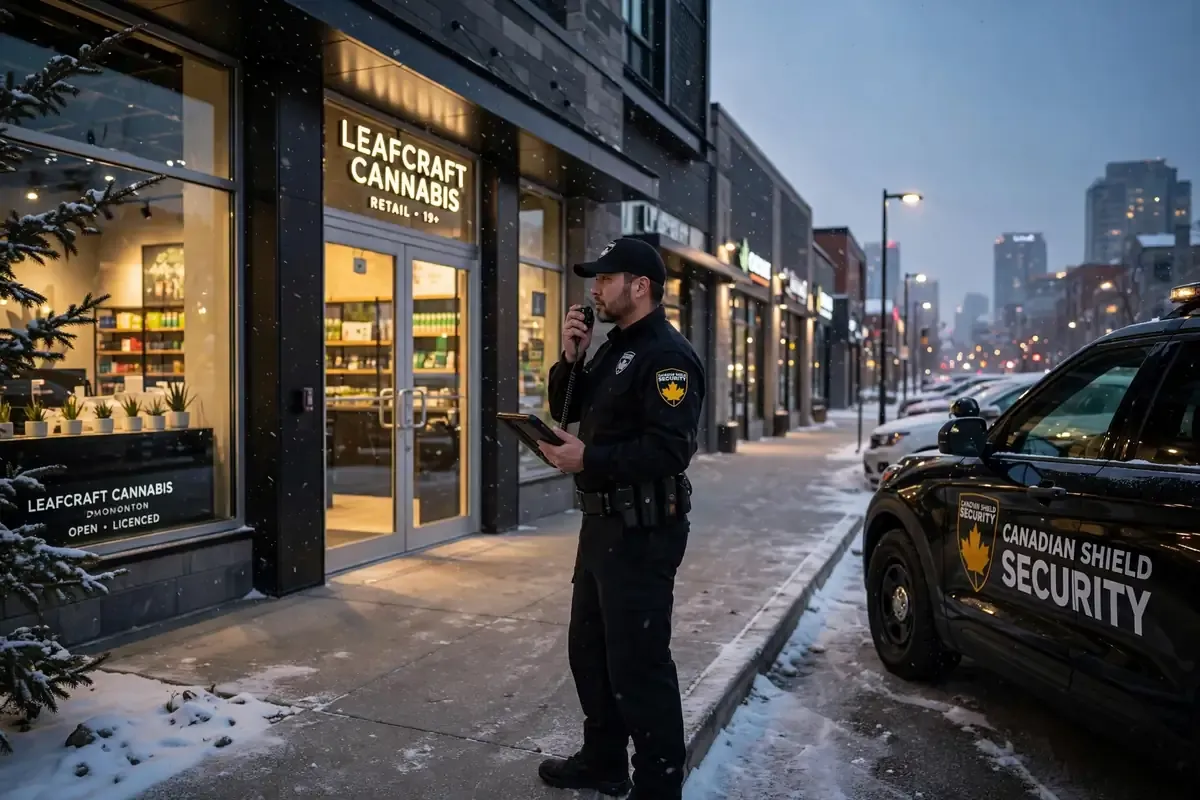
An Edmonton cannabis store owner spent about $20,000 on a smoke-fogging security system in 2019, then learned from AGLC that it violates the handbook because smoke blocks the cameras. Cannabis dispensary security Edmonton owners can trust starts with compliance. Canadian Shield Security helps stores build protection that passes inspection.
Alberta Gaming, Liquor and Cannabis (AGLC) sets the alarm, camera, door and storage rules in its Retail Cannabis Store Handbook. The physical security section does not require guards, but robbery risk and late hours lead many owners to add them.
This guide covers what AGLC requires, who may work your door, how guard licensing fits in, and how areas like Whyte Avenue (T6E), Downtown (T5J) and Mill Woods (T6K) shape your plan.
Key takeaway: Cannabis dispensary security in Edmonton must meet the AGLC Retail Cannabis Store Handbook: a professionally installed and monitored alarm with panic buttons, 24-hour cameras with 60 days of recordings on site, hardened doors and locked storage. Guards are optional, but any guard must hold SellSafe certification within 30 days of starting.
Cannabis Dispensary Security Edmonton: What AGLC Requires
AGLC will not issue a licence until your premises meet its physical security rules. Municipal approval comes first, and the store cannot sit within 100 metres of a school or provincial health care facility unless the municipality varies that distance.

Cameras must sit in the ceiling or in domes, linked to a recorder in a secure room, with lighting that identifies everyone entering or leaving. AGLC and police can demand recordings, and you must keep footage if you know of a pending investigation.
The storage room needs steel mesh or 16-gauge sheet steel, a door no wider than 36 inches and a commercial lock. Product on the sales floor stays in locked showcases, and you submit alarm, camera and storage plans to AGLC for approval.
Non-compliance can bring disciplinary action from the AGLC Board, including suspension or cancellation of the licence, so keep your records ready for any inspection.
| Requirement | AGLC rule | Handbook section |
|---|---|---|
| Alarm | Professionally installed and monitored, with door, window, motion and tamper detection | 3.3.2 |
| Panic buttons | One at every point-of-sale position | 3.3.2 |
| Cameras | 24-hour coverage of entrances, sales floor, receiving and storage room | 3.3.3 |
| Recordings | 60 days minimum, kept on site, with a weekly test log | 3.3.3 |
| Doors and locks | 16-gauge hollow metal doors, commercial locks, no master key | 3.3.4 |
| Storage | Locked showcases and a reinforced storage room after hours | 3.3.5 to 3.3.10 |
Terminology: Terminology: Alberta law calls these businesses retail cannabis stores, and AGLC bars the word dispensary from store names and signs. Use dispensary as a search term, not on your signage.
Who May Work Your Door: SellSafe, ID Checks and Staffing
Every guard at a licensed store, employed or contracted, needs AGLC SellSafe certification within 30 days of starting. The same applies to direct supervisors at a contracted guard company.
AGLC's July 2, 2025 bulletin ended Qualified Cannabis Worker certification for retail positions. Confirm with AGLC how that change applies to contracted guards, because supervisors must still pass a records check to the licensee's satisfaction.
AGLC counts contractors as staff, so a trained guard can check ID. Anyone who looks under 25 must show valid ID before entering, minors are barred, and staff cannot serve an apparently intoxicated person. The store must be staffed whenever it is open.
Privacy note: Privacy note: AGLC lets stores collect a patron's name, age and photograph only for crime prevention and public safety, and stores must follow Alberta privacy guidance.
SellSafe certification expires five years after completion. Keep a log of each guard's name, registration number and expiry date so an inspector can verify it on request.
Key insight: Key insight: AGLC inspectors can ask any staff member for proof of SellSafe certification, and every police officer counts as an inspector under the handbook.
SSIA Licensing: The Second Layer for Edmonton Guards
Under the Security Services and Investigators Act (Alberta) (SSIA), anyone paid to guard property must hold a security service worker licence. Classes include security guard, alarm responder, patrol dog handler, loss prevention worker and bodyguard.
A cannabis store guard therefore carries two credentials: the SSIA licence for guarding work and SellSafe for AGLC. Ask any provider for both, plus its business licence number.
An SSIA licence lasts two years and requires approved basic security training and a provincial exam, so a guard's licence should show a current expiry date.
How to Plan Dispensary Security in Edmonton Step by Step
Plan security in six steps, in this order, before you sign a lease.
- Confirm the site. Check the 100 metre rule and Edmonton municipal approval before spending on security.
- Design the shell. Specify hollow metal doors, commercial locks without master keys and a reinforced storage room.
- Install monitored systems. Use professional installers for the alarm and cameras, then submit both plans to AGLC.
- Fit panic buttons and test cameras. Place a panic button at every till and log weekly camera tests.
- Decide guard coverage. Choose door ID checks, closing escorts or after-hours patrols, and verify SSIA and SellSafe credentials.
- Train and review. Rehearse your written robbery response and review the plan every quarter.
Keep a compliance file where an inspector can find it: approved alarm and camera plans, the surveillance plan with camera locations and authorized users, weekly test logs and SellSafe records.
Edmonton Risks: Robbery, Window Coverings and Winter Nights
Robbery is the main risk police and AGLC are watching. A CBC report counted 29 cannabis store robberies in Calgary in a single year, almost half involving violence or threats, and police urged working panic alarms, better camera placement and vaulted stock.
Window coverings used to hide product also hide staff from passers-by. Our guide to CPTED for Edmonton businesses explains how sightlines and lighting deter crime while product stays out of view.
Stores may open until 2 a.m., so closing happens in the dark. Edmonton winters reach -40C, which can stress cameras, sensors and locks, so test equipment after every cold snap and light the parking area evenly.
Delivery days are a weak point. AGLC requires product from its warehouse to be stored in a secured area visible under a camera, and master cases must be opened and counted under a camera. Curbside pickup is allowed only after the sale is complete, with age verified, outside the vehicle.
AGLC supports police walk-through programs, and staff must cooperate fully when officers enter the store.
When to Add Licensed Guards and What They Cannot Do
Add licensed guards when cameras and alarms record a crime but cannot stop it. A guard gives you a visible presence at the door, closing escorts and after-hours lot checks. Cameras show what happened, while a guard can change what happens next.
At the door, a guard can check ID, flag apparent intoxication to the cashier and keep a calm record of incidents. The licensee stays responsible for every sale, so guards support staff rather than replace them.
Honest limit: Honest limit: Guards observe, deter and report. They have no police powers. For a robbery in progress, staff should follow the written response plan and call 911 when safe.

Stores may trade from 10 a.m. to 2 a.m., so build the guard schedule around opening, peak evening hours and the closing cash-out. Match shifts to your incident log rather than a fixed template.
Pair door coverage with mobile patrol security after hours. Our retail security and on-site guard pages outline options, and our security audit guide shows how to review the site.
Review the plan every quarter and after any incident, and tie it into your wider commercial property security strategy.
Conclusion
Cannabis dispensary security in Edmonton comes down to three layers: AGLC-approved hardware, trained and licensed people, and steady upkeep. AGLC rules cover the first, SSIA and SellSafe cover the second, and a quarterly review covers the third. Skipping any layer risks both losses and licence trouble.
If your store sits near Whyte Avenue, Downtown or Mill Woods, book a free site assessment with our team. Call 1 (800) 326-7879 and we will review your doors, cameras and guard needs before AGLC inspects.
Free consultation: Canadian Shield Security serves Edmonton 24/7. Free consultation -- no hidden fees. Call 1 (800) 326-7879.
Frequently Asked Questions
Are security guards at Edmonton cannabis stores required to be licensed?
Yes. The Security Services and Investigators Act (Alberta) requires a security service worker licence for anyone paid to guard property. Guards at a cannabis store also need AGLC SellSafe certification within 30 days of starting work. Licences cover guards, alarm responders, patrol dog handlers, loss prevention workers and bodyguards.
How much does dispensary security cost in Edmonton?
Cost depends on coverage hours, site layout and guard count, so no honest flat rate exists. Canadian Shield Security quotes after a free site assessment with no hidden fees. Budget separately for the AGLC-required alarm, cameras, hardened doors and storage room, because AGLC must approve them before licensing.
Does Canadian Shield Security cover Sherwood Park and St. Albert cannabis stores?
Yes. Canadian Shield Security serves Edmonton, St. Albert, Sherwood Park, Leduc, Beaumont, Nisku, Acheson, Stony Plain and Spruce Grove, with 24/7 coverage including holidays. Call 1 (800) 326-7879 to book a free site assessment covering doors, cameras and guard needs for your store.
How long must an Alberta cannabis store keep security camera footage?
AGLC requires at least 60 days of recordings kept on the premises in a common format that clearly identifies individuals and carries a time and date stamp. Cameras must be tested weekly with a written log, and footage must go to AGLC and police on request.
Are panic buttons required in Alberta cannabis stores?
Yes. The AGLC handbook requires a panic or robbery button at every point-of-sale position, connected to a professionally installed and monitored alarm that also detects tampering and movement, including inside the secure storage room. Owners must submit a plan showing system compliance to AGLC for approval.
