
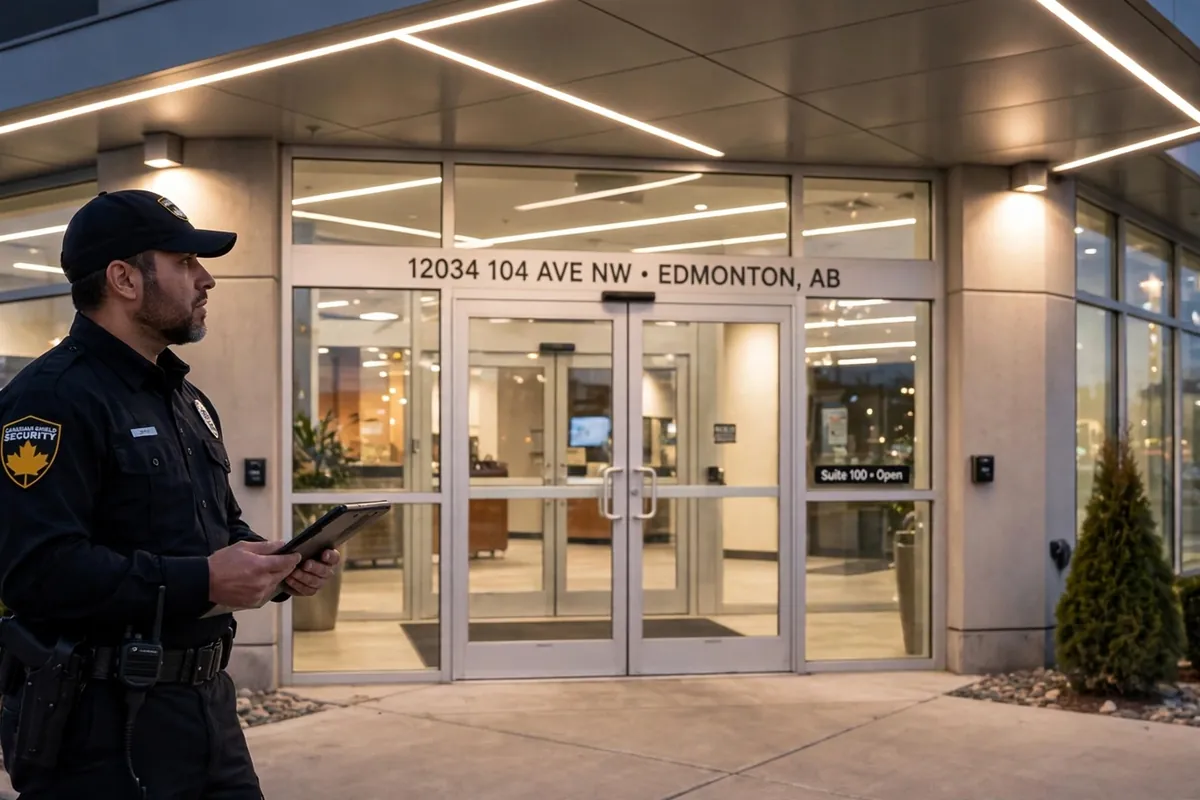

Strong CPTED Edmonton business security often starts with a simple walk-through. When Edmonton Police Service (EPS) officers assessed a store on 157 Street in west Edmonton, theft was hitting it five to ten times a day. They found a fence hole that gave thieves an easy alley escape. Canadian Shield Security applies the same thinking to Edmonton properties.
Lighting, trimmed trees and a repaired fence followed. EPS reports the store's yearly losses fell from $70,000 to $3,000 after one quarter. Police follow-up helped too, so treat it as one real case, not a promise.
This guide explains what CPTED is, its four principles, how Edmonton rules treat it and how to run your own walk-through. It also shows where design stops and licensed guards begin.
What Is CPTED and Why Does It Matter in Edmonton?
CPTED is a crime prevention method that changes the physical setting so offenders face more risk and less reward. The Edmonton Police Service calls it a multi-disciplinary approach that uses urban and architectural design and the management of built spaces. It is pronounced "sep-ted".
The idea dates to the early 1970s, when criminologist C. Ray Jeffery and architect Oscar Newman linked design to crime. It matters in Edmonton because weak points are easy to spot: dark rear lots in South Edmonton (T6H), propped service doors near Whyte Avenue (T6E) and hidden corners in Downtown (T5J) parkades.
CPTED does not replace locks, cameras or guards. It is the first layer, and it often costs less than hardware because many fixes are changes to layout, landscaping and daily habits.
Property managers, retailers and warehouse operators gain the most, because their sites mix public access, after-hours vacancy and shared parking. Each of those traits creates blind spots that design can reduce.
CPTED Edmonton Business Security Starts With Four Principles
Four principles drive every CPTED review: natural surveillance, natural access control, territorial reinforcement and maintenance. The City of Edmonton lists surveillance, access control and natural boundaries, which matches territorial reinforcement, and practitioners commonly add maintenance.
| Principle | What it changes on your site | Typical Edmonton fix |
|---|---|---|
| Natural surveillance | More eyes on the site, fewer hiding spots | Trim shrubs below 1 m, raise canopies above 2 m, clear window displays |
| Natural access control | Visitors follow marked routes, not shortcuts | One main entry, locked or alarmed rear doors, fencing that guides flow |
| Territorial reinforcement | Strangers feel they have entered someone's space | Address numbers, posted hours, branded signage, visible cameras |
| Maintenance | The site signals it is watched every day | Repair bulbs and locks within days, remove graffiti fast, log every issue |
Common CPTED guidance keeps shrubs below about 1 metre and tree canopies above about 2 metres, so sightlines stay open. Second generation CPTED, covered in the EPS Advanced course, adds community activity that keeps spaces in use.
Lighting supports every principle. Aim for even coverage at entrances, parking areas and loading docks, with no dark pockets between fixtures. EPS guidance also suggests motion-sensor lights outside doors, which suits rear entrances.
Territorial reinforcement matters as much as fences. Clear address numbers, branded signage and well-kept planters tell strangers they have entered someone's space. Maintenance carries the same message daily: a repaired lock and a fresh coat of paint say the property is watched, while peeling paint and graffiti say it is not.

How Edmonton Police and City Rules Treat CPTED
Edmonton supports CPTED through its zoning rules, its police service and a City safety team. Three sources matter to a business owner:
- Zoning Bylaw: site and building layouts must consider CPTED, especially for commercial, industrial, multi-unit residential and parking uses. A Development Officer may require a CPTED assessment from a qualified professional.
- EPS training: three-day Basic and Advanced CPTED courses are open to property managers and private security managers. Each costs $300 including GST.
- City self-assessment: the Neighbourhood Empowerment Team offers an online CPTED questionnaire for businesses, workplaces and industrial areas, with tips afterward.
The link between design and safety is not new here. The City's Design Guide for a Safer City came out of a mayor's task force, and CPTED criteria were written into the Land Use Bylaw in 1995, as reported by MacEwan University journalism students.
How to Run a CPTED Walk-Through at Your Edmonton Business
Complete a basic CPTED walk-through in five steps, ideally after dark.
- Walk the perimeter after dark. Note dim spots, hiding places and fence gaps, as EPS officers did on 157 Street.
- Check sightlines. Trim shrubs below 1 metre, raise tree canopies above 2 metres and clear window displays.
- Count entrances. Keep one main customer entry and lock or alarm rear and service doors.
- Signal ownership. Add address numbers, posted hours, signage and visible cameras where they fit.
- Log and fix repairs within days. Broken bulbs, graffiti and damaged locks tell offenders no one is watching.
Rank your findings by cost and risk. Fix the free items first, such as trimming, repairs and moving cash or terminals. Then budget for lighting and entry hardware, and add patrols for gaps design cannot close.
Take dated photos at each step. A before-and-after record shows progress to landlords, tenants and, if needed, the City.
Share the finished walk-through with your staff. When door staff, cleaners and closing managers know what to watch for, the design keeps working between reviews. A short huddle each quarter keeps the fixes alive.

Edmonton Winter and CPTED: Lighting, Snow and Sightlines
Edmonton winters weaken CPTED unless you plan for them. With under eight hours of daylight in December, arrivals and closing happen in the dark, so even lighting across the lot matters more than one bright spot.
Plowed snow can pile against fences and block sightlines. Cold of -40C can stress cameras, sensors and lock mechanisms, so confirm equipment is rated for Edmonton winters and check it after every cold snap.
Downtown (T5J) lots and Whyte Avenue (T6E) laneways need extra attention because snow banks narrow lanes and cast shadows. Schedule lighting checks in October and again in January.
When CPTED Needs Licensed Guards and Ongoing Upkeep
Call a professional security company when design fixes cannot cover a risk that needs people on site. CPTED lowers opportunity but does not stop a determined offender. Guards add live observation, patrols and response.
Guards also supply records. Post orders and written incident reports show which spots keep attracting trouble, so patrol data feeds the next round of CPTED fixes.
Under the Security Services and Investigators Act (Alberta) (SSIA), anyone paid to patrol or guard property needs a security service worker licence from Alberta's Security Programs office. Review the Alberta security licence rules and our guide to the SSIA licence for security guards in Alberta.
Ask any provider for its business licence number and proof that each guard's licence is current. Licensed guards must carry the original licence card while working, so a site supervisor can ask to see it.
Patrol officers check what design cannot: whether a door that was locked at 9 p.m. is still locked at 2 a.m., and whether the dark corner by the dumpster has gained new hiding cover. Each visit produces a report that feeds your next walk-through.
Review your walk-through every quarter and after any incident. Pair design fixes with mobile patrol security for after-hours lot and rear-door checks. Our guides on commercial property security in Edmonton and parking lot security in Edmonton cover next steps.
Conclusion
CPTED gives Edmonton businesses a low-cost starting point: light the site, open sightlines, control the doors and repair problems fast. The 157 Street case shows how simple fixes combine with attentive follow-up.
If your Downtown, Mill Woods or South Edmonton property needs a second set of eyes, book a security consultation and planning visit. We review lighting, access points and patrol needs, then link fixes to your commercial building security plan. For a step-by-step review, read our security risk assessment guide.
Frequently Asked Questions About CPTED for Edmonton Businesses
Are security guards in Edmonton required to be licensed?
Yes. The Security Services and Investigators Act (Alberta) requires a security service worker licence for anyone paid to patrol, guard or provide security for another person's property. Licences last two years and require approved training plus a provincial exam score of 80% or higher.
How much does CPTED cost for an Edmonton business?
Costs depend on the property. Many fixes, such as trimming shrubs, repairing fences and replacing bulbs, cost little. EPS CPTED courses cost $300 each including GST, and the City offers an online self-assessment. Consultant reports are quoted per site, and Canadian Shield Security's initial site assessment is free.
Does Canadian Shield Security cover Sherwood Park and St. Albert?
Yes. Canadian Shield Security serves Edmonton, St. Albert, Sherwood Park, Leduc, Beaumont, Nisku, Acheson, Stony Plain and Spruce Grove, with 24/7 coverage including holidays. Call 1 (800) 326-7879 to book a free site assessment covering lighting, access points and patrol needs for your property.
Is CPTED required by law for Edmonton businesses?
Not for every business, but it influences approvals. Edmonton's Zoning Bylaw directs site and building layouts to consider CPTED, especially for commercial, industrial, multi-unit residential and parking uses. A Development Officer may require a CPTED assessment from a qualified professional and attach permit conditions. Confirm your conditions with the City.
Who can complete a CPTED assessment for an Edmonton business?
Trained professionals can, including consultants and graduates of CPTED courses. EPS runs three-day Basic and Advanced courses open to property managers, planners and private security managers. Owners can also start with the City's online self-assessment, then book a free Canadian Shield Security site assessment to plan patrols and fixes.
