
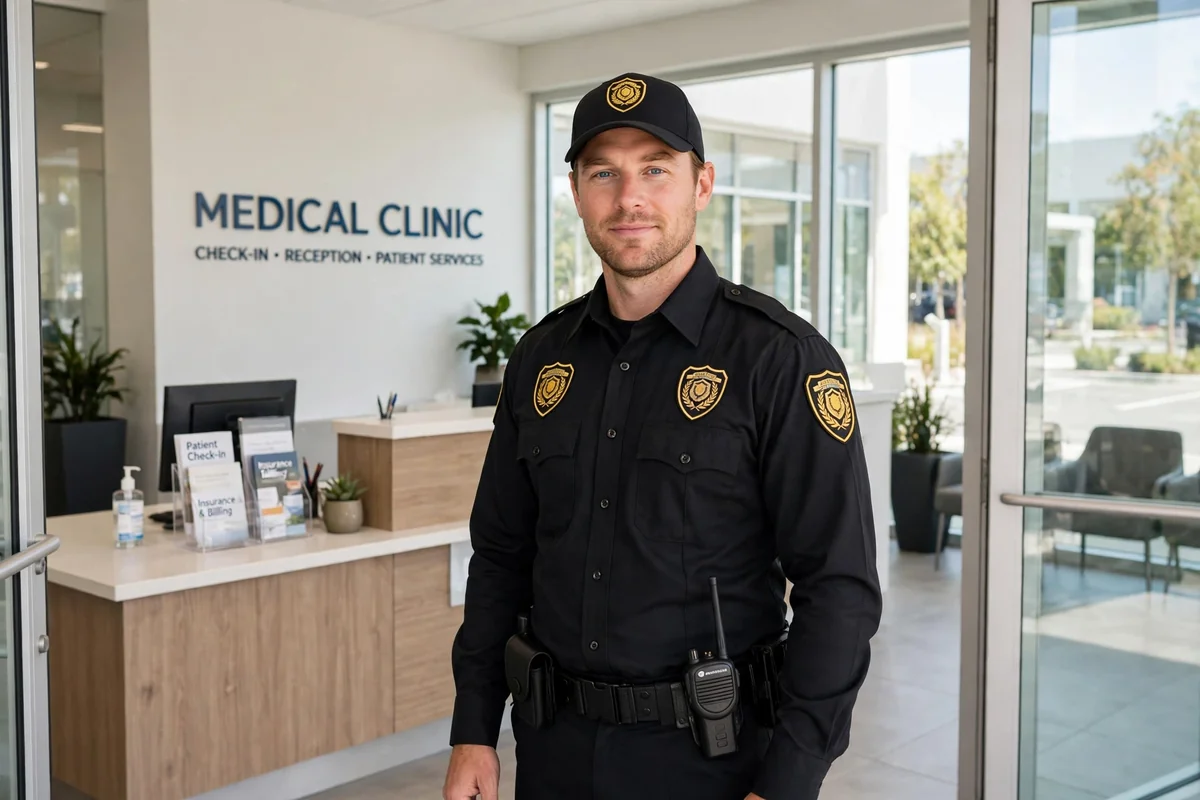
Medical Clinic Security Edmonton: Safer Care Starts at the Door

A family clinic on Edmonton's south side (T6H) locks up at 9 p.m., and by 9:20 the parking lot is empty and dark. Staff leave alone, the medication cabinet sits behind one deadbolt, and help is a phone call away. That gap is where clinic risk concentrates.
Medical clinic security Edmonton managers choose today covers staff safety, patient privacy and after-hours protection. Canadian Shield Security supplies guards licensed under the Security Services and Investigators Act (Alberta) (SSIA), trained in de-escalation for tense waiting rooms.
This guide covers what Alberta law requires, which options suit which clinics, what coverage costs, and how to build a plan. It is written for managers and owners across Edmonton, from Whyte Avenue (T6E) to Mill Woods (T6K).
Most Edmonton medical clinics need three layers of security: controlled access with a visible staff or guard presence during opening hours, a written violence and harassment prevention plan required by Part 27 of the Alberta OHS Code, and after-hours patrol or alarm response. Licensed guards under the Security Services and Investigators Act (Alberta) add de-escalation and incident reporting.
What Medical Clinic Security Edmonton Managers Face Every Week
Edmonton clinics face four recurring risks: after-hours break-ins, aggressive patients, medication and equipment theft, and exposure of patient records. Each calls for a different control, so match the response to the risk.
Unlike hospitals run by Alberta Health Services, most independent clinics have no dedicated security team. Sites near the Royal Alexandra Hospital (T5H) and along Whyte Avenue (T6E) handle heavy walk-in traffic, while quieter Mill Woods (T6K) and Windermere (T6W) sites invite trouble once the lot empties after dark.
| Risk | Typical trigger | First-line control |
|---|---|---|
| After-hours break-in | Medication, laptops, cash | Alarm response and mobile patrol |
| Aggressive patient | Long waits, pain, intoxication | De-escalation-trained front-desk guard |
| Staff safety at close | Dark lots, -40C evenings | Escorts to vehicles |
| Records exposure | Unlocked rooms, open screens | Access control, locked file areas |
Staff safety matters as much as property. Receptionists meet frustrated patients first, and a late January shift means walking out at -30C to a dark lot. Alberta's OHS Act treats violence and harassment as workplace hazards, so your employer plan has to address that exposure.
What Alberta Law Requires for Clinic Security
Alberta law does not require a clinic to hire a guard, but it does require a violence prevention plan, safeguards for patient records, and licensed guards if you hire any.
Under the Security Services and Investigators Act (Alberta), anyone paid to guard or patrol property needs a security service worker licence, valid for two years. Review the Alberta security licence rules and ask to see every guard's licence card.
Licensing is not a formality. Applicants need a criminal record check, a vulnerable sector search, approved basic training and a provincial exam score of at least 80%, which matters in a setting with children, seniors and anxious patients.
| Law | Applies to | What it means for your clinic |
|---|---|---|
| SSIA (Alberta) | Any guard or patrol you hire | Every guard holds a licence valid 2 years |
| OHS Act and OHS Code Part 27 | Every Alberta employer | Written violence and harassment prevention plan, reviewed at least every 3 years |
| Health Information Act, s. 60 | Clinics and physician custodians | Administrative, technical and physical safeguards for patient records |
Part 27 also requires employers to investigate incidents and keep the report for 2 years. A guard's incident log supports your file, but the legal duty stays with the employer. Alberta's violence and harassment guide explains the plan, and the Information and Privacy Commissioner of Alberta oversees records safeguards.
Which Security Option Fits Your Clinic
A front-desk guard suits busy walk-in clinics, while scheduled mobile patrol and alarm response suit smaller practices that close by early evening. Many clinics combine both.
Our on-site guard service covers reception and waiting areas, and mobile patrol covers closed hours. Estimated costs below reflect Edmonton market rates and vary by shift and site.
| Option | Best for | Estimated cost |
|---|---|---|
| Front-desk guard | Walk-in and multi-physician clinics | $32-$45 per hour |
| Evening guard, 4 hours, 5 days | Clinics with late shifts | $640-$900 per week |
| Weekday guard, 40 hours | High-traffic health centres | $1,280-$1,800 per week |
| Mobile patrol and alarm response | After-hours cover | Quoted per site after assessment |
Ask each provider five things: licence details for assigned guards, healthcare or de-escalation training, written post orders for your site, how incident reports reach you, and who covers when a guard calls in sick. For context on typical pricing, see our guide to security guard cost in Edmonton. Clear answers separate prepared teams from last-minute staffing.
Edmonton winters reach -40C -- this affects patrol vehicle performance, camera operation, and lock mechanisms. Ask every provider how guards handle cold starts, frozen locks and icy parking lots.

How to Build a Clinic Security Plan, Step by Step
Build your plan in six steps, starting with a walk-through of your own premises. Work through them in order, because each step feeds the next.
- Walk the site at opening, midday and closing. Note blind spots, unlocked doors and poorly lit parking.
- Review 12 months of incidents, near-misses and staff concerns for patterns.
- Update your Part 27 violence and harassment prevention plan, and train every staff member on it.
- Lock records areas and medication storage to meet the HIA safeguard duty.
- Choose coverage: front-desk guard, mobile patrol, alarm response, or a mix.
- Write post orders (written guard instructions) and test them with a drill.
Post orders should name who to call, where the exits are, how to handle a patient who refuses to leave, and when to phone 911. Keep one copy at reception and one with your guard provider.
When to Call a Professional Security Company
Call a licensed security company when incidents repeat, staff feel unsafe, or opening hours run past what your team can safely cover alone. Two or more incidents in a quarter is a clear signal.
Our healthcare facility security team supports clinics with staff trained in de-escalation for healthcare settings. Guard skills for waiting rooms and reception areas are explained on the same page.
Triggers worth acting on include repeat after-hours alarms, a staff member avoiding late shifts, a verbal threat at the front desk, or missing medication stock. Each is a documented hazard under Part 27, and a written record strengthens your plan.
For active criminal incidents, call 911 first. SSIA-licensed security guards are trained to observe and report. They do not replace police authority or emergency services, and they do not provide patient care. Use the Edmonton Police Service non-emergency line, 780-423-4567, for non-urgent reports.

Keeping Your Clinic Secure Year-Round
Review your clinic security plan every quarter, and at least every three years as Part 27 requires. Log every incident and compare it with the previous quarter.
December daylight fades before 4:30 p.m., so move escort routines and lighting checks earlier in winter. Refresh de-escalation practice twice a year. Walk-in sites with long evening queues often add a part-time front-desk guard for their busiest hours.
Track three numbers: incidents per month, false alarm activations, and staff reports of feeling unsafe. If incidents fall for two quarters, keep the current coverage. If they rise, add hours before the next review.
Conclusion
Reliable medical clinic security Edmonton clinics can sustain rests on three habits: know your legal duties, match coverage to your real hours, and review the plan often. Small steps, such as locking medication storage and escorting staff at close, prevent the incidents that cost the most.
If your clinic in T6H, T5H or Sherwood Park wants a second opinion, our team will walk the site with you and explain every option in plain terms through a free site assessment and consultation.
Canadian Shield Security serves Edmonton 24/7. Free consultation -- no hidden fees. Call 1 (800) 326-7879.
Frequently Asked Questions About Clinic Security in Edmonton
Are security guards at Edmonton clinics required to be licensed?
Yes. Under the Security Services and Investigators Act (Alberta), anyone paid to guard or patrol property must hold a security service worker licence, valid for two years. Guards must complete approved training and carry the original licence on duty. Ask any provider to confirm that every guard assigned to your clinic is licensed.
How much does clinic security cost in Edmonton?
Licensed guard coverage in Edmonton typically costs $32 to $45 per hour. A four-hour evening guard, five days a week, runs about $640 to $900 weekly, while a full 40-hour weekday post runs $1,280 to $1,800. Mobile patrol and alarm response are quoted per site after a free assessment, with no hidden fees.
Does Canadian Shield Security cover clinics in Sherwood Park and St. Albert?
Yes. Canadian Shield Security serves clinics across Edmonton, including Sherwood Park, St. Albert, Leduc, Beaumont, Stony Plain and Spruce Grove. Coverage runs 24/7, 365 days a year, including holidays. Call 1 (800) 326-7879 to book a free site assessment and receive a custom quote for your clinic location.
Do small medical clinics in Edmonton need a security guard?
Not always. Alberta law does not require a clinic to hire a guard, but every employer needs a Part 27 violence and harassment prevention plan. Small clinics that close early often do well with alarm response and scheduled mobile patrol. Add a front-desk guard when incidents repeat, waits run long, or staff work late alone.
Can a security guard restrain an aggressive patient at a clinic?
Security guards in Alberta do not have police powers. They are trained to de-escalate, observe and report, and may use only the reasonable force allowed to any person under the Criminal Code. For physical violence, call 911 immediately, then notify clinic management and complete an incident report.
Canadian Shield Security Editorial Team | Edmonton, Alberta
