
Edmonton Access Control Systems: A Guard's Essential Guide
A facilities manager at a T6H office tower called Canadian Shield Security after a stranger tailgated an employee through the parkade entrance at 9 p.m. and wandered two floors before anyone noticed. The building had key fobs, but no guard watching the lobby cameras and no procedure for challenging unfamiliar faces. Within a month of adding an evening guard post and tightening visitor logging, after-hours incidents stopped. That outcome is the standard every Edmonton facility should expect when access control and guards work as one system.
Edmonton commercial buildings face a specific access problem. Downtown T5J towers, T6H office parks and industrial facilities near Acheson all run on credentials -- fobs, cards, PINs -- that work perfectly until they are shared, stolen or held open for a stranger. Technology controls the door; it does not judge who walks through it.
This guide explains how access control systems actually work, which credential technology fits which building, what security guards add that electronics cannot, how Alberta's PIPA privacy rules apply to access data, and when to bring in a professional team. It closes with clear next steps for facilities managers ready to tighten their buildings.
How Access Control Systems Actually Work in Edmonton Buildings
Every access control system has the same four parts: a credential (fob, card, phone or fingerprint), a reader at the door, a controller that decides yes or no, and software that logs every event. When a tenant taps a fob at a T6H tower lobby, the reader sends the credential ID to the controller, which checks it against the access list and releases the lock -- all in under a second.
The software layer is where the real value sits. It records who entered, which door, and when, creating an audit trail that resolves disputes and investigations. A facilities manager can pull a report showing every entry to the server room last month, or instantly deactivate a lost fob across all doors. Without that log, a building has locks but no memory.
Edmonton buildings add one local complication: winter. Outdoor readers and keypads at parkade entrances must survive -40C, ice buildup and wind-driven snow. Specifying cold-rated hardware for exterior doors is a small decision that prevents the most common winter failure -- a frozen reader propping a door open at 2 a.m.
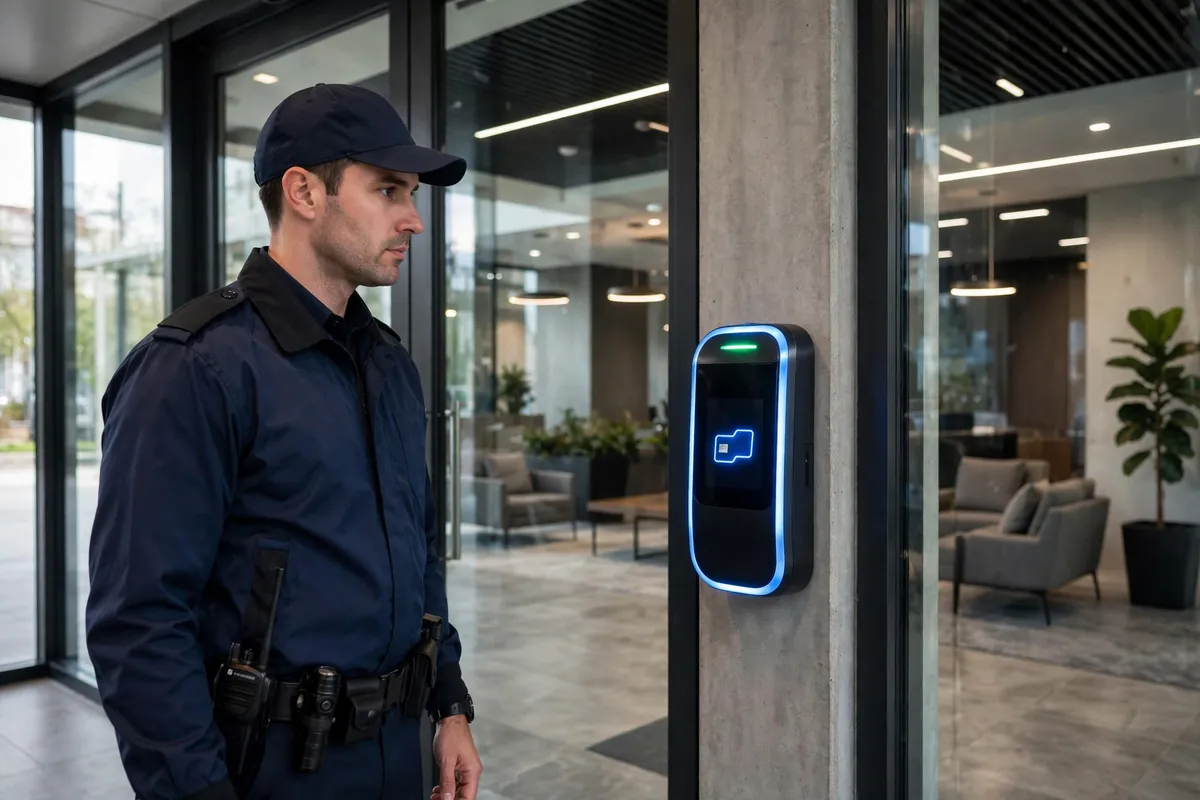
Access control systems work with security guards by combining electronic barriers -- key fobs, biometric readers and intercoms -- with human judgment at entry points. Guards verify credentials, manage visitor logs, respond to tailgating alerts and enforce PIPA-compliant procedures. Canadian Shield Security designs integrated access plans for Edmonton facilities after a free consultation. Call 1 (800) 326-7879.
Key Fobs, Biometrics and Mobile Credentials: Choosing the Right Technology

Key fobs and cards remain the workhorse of Edmonton office towers. They are cheap, familiar and easy to replace, but they share one weakness: they authenticate the credential, not the person. A found fob opens every door its permissions allow, which is why lost-fob deactivation speed matters more than the fob itself.
Biometric readers -- fingerprint or facial recognition -- fix the shared-credential problem by tying access to the body. They suit high-security areas like server rooms, cash offices and pharmaceutical storage, where a facilities manager needs certainty about identity. Privacy expectations run higher here, so clear PIPA-compliant signage and policies are essential before deployment.
Mobile credentials turn staff phones into keys. They cut card-issuing costs for large tenant rosters and let managers grant temporary access remotely -- ideal for contractors and cleaning crews. The tradeoff is dependence on charged phones and Bluetooth reliability, which makes them a complement to fobs rather than a full replacement in most Edmonton buildings.
| Technology | Typical Cost Per Door | Security Level | Best For |
|---|---|---|---|
| Key fob / card | $800-$1,500 | Medium -- authenticates credential only | General office floors, parkades |
| Biometric reader | $2,500-$5,000 | High -- authenticates the person | Server rooms, cash handling, pharma storage |
| Mobile credential | $1,200-$2,000 | Medium-high -- phone as key | Large tenant rosters, contractor access |
| PIN keypad | $400-$900 | Low -- codes get shared | Low-risk interior doors, storage rooms |
| Intercom + remote release | $1,500-$3,000 | Medium -- human verifies visitor | Main lobbies, after-hours entry |
Access Credential Technologies Compared
Quick win: audit who holds active credentials every quarter. In most Edmonton office towers, 10 to 20 percent of active fobs belong to former staff, ex-tenants or lost cards never deactivated. A quarterly purge closes the easiest hole in the building for free.
What Security Guards Add That Technology Alone Cannot

A reader cannot spot tailgating. When an employee holds the lobby door for a friendly stranger, the system logs one authorized entry and misses the second person entirely. A guard at the lobby desk sees the interaction, challenges the visitor and enforces the sign-in procedure that the hardware cannot.
Guards also run the visitor management process end to end. They check ID, confirm the host, issue temporary badges, and escort where policy requires. During a recent downtown T5J tower assessment, the weakest link was not the reader system but the unmanned reception desk where delivery drivers walked straight to the elevators.
Incident response is the third gap guards close. When an access alarm fires -- a forced door, a held-open alarm at midnight -- someone must decide whether it is a malfunction or a break-in. Mobile patrol officers investigate on site, reset the system and document the event, instead of the alarm ringing unanswered until morning.
The strongest setups pair both deliberately. Technology handles the routine thousand entries a day; guards handle the exceptions -- the tailgater, the lost visitor, the 2 a.m. alarm. Facilities managers who budget for the pair spend less than those who buy hardware first and add guards only after an incident.
PIPA Alberta: Privacy Rules for Access Control Data
Access logs are personal information under Alberta's Personal Information Protection Act (PIPA). Every tap of a fob creates a record of an identifiable individual's movements, which means collection, retention and disclosure rules apply. A facilities manager should know how long logs are kept, who can view them, and what the building tells tenants on signage.
Practical compliance is straightforward. Post clear notice at entrances that access is logged, keep retention to what the building actually needs (many Edmonton properties use 30 to 90 days), restrict log access to named staff, and document the policy. Biometric templates deserve extra care -- store them as encrypted templates, never raw images, and complete a privacy impact assessment before rollout.
Guards who operate these systems need the same discipline. Under the Security Services and Investigators Act (Alberta), every guard posted at an Edmonton building must hold a valid SSIA licence, and reputable firms train their officers on PIPA handling as part of post orders. You can verify licensing requirements through the Government of Alberta at alberta.ca.
When in doubt, ask the building's privacy officer or legal counsel before expanding data collection. Cameras paired with CCTV monitoring fall under the same PIPA duties, so a single written policy covering access logs and video keeps the whole site consistent.
For an active break-in, forced entry or threat in progress, call 911 and Edmonton Police Service first. Guards document, deter and de-escalate, but they do not replace police authority during a criminal incident. Report non-emergency access incidents through edmontonpolice.ca.
Mobile Patrol and Alarm Response: The After-Hours Layer
Access control does its heaviest lifting after hours, when buildings empty out and the credential system becomes the only gatekeeper. That is also when it is most vulnerable: a propped parkade door or a shared fob defeats every reader in the building. Scheduled verification closes the gap.
Randomized mobile patrol visits check that doors are actually secured, challenge anyone on site without credentials, and respond to held-open or forced-door alarms within minutes. For downtown Edmonton towers and multi-building portfolios, one patrol route can cover several properties through the night at a fraction of a full-time overnight guard post.
Alarm integration multiplies the value. Door-forced and door-held alarms routed to a monitored response team turn the access system from a passive log into an active tripwire. The difference between a 4-minute patrol response and a Monday-morning discovery is often the difference between an attempt and a loss.
When to Call a Professional Access Control Security Company in Edmonton
Call a professional firm when tailgating becomes routine, when PIPA questions go unanswered, when the credential database has not been audited in a year, or when a new tenant mix raises the stakes. Waiting until after a breach means paying for the incident and the fix.
A reputable company starts with a free site walkthrough, not a product pitch. Expect a licensed supervisor to review door hardware, credential hygiene, visitor procedures and log retention, then propose a plan that pairs technology with commercial building security staffing. The proposal should name guard hours, patrol frequency and cost with no hidden fees.
Canadian Shield Security works with facilities managers across Edmonton, from downtown T5J towers to T6H office parks, designing access programs that guards can actually enforce. Operators comparing approaches should also review how commercial property protection programs are structured. Call 1 (800) 326-7879 to schedule a free consultation.
Maintaining Access Control Long-Term: Audits and Access Reviews
Access control decays without maintenance. Staff turn over, tenants change, contractors finish -- and every departure that is not processed leaves a live credential behind. A quarterly access review, tied to HR offboarding lists, is the single highest-value habit a facilities manager can build.
Hardware needs seasonal attention too. Edmonton winters punish exterior readers: ice in keypads, condensation in biometric sensors, and gate mechanisms that freeze. A January function check of every exterior door, not just the October install inspection, keeps the system honest through the coldest months. Detailed security technology reporting makes these seasonal patterns visible.
Test the human layer as well. Occasional tailgating tests -- with management approval -- reveal whether lobby staff actually challenge strangers. Buildings that test quarterly see challenge rates climb; buildings that never test discover the gap during a real incident.
Conclusion
Access control systems and security guards solve different halves of the same problem. Electronics provide the audit trail, the 24-hour consistency and the instant deactivation; guards provide judgment, deterrence and response. Edmonton facilities that run both as one program -- credentials managed, lobbies staffed, alarms answered -- see fewer incidents and cleaner investigations.
The facilities managers who lose the least sleep treat access as an operating discipline with a measurable return, not a one-time install. Start with a credential audit, staff the lobby during risk hours, and review the program as the tenant mix changes.
Canadian Shield Security designs integrated access control and guard programs for Edmonton commercial buildings, from downtown towers to T6H office parks. Call 1 (800) 326-7879 for a free consultation and a written protection plan.
Frequently Asked Questions
Are security guards who manage access control in Edmonton required to be licensed?
Yes. Under the Security Services and Investigators Act (Alberta), every guard operating access control, staffing a lobby desk or responding to door alarms in Edmonton must hold a valid SSIA licence. Licensing requires accredited training, a provincial exam and a police information check. Always verify a security company's licences before signing, since unlicensed guards create liability for the building owner.
How much does an access control system cost for an Edmonton commercial building?
A key fob system for an Edmonton office building typically runs $800 to $1,500 per door installed, while biometric readers cost $2,500 to $5,000 per door. A 10-door floor ranges from $8,000 to $20,000 before guard services. Every project receives a written quote after a free site consultation, so pricing reflects the building's doors, wiring and risk profile.
Does Canadian Shield Security provide access control guards in downtown Edmonton and T6H?
Yes. Canadian Shield Security staffs lobbies, loading docks and parkade entrances across downtown Edmonton, the T5J core and T6H office parks, and designs access programs for commercial towers throughout the region. Guards manage visitor logs, challenge tailgaters and respond to door alarms around the clock. Contact us to confirm coverage for a specific building address.
Can access control systems stop tailgating in office towers?
Access control alone cannot stop tailgating, because the system logs the authorized fob and never sees the second person slipping through behind. Anti-tailgating mantraps, turnstiles and clear signage help, but a lobby guard who challenges unfamiliar faces is the only reliable fix. Most Edmonton towers combine hardware deterrents with staffed lobbies during peak hours.
What happens to access control during a power outage?
Most commercial access systems switch to battery backup and keep working for several hours, with doors set to fail-safe (unlocked for life safety) or fail-secure (locked) per fire code. Guards become the access system during an outage, manually verifying credentials at key entries. A written power-failure plan, tested twice a year, keeps the building secure when electronics go dark.
Canadian Shield Security Editorial Team | Edmonton, Alberta
