
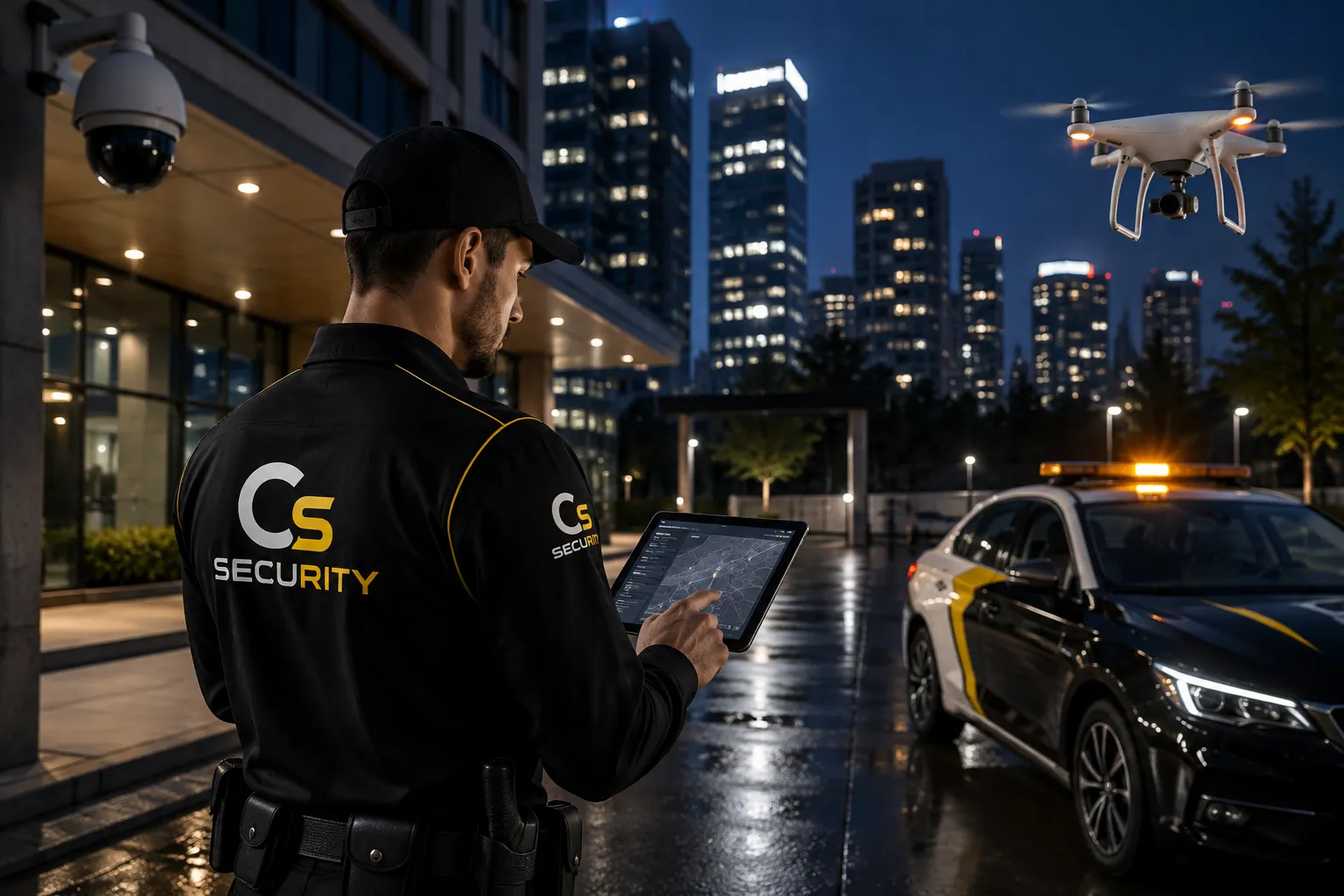
A retail plaza manager near West Edmonton Mall used to get a single paper log at the end of each night, listing patrol times a guard claimed to have completed with no way to confirm any of it. After switching to GPS-verified security patrol technology, the same manager now sees every checkpoint timestamped and photographed in real time, including the night a broken gate lock showed up on the report within minutes of the guard's discovery.
Security patrol technology in Edmonton has moved well past a guard driving a marked vehicle past a property once a shift. GPS tracking, AI-assisted cameras, and mobile incident apps now sit alongside SSIA-licensed guards on nearly every patrol route in the city.
This guide covers exactly how technology is changing security patrols in Edmonton, what business owners should expect from a modern provider in 2026, and where a licensed guard is still the part no camera can replace.
|
Security patrol technology in Edmonton now includes GPS-verified checkpoints, AI-assisted cameras that flag suspicious activity in real time, and mobile apps that deliver timestamped incident reports to a client portal. These tools improve accountability and response speed, but SSIA-licensed guards still assess and respond to every real incident. |
How Is Security Patrol Technology Changing in Edmonton?
Edmonton security companies have shifted from paper checkpoint logs and radio call-ins to GPS-tracked routes, digital reporting apps, and AI-assisted camera monitoring. A patrol vehicle's exact route and stop times are now recorded automatically rather than self-reported by the guard at the end of a shift.
This shift matters most for Edmonton property owners who need proof a patrol actually happened, not just an invoice claiming it did. A GPS-verified route removes the guesswork that used to come with a handwritten log.

Downtown T5J office towers and Nisku Industrial Park yards use this technology differently. Towers rely more on scheduled indoor checkpoint scans, while industrial yards lean on GPS-tracked vehicle routes covering wider outdoor perimeters overnight.
Smaller Edmonton businesses sometimes assume this technology is only for large commercial portfolios. In practice, a single-location retail store or small warehouse benefits just as much from GPS-verified proof of patrol, since one missed checkpoint can be the difference in a break-in insurance claim.
|
Ask any Edmonton security provider whether patrol verification is GPS-based, checkpoint-based, or both. A provider using only one method may miss gaps a combined system would catch. |
What Technology Do Modern Security Patrols Use?
Three tools now define a modern patrol: GPS dispatch for route verification, AI-assisted cameras for real-time monitoring, and mobile incident apps for reporting. GPS dispatch confirms a guard physically reached a checkpoint rather than estimating the route from memory.
AI-assisted cameras do not replace a guard's judgment. They flag movement, loitering, or unusual activity so a supervisor or guard can review footage faster, cutting the time between an event happening and a person responding to it.
Mobile incident apps let a guard file a timestamped report with photos directly from a checkpoint, rather than waiting until the end of a shift to write everything down from memory in a vehicle or guard shack.
Route optimization software is a newer addition to this stack. It analyzes past patrol data to suggest more efficient routes and timing, helping one patrol vehicle cover more Edmonton properties per shift without cutting corners on checkpoint frequency.
Patrol Technology Compared: What Each Tool Actually Does
The table below breaks down what each common patrol technology actually verifies, and where a licensed guard's judgment is still required, so Edmonton property owners know exactly what they are paying for.
|
Technology |
What It Does |
What It Does Not Do |
|
GPS dispatch |
Verifies a guard physically reached each checkpoint on schedule |
Does not assess or respond to an incident on its own |
|
AI-assisted cameras |
Flags motion, loitering, or unusual activity in real time |
Does not replace a licensed guard's judgment or authority |
|
Mobile incident apps |
Captures timestamped reports and photos on-site |
Does not substitute for a verbal briefing during active emergencies |
|
Cloud-based storage |
Secures footage and reports for insurance or legal use |
Does not guarantee footage quality without proper camera placement |
|
Geofencing alerts |
Notifies dispatch if a patrol vehicle leaves its assigned route |
Does not account for legitimate detours without manual override |
Why Does This Matter for Edmonton Business Owners?
A business owner comparing security providers used to have to take a company's word that patrols happened as promised. GPS-verified technology turns that promise into a record every client can review, which changes how contracts get renewed and disputed.
Under the Security Services and Investigators Act (Alberta), guards remain accountable for what they observe and report regardless of the technology involved. Cameras and apps do not shift that legal responsibility away from a licensed officer.
Edmonton's winter conditions add a practical reason to want verified technology. A GPS-tracked patrol proves a guard actually reached an icy loading dock at Nisku Industrial Park at 3:00 a.m., rather than skipping a hard-to-reach checkpoint on a cold night.
Insurance providers increasingly ask for this kind of documentation directly. A commercial property policy renewal in Edmonton may now request GPS patrol logs or camera monitoring records as part of underwriting, not just a general description of security coverage.
|
Technology improves accountability, but it does not replace a licensed guard's authority to act. Alberta's Use of Force (UoF) standards still require an SSIA-licensed officer to assess and respond to any real incident, camera footage or not. |
How Do Edmonton Security Companies Deploy This Technology Today?
Canadian Shield Security runs mobile patrol routes through GPS dispatch tied to post orders for each site, so a Downtown tower and a Sherwood Park retail plaza follow different checkpoint schedules built around their specific risks.
AI-assisted camera monitoring supplements, rather than replaces, in-person patrols. A flagged event on camera triggers a guard response, and that response gets logged through the same AI-supported monitoring platform used for routine checkpoint reporting.

This combination supports Alberta's Personal Information Protection Act (PIPA) requirements, since footage and reports collected through a controlled digital platform are easier to secure, retain for a defined period, and produce on request than scattered paper logs ever were.
Edge computing is starting to appear in Edmonton camera deployments as well, processing video analysis directly on-site rather than sending every frame to the cloud. This reduces the delay between a camera detecting movement and a guard receiving an alert.
|
Request a live demo of a provider's client portal before signing a contract. Seeing real checkpoint data and camera alerts firsthand shows you more than any sales brochure can. |
What Should Edmonton Businesses Look for in a Technology-Enabled Provider?
Ask whether checkpoint verification is GPS-based, whether cameras are monitored live or only reviewed after an incident, and whether reports reach you the same day rather than the following week.
A provider that cannot show a sample digital report during a sales conversation likely does not have the technology in place yet. Canadian Shield Security's 32-plus licensed guards file GPS-verified reports on every posting across Edmonton.
Cost should not be the only factor. A slightly higher rate for GPS-verified, AI-supported patrols often costs less than an insurance claim or liability dispute tied to a patrol that technically never reached the property that night.
Response time is worth asking about directly. A camera alert or GPS anomaly is only useful if it reaches a live person quickly. Canadian Shield Security routes flagged events to an on-duty guard the same shift, not a queue reviewed the next morning.
How Should Edmonton Businesses Prepare for Ongoing Technology-Enabled Patrols?
Start with a site assessment that maps out camera placement, checkpoint locations, and patrol timing before any technology gets installed. A route designed around a generic template rarely matches how a specific Edmonton property actually needs to be covered.
Review patrol reports monthly, not just after an incident. Patterns in GPS data, such as a checkpoint consistently reached late, often point to a scheduling or staffing issue worth raising with the provider before it becomes a bigger problem.
As AI-assisted monitoring and patrol apps become standard across Edmonton, providers still using only paper logs and unverified routes will fall behind on the documentation clients and insurers increasingly expect. Choosing a technology-enabled provider now avoids a harder transition later.
|
Camera footage and GPS data are personal information under Alberta's PIPA when they capture identifiable people or vehicles. Confirm your provider has defined retention limits and secure storage before signing a contract. |
Conclusion
Security patrol technology in Edmonton has changed what business owners should expect from a provider: GPS-verified routes, AI-assisted monitoring, and mobile incident reporting, all tied to an SSIA-licensed guard who still makes the judgment calls no camera can make.
Canadian Shield Security combines all three with 24/7 coverage across Edmonton and surrounding areas. Contact Canadian Shield Security today for a free site assessment and see this technology running on a real patrol route.
Technology changes fast, but Edmonton's regulatory baseline does not. Whatever patrol technology a provider adopts next, SSIA licensing and Alberta's privacy obligations still set the floor every security company must meet.
|
Canadian Shield Security serves Edmonton 24/7. Free consultation, no hidden fees. Call 1 (800) 326-7879. |
Frequently Asked Questions
Do security guards still need to be licensed if patrols use AI cameras and GPS?
Yes. Any technology a security company uses, from GPS tracking to AI cameras, still requires guards licensed under the Security Services and Investigators Act (Alberta). Canadian Shield Security verifies SSIA licensing and runs background checks on every guard, regardless of what patrol technology is deployed on a given site.
Does adding patrol technology increase security costs in Edmonton?
Adding GPS tracking and app-based reporting typically adds little to no extra cost, since most Edmonton providers now include it standard, while AI camera monitoring can add $50 to $200 per month depending on camera count and coverage hours. Canadian Shield Security includes a free consultation to quote exact pricing.
Does Canadian Shield Security offer technology-enabled patrols in Sherwood Park?
Yes. Canadian Shield Security's GPS-tracked mobile patrols and AI-supported monitoring cover Edmonton and surrounding communities including Sherwood Park, St. Albert, Leduc, and Nisku. Coverage runs 24 hours a day, 365 days a year, so technology-backed patrols reach every service area, not just central Edmonton.
Can AI cameras replace security guards on patrol?
No. AI cameras and patrol apps flag anomalies and verify checkpoints, but Alberta's Use of Force standards and SSIA training still require a licensed human guard to assess and respond to any real incident. Technology supports guards; it does not replace the judgment or legal authority a licensed officer provides.
How do I know if a security company's patrol technology is legitimate?
Look for GPS-verified checkpoints, timestamped digital reports, and a live client portal, since a provider still relying on paper logs or unverified routes cannot show you real proof of patrol activity. Ask any Edmonton provider for a sample digital report before signing a contract.
