
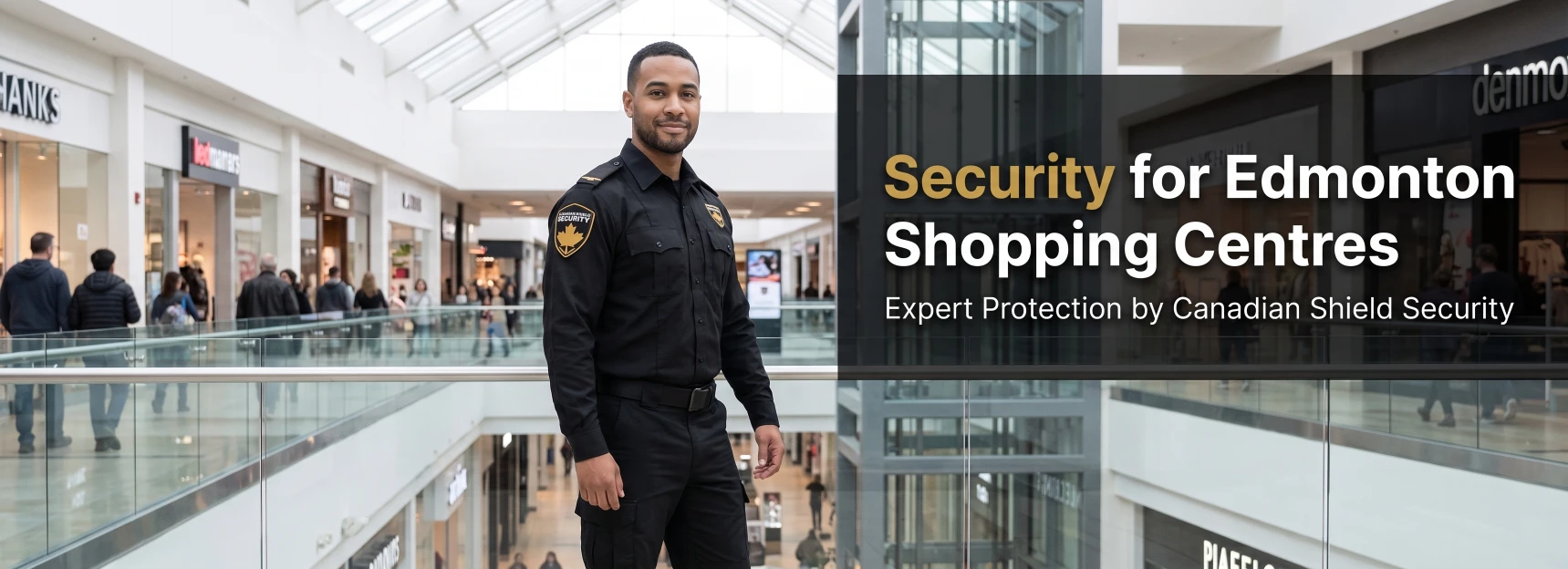
A strip mall near Southgate Centre in South Edmonton went nearly a year without dedicated security coverage, relying only on individual store alarms, until a string of after-hours break-ins across three tenants in one month pushed the property manager to bring in licensed guards for the first time.
Shopping centre security in Edmonton covers far more than watching for shoplifters. Properties from small strip malls to large enclosed centres like West Edmonton Mall face theft, crowd management, parking lot safety, and emergency response, all at once, often with thousands of people moving through the property daily.
This guide covers what effective shopping centre security in Edmonton actually includes, how coverage should scale with foot traffic and season, and what SSIA-licensed officers can and cannot do when an incident happens.
|
Effective shopping centre security in Edmonton combines SSIA-licensed guards for theft deterrence and crowd management, CCTV coverage of common areas and parking lots, and scheduled coverage that scales up during evenings, weekends, and holiday shopping periods. Officers observe, deter, and report incidents, working alongside Edmonton Police Service for anything beyond their legal authority. |
Why Do Edmonton Shopping Centres Need Dedicated Security?
Shopping centres combine several risk factors most single-tenant properties do not face at once: high daily foot traffic, multiple tenants with separate inventory, shared parking areas, and public common spaces where incidents can happen far from any one store's staff.
West Edmonton Mall alone sees more than 800 stores and tens of thousands of daily visitors across its property, and even a mid-size Edmonton strip mall or plaza carries enough combined foot traffic and tenant risk to justify dedicated coverage rather than relying on individual store alarms.
Southgate Centre, with more than 130 stores and multiple anchor tenants, illustrates the mid-size end of this range: not as large as West Edmonton Mall, but still enough combined tenant risk and daily foot traffic to require a coordinated security plan rather than tenant-by-tenant coverage.
Insurance carriers increasingly factor documented security coverage into commercial property premiums for Edmonton shopping centres. A property with a licensed guard presence and CCTV documentation often qualifies for better terms than one relying on individual tenant alarms alone.
What Does Shopping Centre Security in Edmonton Actually Cover?
A complete shopping centre security plan covers four areas: theft deterrence across tenant stores, common area and parking lot patrol, crowd management during peak periods, and emergency response coordination with mall management and Edmonton Police Service.
Parking lots deserve particular attention. Vehicle break-ins and unsafe conditions in poorly lit or poorly patrolled lots are a common source of complaints at Edmonton shopping centres, even when in-store security is strong.
Tenant coordination is often the most overlooked piece. A shopping centre with 20 individual tenants and no shared security protocol leaves each store handling incidents in isolation, missing patterns a centralized security team would catch across the whole property.
Loading dock and back-of-house areas need coverage too, since delivery windows create foot traffic and access points that shoppers never see but that carry real theft and safety risk if left unmonitored during business hours.
Shopping Centre Security Coverage by Property Type
The table below shows how shopping centre security coverage typically scales with property size and type across Edmonton, from a small strip mall to a large enclosed centre.
|
Property Type |
Typical Coverage |
Key Focus |
|---|---|---|
|
Small strip mall or plaza |
1 guard, evening/weekend coverage |
Break-in deterrence, parking lot patrol |
|
Mid-size shopping centre |
1-2 guards, extended daily hours |
Theft deterrence, common area patrol, tenant coordination |
|
Large enclosed mall |
Multiple guards, 24/7 coverage |
Crowd management, emergency response, CCTV monitoring |
|
Seasonal/event coverage |
Scaled-up temporary staffing |
Holiday crowds, special events, high-traffic weekends |
How Do Security Guards Handle Theft at Edmonton Shopping Centres?
Officers trained under the Security Services and Investigators Act (Alberta) rely on visible presence, foot patrol through common areas, and coordination with individual store staff to deter shoplifting before it happens rather than only reacting after the fact.
When theft is observed, officers can approach, ask a person to leave the property, and document the incident, but they do not have police powers of arrest. Anything beyond that threshold gets handed to Edmonton Police Service.
Organized retail crime groups increasingly target multiple stores within the same shopping centre in a single visit, which is one more reason a coordinated, centre-wide security presence catches patterns that isolated, store-by-store coverage misses entirely.
Documentation matters as much as the intervention itself. A detailed incident report, timestamped and tied to CCTV footage where available, supports both the shopping centre's insurance position and any later police follow-up on repeat offenders.
|
COMPLIANCE NOTE: Security officers at Edmonton shopping centres operate within Alberta's Use of Force (UoF) standards. They deter, observe, and report; they do not replace the police for active criminal incidents or physical confrontation. |
How Should Shopping Centres Handle Crowd Management?
Crowd management becomes critical during holiday shopping periods, back-to-school weekends, and scheduled mall events, when foot traffic can multiply well beyond a typical weekday and normal staffing levels cannot keep pace.
Officers trained in crowd management position themselves at high-traffic pinch points, entrances, and food court areas, watching for both security risks and simple congestion problems that can escalate into safety issues if left unmanaged.
Coordinating security staffing with mall management ahead of a known high-traffic event, rather than reacting once crowds arrive, is the difference between a smooth event and a preventable incident.
Winter adds a specific Edmonton complication. Icy parking lots and entrances during peak holiday shopping season create both slip-and-fall liability and additional patrol demands, right at the exact time foot traffic is highest.
Food court areas deserve specific attention during peak hours. High seating turnover, spilled food creating slip hazards, and concentrated crowds combine to make food courts one of the more incident-prone common areas in a shopping centre.
|
TIP: Ask your security provider for a staffing plan tied to a full-year event calendar, not just a flat weekly schedule. Holiday weekends and sale events need more coverage than a typical Tuesday afternoon. |
What Role Does CCTV Play in Shopping Centre Security?
CCTV coverage of common areas, entrances, and parking lots supports officers rather than replacing them, documenting incidents for insurance claims, tenant disputes, and police reports while officers handle real-time response.
Camera placement matters as much as camera count. Poorly positioned cameras that miss parking lot corners or loading dock areas leave the same blind spots a foot patrol would need to cover manually.
Retailers within a shopping centre sometimes install their own in-store cameras separately from centre-wide CCTV. Coordinating both systems, rather than treating them as unrelated, closes gaps at the exact boundary where a shoplifter moves from one tenant's space into a common area.
Camera systems should be tested on a regular schedule, not just installed and left alone. A malfunctioning camera in a blind-spot-prone area defeats the purpose of the coverage plan without anyone realizing it until an incident happens.
|
COMPLIANCE NOTE: Under Alberta's Personal Information Protection Act (PIPA), CCTV footage capturing shoppers or employees must be stored securely with defined retention limits. Confirm mall management and your security provider both follow PIPA requirements. |
|
TIP: Walk your property's parking lot and common areas at night before assuming lighting and camera coverage are adequate. Gaps are often only obvious after dark, not during a daytime site visit. |
How Should Edmonton Shopping Centres Choose a Security Provider?
Ask specifically about mall and retail plaza experience, not just general commercial security. A provider used to office building lobbies handles a very different environment than one experienced with high foot traffic and multi-tenant coordination.
Confirm how the provider coordinates with mall management, individual tenants, and Edmonton Police Service during an incident. A security plan that only addresses one of those relationships leaves gaps during an actual emergency.
Request a sample incident report and a proposed staffing plan tied to your property's actual traffic patterns before signing a contract, rather than accepting a generic weekly guard count that does not reflect your busiest hours.
Pilot a revised staffing plan for one high-traffic season, such as the holiday shopping period, before committing to a full-year contract change. Comparing incident data before and after shows whether the new plan actually reduced problems.
Get the contract terms around cancellation and staffing changes in writing too. A provider that requires a full season of notice to adjust guard counts cannot respond to a sudden change in your property's risk profile.
Conclusion
Shopping centre security in Edmonton works best as a combination of SSIA-licensed officers, CCTV coverage, and a staffing plan that scales with foot traffic, not a single fixed guard count applied year-round regardless of season or event.
Canadian Shield Security provides scalable shopping centre and retail plaza security across Edmonton. Contact Canadian Shield Security today for a free site assessment tied to your property's actual traffic patterns.
Shopping centre security is never a one-time setup. Reviewing coverage against actual incident patterns each season keeps a property's security plan matched to how people are actually using it, not how it was staffed the year the contract began.
|
GET STARTED: Canadian Shield Security serves Edmonton 24/7. Free consultation, no hidden fees. Call 1 (800) 326-7879. |
Frequently Asked Questions
Do shopping centre security guards in Edmonton need to be licensed?
Yes. Every security guard working at an Edmonton shopping centre must hold a valid licence under the Security Services and Investigators Act (Alberta). Canadian Shield Security verifies SSIA licensing and runs background checks on all officers before assigning them to a mall, plaza, or retail centre posting.
How much does shopping centre security cost in Edmonton?
Shopping centre security coverage in Edmonton typically costs $22 to $38 per hour per guard, depending on foot traffic, coverage hours, and whether crowd control staffing is needed for events or holiday seasons. Canadian Shield Security offers a free site assessment to build a custom coverage plan.
Does Canadian Shield Security cover retail plazas outside central Edmonton?
Yes. Canadian Shield Security provides shopping centre and retail plaza security across Edmonton and surrounding areas including Sherwood Park, St. Albert, and Leduc, covering everything from standalone strip malls to large enclosed shopping centres, with 24/7 coverage available for any property size.
Can shopping centre security guards arrest shoplifters?
Security officers observe, deter, and report suspicious activity, and can ask a person to leave the property, but they do not have police powers of arrest. For active criminal incidents or violence, officers contact Edmonton Police Service while maintaining a safe presence for shoppers and staff.
Does shopping centre security coverage need to change by season?
Coverage should scale up during evenings, weekends, holiday shopping seasons, and any scheduled event that increases foot traffic. A shopping centre with flat year-round staffing often carries unnecessary risk during predictable high-traffic periods that a properly scaled schedule would otherwise cover.
