
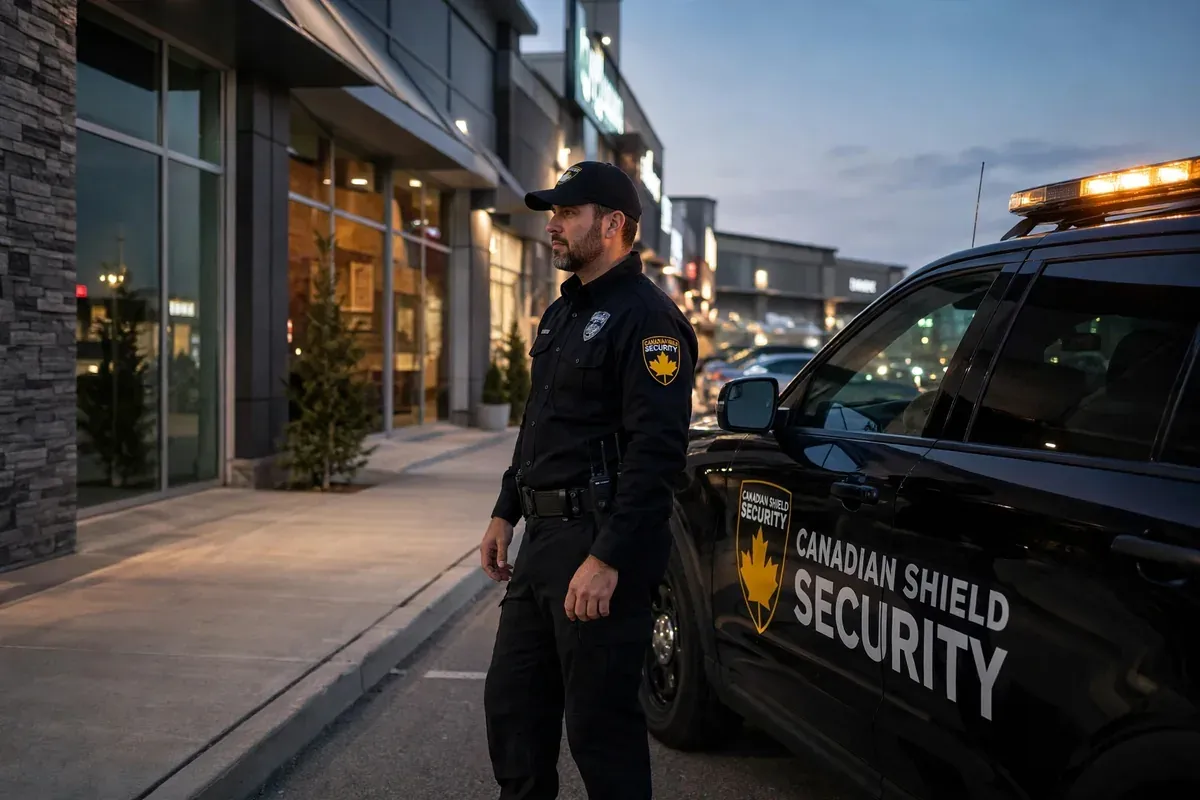
A mid-size apparel retailer near West Edmonton Mall was losing close to 3 percent of sales to shrinkage, well above the Canadian retail average, until a loss prevention audit found the real problem was not shoplifters at the front door but a blind spot near the fitting rooms where staff could not see concealment happening.
Loss prevention strategies that work for Edmonton retailers combine trained officers, smart store design, and consistent CCTV coverage, not just a guard standing near the exit. Canadian retail shrinkage has hovered between 1.5 and 2.5 percent of sales in recent years, and organized retail crime has pushed that number higher for many stores.
This guide covers the loss prevention strategies actually reducing shrinkage for Edmonton retailers in 2026, from CPTED store design to SSIA-licensed loss prevention officers and what a real shrinkage reduction plan should include.
|
Effective loss prevention strategies for Edmonton retailers combine trained, SSIA-licensed loss prevention officers, CPTED-based store layout design, consistent CCTV coverage of blind spots, and clear staff protocols for suspected theft. Retailers using all four typically see shrinkage rates well below the Canadian average of 1.5 to 2.5 percent of sales. |
Why Does Loss Prevention Matter for Edmonton Retailers?
Retail shrinkage costs Canadian businesses more than $8 billion a year according to the Retail Council of Canada, and Edmonton retailers are not exempt from that pressure, particularly stores in high foot-traffic areas like West Edmonton Mall and Whyte Avenue.
Shrinkage does not come from one source. External shoplifting, employee theft, administrative errors, and organized retail crime all contribute, and more than half of retailers reported an increase in organized retail crime activity in the past year.
Self-checkout areas carry a disproportionate share of shrinkage risk. Industry data shows self-checkout shrink running as high as 3.5 percent compared to roughly 0.2 percent at staffed checkout lanes, a gap Edmonton retailers adding self-checkout should plan for directly.
Administrative errors, mispriced items, miscounted receiving, and paperwork mistakes, account for a meaningful share of shrinkage too, often overlooked because it carries less urgency than visible theft but adds up the same way on a quarterly inventory count.
What Loss Prevention Strategies Actually Reduce Shrinkage?
Trained loss prevention officers remain the most effective single strategy, since a person trained to recognize concealment behavior and coordinated distraction techniques catches theft that cameras alone miss.
CPTED, crime prevention through environmental design, addresses the physical layout of a store: sightlines, shelf height, lighting, and fitting room placement all affect how easily theft can happen undetected.
CCTV coverage works best as a support tool for officers, not a replacement. Cameras document incidents for prosecution and insurance claims, but footage reviewed after the fact does not stop a theft in progress the way a trained officer can.
No single strategy works in isolation. A retailer with excellent CCTV coverage but no trained officer on the floor still lets theft happen in real time, since footage only supports action after the fact.
Loss Prevention Strategies Compared
The table below breaks down the four core loss prevention strategies Edmonton retailers should combine, since relying on only one typically leaves an obvious gap for organized retail crime to exploit.
|
Strategy |
What It Addresses |
Edmonton Application |
|---|---|---|
|
SSIA-licensed loss prevention officers |
Real-time theft detection and intervention |
Uniformed or plainclothes coverage for West Edmonton Mall retailers |
|
CPTED store design |
Blind spots, concealment opportunities |
Fitting room placement, shelf height in high-traffic Edmonton stores |
|
CCTV coverage |
Incident documentation, insurance and prosecution support |
Blind-spot coverage near fitting rooms and back-of-house areas |
|
Staff training protocols |
Consistent, legally sound response to suspected theft |
De-escalation training aligned with Alberta Use of Force standards |
|
Inventory audit cadence |
Detecting administrative error and internal theft patterns |
Monthly counts flag shrinkage before it compounds over a quarter |
How Do Trained Loss Prevention Officers Reduce Theft?
A loss prevention officer trained under the Security Services and Investigators Act (Alberta) is positioned differently than a general security guard. Officers learn to recognize concealment behavior, unusual movement patterns, and coordinated distraction tactics used by organized retail crime groups.
Plainclothes coverage works well for larger retailers where a uniformed presence might simply push theft to a different aisle rather than stopping it, while uniformed officers provide visible deterrence for smaller stores or high-traffic mall locations.
Officer scheduling should follow actual risk patterns, not a fixed template. Edmonton retailers see predictable spikes around evenings, weekends, and major sale events, and coverage should scale up during those windows rather than staying flat year-round.
|
COMPLIANCE NOTE: Loss prevention officers observe, document, and intervene within Alberta's Use of Force limits. They do not have police authority to arrest, and any physical confrontation carries legal risk. Training on this boundary protects both the officer and the retailer. |
How Does CPTED Store Design Prevent Theft?
CPTED principles focus on removing the physical conditions that let theft happen unnoticed. Lower shelf heights near entrances improve sightlines from the front counter to the back of the store, reducing blind spots without making the store feel unwelcoming.
Fitting room placement deserves particular attention in Edmonton apparel retail. A fitting room positioned outside staff sightlines, as in the West Edmonton Mall example above, is one of the most common shrinkage sources loss prevention audits uncover.
Lighting matters more than most retailers assume. Poorly lit corners and stockroom entrances create concealment opportunities that a simple lighting upgrade can close without any additional staffing cost.
Signage plays a supporting role too. Visible notice of loss prevention measures, paired with actual enforcement, deters casual shoplifters without requiring a confrontation, while organized retail crime groups are typically undeterred by signage alone and require trained officer intervention.
Parking lot and entrance visibility matters for organized retail crime specifically, since groups often stage a getaway vehicle nearby. Coordinating loss prevention officers with exterior camera coverage closes that gap for stand-alone Edmonton retail locations outside enclosed malls.
|
TIP: Request a free loss prevention audit before investing in new cameras or staffing. A walkthrough often identifies layout fixes that reduce shrinkage at no ongoing cost. |
What Should an Edmonton Retailer's Loss Prevention Plan Include?
A complete plan combines SSIA-licensed officer coverage matched to store risk level, CPTED-informed layout adjustments, CCTV coverage of identified blind spots, and written staff protocols for handling suspected theft consistently and legally.
Monthly inventory audits catch shrinkage trends early, before a small pattern of loss becomes a quarterly write-off. Comparing shrinkage against Canada's 1.5 to 2.5 percent benchmark shows whether a store's current measures are actually working.
Loss prevention plans should be reviewed quarterly, not set once and left alone. Seasonal shifts, new store layouts, and changes in organized retail crime tactics all affect which strategies still work.
Involve loss prevention officers in new store layout planning, not just staffing decisions after the fact. A CPTED review during a renovation or new location buildout costs far less than retrofitting sightline fixes into an existing store.
|
COMPLIANCE NOTE: Under Alberta's Personal Information Protection Act (PIPA), CCTV footage capturing customers or employees must be stored securely with defined retention limits. Confirm your loss prevention provider follows PIPA requirements for any footage collected. |
|
TIP: Review your fitting room and stockroom sightlines specifically. These two areas account for a disproportionate share of concealment-based theft in Edmonton apparel and specialty retail. |
How Should Edmonton Retailers Measure Loss Prevention Success Over Time?
Track shrinkage rate as a percentage of sales quarter over quarter, not just total dollar loss, since a growing store can show rising dollar losses while actually improving on a percentage basis.
Compare incident reports from loss prevention officers against actual inventory counts. A high number of documented interventions with flat or rising shrinkage suggests a layout or staffing gap rather than an officer performance issue.
Benchmark against the Canadian average of 1.5 to 2.5 percent honestly. A store sitting above that range after implementing officer coverage, CPTED adjustments, and CCTV likely needs a full loss prevention audit rather than another round of the same fixes.
Share these numbers with staff, not just ownership. Employees who understand how shrinkage is tracked and why it matters tend to follow loss prevention protocols more consistently than teams told simply to watch for theft without context.
Conclusion
Loss prevention strategies that work for Edmonton retailers combine trained SSIA-licensed officers, CPTED store design, and CCTV coverage, not any single tactic on its own. Retailers using all three consistently see shrinkage well below the Canadian average.
Canadian Shield Security offers a free loss prevention audit for Edmonton retailers to identify exactly where shrinkage is happening. Contact Canadian Shield Security today to see what a plan built for your specific store looks like.
Shrinkage never reaches zero, and treating loss prevention as a one-time fix rather than an ongoing program is the most common reason Edmonton retailers see results fade within a year of implementation.
|
GET STARTED: Canadian Shield Security serves Edmonton 24/7. Free consultation, no hidden fees. Call 1 (800) 326-7879. |
Frequently Asked Questions
Do loss prevention officers in Edmonton need to be licensed?
Yes. Any loss prevention officer or retail security guard working in Edmonton must hold a valid licence under the Security Services and Investigators Act (Alberta). Canadian Shield Security verifies SSIA licensing and runs background checks before assigning any officer to a retail floor, whether uniformed or plainclothes.
How much does loss prevention coverage cost for an Edmonton retailer?
Loss prevention officer coverage in Edmonton typically costs $22 to $38 per hour depending on store size, risk level, and whether coverage is uniformed or plainclothes. Canadian Shield Security offers a free loss prevention audit and site assessment to build a custom quote for any Edmonton retail location.
Does Canadian Shield Security cover retailers near West Edmonton Mall?
Yes. Canadian Shield Security provides retail loss prevention coverage throughout Edmonton, including West Edmonton Mall area retailers, Sherwood Park, St. Albert, and surrounding shopping districts. Coverage includes both stationed officers and mobile patrol options for retail plazas and standalone stores across the region.
What is a normal shrinkage rate for a retail store in Canada?
Retail shrinkage in Canada typically runs between 1.5 and 2.5 percent of sales annually, with some categories like apparel and electronics running higher. Edmonton retailers facing organized retail crime or high foot-traffic locations often see shrinkage above this range without dedicated loss prevention coverage in place.
What is CPTED and how does it reduce retail theft?
CPTED, crime prevention through environmental design, changes store layout, lighting, and sightlines so staff and cameras can naturally observe more of the floor. Combined with trained loss prevention officers and CCTV, CPTED principles reduce concealment opportunities before theft happens rather than only responding after it occurs.
