
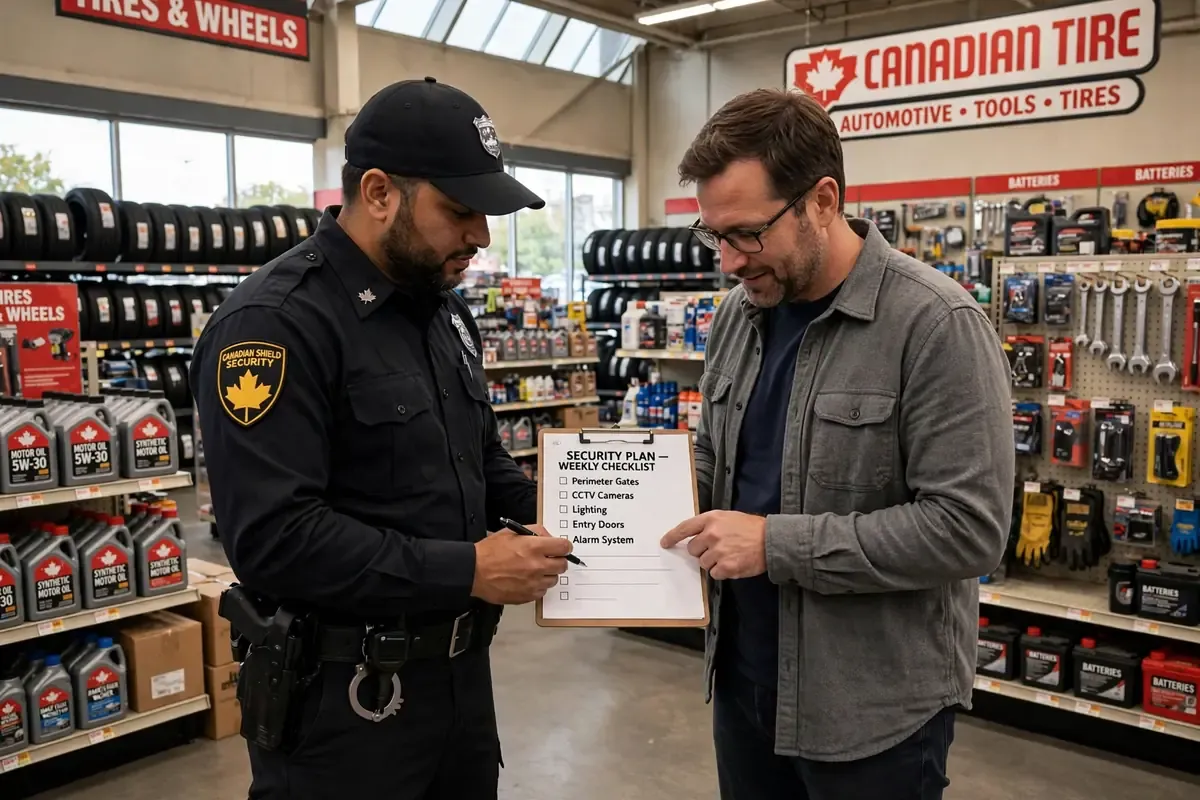
A 12-person tire and auto shop in South Edmonton (T6H) loses a night's worth of tools to a break-in. The owner pays the insurance deductible, replaces the locks, then hires a guard on a panic call at emergency prices, with no budget line for any of it.
Security budget planning Edmonton owners can defend starts before the incident, not after it. Canadian Shield Security provides guards licensed under the Security Services and Investigators Act (Alberta) (SSIA), and we price every option before you commit.

This guide covers physical security: how to size risk, price each control, phase spending and prove value to your accountant. It suits owners from Whyte Avenue (T6E) to Mill Woods (T6K). IT security budgets are a separate topic.
Quick answer: Plan an Edmonton SME security budget in four steps: list your highest risks, price the controls that address them, add guard hours only where incidents cluster, and review every quarter. Licensed guards under the Security Services and Investigators Act (Alberta) typically cost $32 to $45 per hour, so phase your spending by risk.
Why Security Budget Planning Edmonton SMEs Skip Costs More
Unplanned security spending often costs more than planned spending, because it arrives as an emergency. The Canadian Federation of Independent Business found that 54% of Alberta small businesses were directly affected by crime in 2024, up from 24% a year earlier.
The same report found a median of $5,750 in crime-related expenses over three years, and 71% of small firms do not consistently file insurance claims, mostly fearing higher premiums. A 2025 CFIB survey found 49% of Alberta owners saw crime rise in their community.
Geography shapes the numbers. A retail shop on Whyte Avenue (T6E) faces theft and late-night disorder, a warehouse in Nisku (T9E) faces equipment theft, and an office in Mill Woods (T6K) faces after-hours break-ins. One flat budget formula cannot fit all three.
| Cost type | Example | Where it lands in your budget |
|---|---|---|
| Direct loss | Stolen tools, stock or cash | Inventory and equipment lines |
| Insurance | Deductible and higher premiums | Insurance line, often unclaimed |
| Repairs | Broken doors, windows, locks | Maintenance line |
| Downtime | A day closed after a break-in | Lost revenue |
| Staff | Safety worries on late shifts | Turnover and overtime |
How to Size Your Security Budget From Risk, Not Guesswork
Size your budget from your own losses and risks, because no Alberta rule sets a fixed percentage of revenue for security. Start with what you have already paid, then price what you want to prevent.
Add up three years of stolen stock, repairs, deductibles and lost trading days. Then rank your top three risks by likelihood and impact. Our guide to security risk assessments in Edmonton shows what a site survey covers.
Be honest about what security cannot do. No budget removes risk entirely, and the aim is to cut the likelihood and cost of incidents. Ask your insurance broker whether monitored alarms or guard coverage change your premium or deductible.
| Method | How it works | Best for |
|---|---|---|
| Loss-based | Total 3 years of losses, deductibles and repairs; budget a share of it | Businesses with past incidents |
| Risk-based | Rank risks by likelihood and impact; fund the top three first | New or growing businesses |
| Coverage-based | Price the guard hours or patrols you need; compare with expected losses | Late-hours or high-value sites |
Compliance alert: Licensed guards are a legal requirement, not an optional upgrade. Under the Security Services and Investigators Act (Alberta), contract guards must hold a security service worker licence. Unlicensed cover wastes your spending and exposes you to liability. See the Alberta security licence rules.
What Security Costs in Edmonton: Budget Tiers
Budget in four tiers: starter, core, enhanced and full coverage. Guard hours drive most of the cost, and licensed guards in Edmonton typically bill $32 to $45 per hour.
Our on-site guard service is priced per hour, while mobile patrol and alarm response are quoted per site. For wider rate detail, see our commercial security cost guide.
Ask about minimum shift length, holiday rates, notice periods and who covers a sick call. These terms change real costs more than a one-dollar hourly gap. Compare static guards and mobile patrol before choosing hours.
| Tier | Profile | Guard hours | Annual guard cost |
|---|---|---|---|
| Starter | Low-traffic office, little cash | After-hours alarm response and patrol | Quoted per site |
| Core | Shop or clinic with evening risk | 10 hours per week | $16,640-$23,400 |
| Enhanced | Late hours or repeat incidents | 20 hours per week | $33,280-$46,800 |
| Full | High-value or high-risk site | 40 hours per week | $66,560-$93,600 |
Winter tip: Edmonton winters reach -40C - this affects patrol vehicle performance, camera operation, and lock mechanisms. Add a winter line to your budget for lock servicing, camera housing checks and extra lighting maintenance.

How to Build and Phase Your Security Budget, Step by Step
Build your budget in six steps and spend in phases, so each dollar follows evidence rather than fear. A phased plan also gives your accountant a clear paper trail.
Step 1: Total your last three years of losses, deductibles, repairs and lost trading days.
Step 2: Walk the site and rank your top three risks.
Step 3: Price one control for each risk, such as locks, lighting, an alarm or patrol.
Step 4: Phase spending: fix now, review at 90 days, expand within 12 months.
Step 5: Add guard hours only where incidents cluster by day and hour.
Step 6: Review quarterly with your broker and accountant.
Write down your review triggers in advance, for example two incidents in a quarter or one forced entry. Triggers turn a stressful decision into a budget rule, and they stop spending from drifting up or down by habit.
When to Bring In a Professional Security Company
Bring in a licensed security company when incidents repeat, your insurer asks questions, or staff avoid late shifts. A free site assessment costs nothing and gives you quotes to set against your own loss figures.
Owners weighing the downside of doing nothing can read about the cost of having no security in Edmonton, and our guide to security costs versus insurance premiums explains the premium trade-off.
Keep your own records too. Dated incident logs, photos, police file numbers and invoices support insurance claims, tax filings and any later review of whether your spending actually cut losses.
Honest limits: No security budget removes risk entirely. For active criminal incidents, call 911 first. SSIA-licensed security guards are trained to observe and report. They do not replace police authority or emergency services. Use the Edmonton Police Service non-emergency line, 780-423-4567, for non-urgent reports.
Keeping Your Security Budget Working Year-Round
Review your security budget every quarter and rebuild it once a year. Compare incidents, losses and guard hours used against the plan, then move money toward the controls that clearly worked.
Seasons change risk. Short winter days raise after-hours break-in risk, while summer patios, open doors and events raise theft and disorder. Adjust guard hours before each season rather than after the first incident.
Track three numbers: incidents per month, losses and deductibles paid, and guard hours used. If incidents fall for two quarters, hold spending steady. If they rise, add hours before the next review.
Conclusion
Sound security budget planning Edmonton businesses can sustain rests on three habits: start from your own losses, spend in phases, and review every quarter. Small, early steps usually cost less than an emergency purchase after an incident.
If your business in T6H, T6E or Sherwood Park wants help sizing a budget, our team will walk the site with you and quote every option in plain terms through a free site assessment and consultation.
Free consultation: Canadian Shield Security serves Edmonton 24/7. Free consultation - no hidden fees. Call 1 (800) 326-7879. Contact us to book your site walk-through.
Frequently Asked Questions About Security Budgets for Edmonton SMEs
Do security guards hired by Edmonton small businesses need a licence?
Yes. Under the Security Services and Investigators Act (Alberta), anyone paid to guard or patrol property needs a security service worker licence, valid for two years. Ask every provider for licence details and keep copies on file. Using licensed guards protects your spending, your insurance position and your reputation if an incident occurs.
How much should an Edmonton small business budget for security?
No fixed percentage applies. Start with your last three years of losses and deductibles, then price controls against them. Licensed guards typically cost $32 to $45 per hour, so 10 hours weekly runs $16,640 to $23,400 yearly. Mobile patrol and alarm response are quoted per site after a free assessment.
Does Canadian Shield Security serve small businesses in Sherwood Park and Leduc?
Yes. Canadian Shield Security serves small businesses across Edmonton, including Sherwood Park, Leduc, St. Albert, Beaumont, Stony Plain and Spruce Grove. Coverage runs 24/7, 365 days a year, including holidays. Call 1 (800) 326-7879 to book a free site assessment and receive a custom quote for your location.
Can small businesses phase security spending over the year?
Yes, and it is often smarter. Fund the highest risk first, such as locks, lighting or after-hours patrol, then add guard hours after 90 days using real incident data. Agree minimum shifts, holiday rates and notice periods in writing so you can scale coverage up or down without penalty surprises.
Are security costs tax deductible for Edmonton businesses?
Often, as ordinary operating expenses, but treatment depends on whether an item is a current expense or a capital purchase such as installed equipment. Confirm the details with your accountant or the Canada Revenue Agency before filing. Keep invoices, contracts and incident logs to support every claim.
