
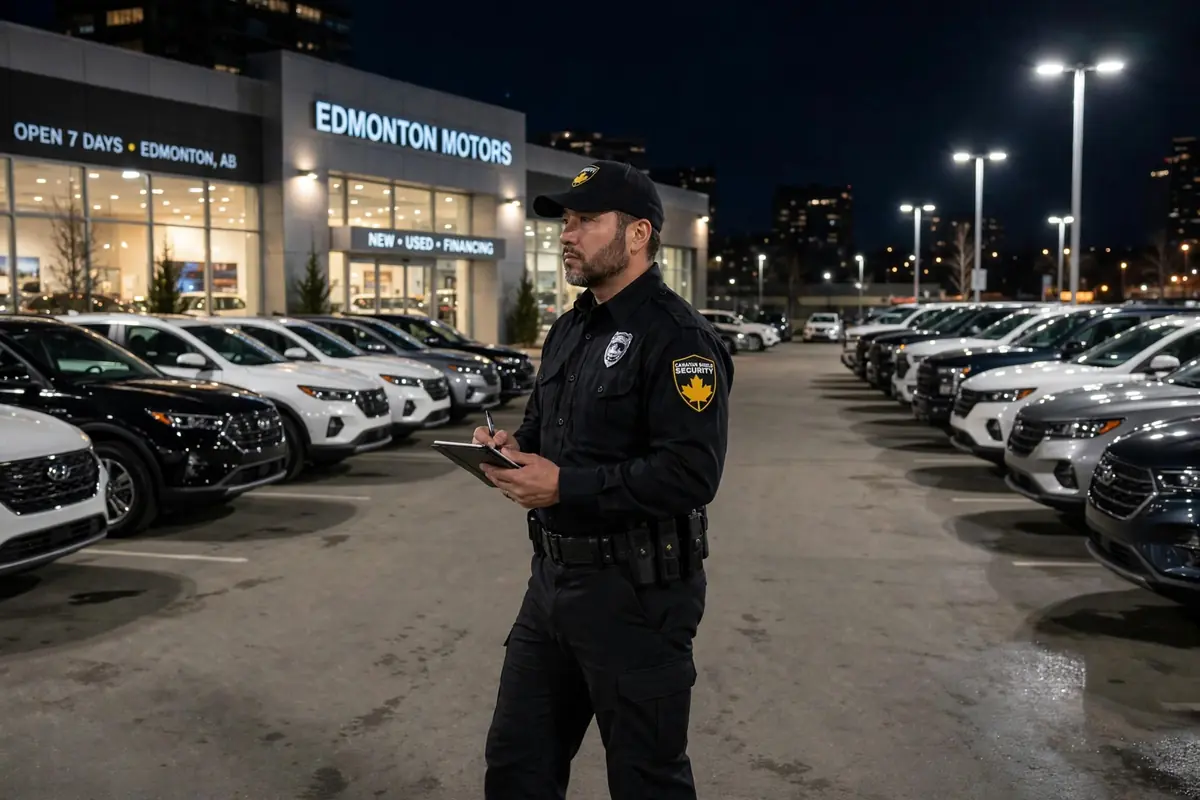
In April 2020, thieves smashed the glass door of a north Edmonton dealership showroom at 4:50 a.m., took keys from the key board, and drove a $23,000 Fiat 500 out through the door. That break-in shows why car dealership security Edmonton owners plan around closing time, and why Canadian Shield Security builds lot protection in layers.
Dealerships hold high-value inventory, a board of keys, and open lots that sit empty overnight. Whether your lot sits in south Edmonton (T6H) or near Downtown (T5J), the exposure is the same.
This guide covers the weak points thieves use, a seven-step protection plan, and when to bring in a security company licensed under the Security Services and Investigators Act (Alberta) (SSIA).
Quick answer: Car dealership security in Edmonton works best as layers: bright lighting, locked key control, barriers at lot entrances, monitored cameras, and overnight mobile patrols by SSIA-licensed guards. Cover after-hours first, because showrooms and lots sit empty then. Add on-site guards for large lots or high-value inventory, and start with a free site assessment.
Why Dealerships in Edmonton Need Their Own Security Plan
Dealerships need their own plan because they combine easy-to-drive inventory, a concentrated supply of keys, and large open areas with few people on site after hours. Edmonton Police Service says many vehicle models can be stolen in under a minute, and that most vehicle crime is opportunistic and preventable.
Police data shows the pressure. Thefts under $5,000 from motor vehicles rose 17% citywide in 2025, and property crime overall rose 10.1%, according to an Edmonton Police Service release. About 126 vehicle break-ins hit the West Division and 161 hit Downtown over a recent 30 days.
Those figures cover thefts from vehicles, the same opportunistic offence that targets unlocked cars on open lots. Edmonton winters reach -40C, which also affects cameras, gate motors, and lock mechanisms.
Where Edmonton Dealership Lots Get Hit: Six Weak Points
Dealership thefts exploit six weak points: showroom glass, key storage, front-row inventory, back lots, service areas, and licence plates. The 2020 Northgate Chevrolet break-in on Edmonton's north side shows several failing at once, with a smashed door, a destroyed key board, and a car driven out through the showroom, as Global News reported.
Edmonton Police Service promotes CPTED principles that favour clear sightlines and good lighting. Trim anything that hides a vehicle from the street, and plan parking lot security for rows that sit far from the showroom.
| Weak Point | How It Fails | Fix |
|---|---|---|
| Showroom glass | A smashed door gives direct access to keys and cars | Laminated glass film, shatter sensors, interior bollards |
| Key board or cabinet | Visible, unlocked, and a single point of failure | Locked steel safe after closing, written key log |
| Front-row inventory | Easy to drive out overnight | Entrance gates, nose-in parking, blocked exits |
| Back lot and storage | Dark, unwatched, and far from the showroom | Perimeter lighting, fencing, overnight patrols |
| Service bays and customer cars | Keys and valuables left in vehicles | Locked key drop box, camera coverage |
| Licence plates | Plate theft is a concern for Edmonton police | Anti-theft bolts, free at Edmonton police stations |
Legal limit: For active criminal incidents, always contact Edmonton Police Service first. SSIA-licensed security guards are trained to observe and report. They do not replace police authority or emergency services, and they should not chase or confront thieves.

Car Dealership Security Edmonton Owners Can Build in 7 Steps
Build your dealership protection in seven steps, starting with a night walk-through, so each layer covers a gap the previous one leaves.
- Audit the lot after dark. Walk every row, gate, and door at 11 p.m. with the lights set as usual. Mark dark corners, blind spots, and any exit a vehicle could use.
- Fix lighting and sightlines. Light entrances, front rows, and the key area first. Trim shrubs and move signs that block camera views or hide vehicles from the street.
- Lock down key control. Store every key in a locked steel safe after closing. Log each key out and in, and keep the key board out of view from showroom windows.
- Block the exits. Add gates or bollards at lot entrances, park inventory nose-in, and place barriers behind high-value rows so vehicles cannot be driven straight out.
- Cover the lot with cameras. Place cameras to capture plates at entrances and faces at doors. Test night footage monthly and post signs, because Alberta's Personal Information Protection Act (PIPA) applies to video of identifiable people.
- Add live monitoring. Cameras that only record show you the loss afterward. Trained operators watching alerts in real time can dispatch a response while thieves are still on site.
- Add overnight patrols. Randomized, GPS-tracked patrol visits check the lot between closing and opening, and each visit produces a timestamped digital report.
Mobile Patrol, On-Site Guard, or Monitored CCTV: Which Fits?
Choose mobile patrol for small and mid-size lots, on-site guards for large lots with high-value inventory, and monitored CCTV as the base layer under both.
Canadian Shield Security offers mobile patrol security, on-site guards, and CCTV monitoring in Edmonton. Each lot is quoted in writing after a free site assessment, with no hidden fees, so price reflects guard hours, patrol frequency, and risk.
| Option | Best For | Coverage | Limit |
|---|---|---|---|
| Mobile patrol | Small and mid-size lots | Randomized checks between closing and opening | Not present between visits |
| On-site guard | Large lots, high-value stock | Continuous presence at the post | Covers one location per post |
| Monitored CCTV | Every lot, as a base layer | 24/7 alert review and dispatch | Needs good lighting and camera placement |
When to Call a Professional Security Company in Edmonton
Call a professional after any break-in, when your inventory value outgrows your current protection, or when your insurer asks for documented security measures. A licensed provider also brings patrol routes, reporting, and response that a sales team cannot staff overnight.
Any guard, alarm responder, or loss prevention worker you hire must hold a security service worker licence under the SSIA. The Government of Alberta sets the fee at $100 for a licence valid 2 years, so ask providers to confirm licensing before you sign.
The Consultation and Planning service starts with a free call and a site walk-through. A licensed supervisor inspects the lot, reviews past incidents, and builds a written plan with options at different price points.
| Question to Ask | What a Good Answer Sounds Like |
|---|---|
| Are all guards licensed under the SSIA? | Yes, with licensing details available on request |
| How are patrol visits proven? | GPS tracking and timestamped digital reports |
| What happens during an active break-in? | Call 911 and Edmonton Police Service first, then document and report |
| How is pricing set? | Written quote after a site assessment, no hidden fees |
| How fast can service start? | Site assessment within 24 hours; deployment typically in 1 to 3 business days |
How to Keep Your Dealership Protected Through Edmonton Winters
Review your dealership security every quarter, and test lighting, cameras, and gates before the first hard freeze each year. Edmonton winters reach -40C, which affects gate motors, camera performance, and lock mechanisms.

Snow banks can hide vehicles and block camera views, so clear sightlines after each plow. Edmonton Police Service's Operation Cold Start campaign also warns against leaving running vehicles unattended, so keep keys and idling cars off the lot after hours.
After any incident, review the footage, update key logs, and re-score your weak points. Dealers with a showroom and service building can also review their winter security plan for shared doors and after-hours entry.
Conclusion
Dealership losses tend to happen fast and after hours, so layers matter more than any single device. Light the lot, lock the keys, block the exits, watch the cameras, and patrol overnight.
Canadian Shield Security can walk your Edmonton lot with you after dark and quote each layer in writing. The consultation is free, and there are no hidden fees. Start with a free consultation today.
Canadian Shield Security serves Edmonton 24/7. Free consultation -- no hidden fees. Call 1 (800) 326-7879.
Frequently Asked Questions
Are security guards in Edmonton required to be licensed?
Yes. Under the Security Services and Investigators Act (Alberta), anyone working as a security guard, alarm responder, patrol dog handler, loss prevention worker, or body guard must hold a security service worker licence. The fee is $100 and the licence is valid for 2 years. Ask any provider to confirm guard licensing before you sign a contract.
How much does dealership security cost in Edmonton?
Cost depends on lot size, guard hours, patrol frequency, and inventory risk, so Canadian Shield Security quotes each dealership in writing after a free site consultation. There are no hidden fees. Most site assessments are scheduled within 24 hours, and guard or patrol deployment typically begins within one to three business days.
Does Canadian Shield Security protect dealerships outside Edmonton?
Yes. Canadian Shield Security serves Edmonton, St. Albert, Sherwood Park, Leduc, Beaumont, Nisku, Acheson, Stony Plain, Spruce Grove, and Fort Saskatchewan. Industrial clients in Nisku and Leduc receive guards trained for oil and gas site protocols. Call 1 (800) 326-7879 to confirm coverage and book a free site consultation at your address.
Is mobile patrol or an on-site guard better for a car dealership?
Mobile patrol suits most small and mid-size lots because randomized, GPS-tracked visits cover the hours between closing and opening. On-site guards suit large lots or high-value inventory that needs continuous presence. Monitored CCTV supports both options. A free site assessment shows which mix fits your lot and your budget.
What should a dealership do after an overnight break-in?
Call 911 and Edmonton Police Service first, and do not enter if thieves may still be inside. Preserve all camera footage, avoid touching damaged doors or key boards, and list missing keys and vehicles. Then notify your insurer, change access codes, and book a security review to close the gap that was exploited.
