
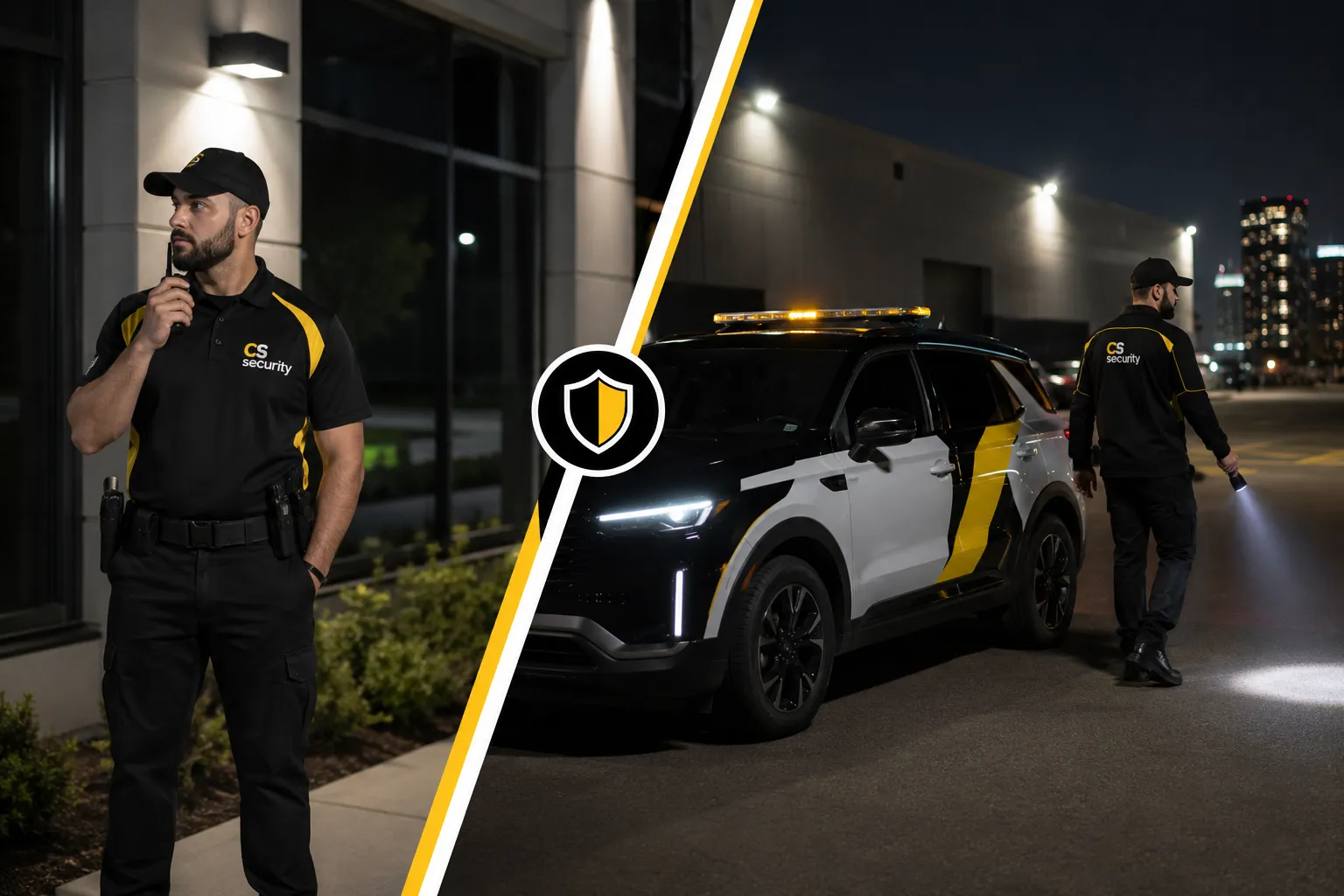
A jewellery retailer on Whyte Avenue posted a static guard at the front entrance for two years, until a string of after-hours break-ins at the loading dock, a spot the guard never covered, pushed the owner to add mobile patrol checks overnight instead of simply extending the guard's hours.
A static guard vs mobile patrol Edmonton decision comes down to a genuine trade-off, not a simple better-or-worse choice. Business owners comparing our static security guards and mobile patrol services need to weigh deterrence style, coverage gaps, and real cost before committing to either.
This guide breaks down the pros, cons, and real Edmonton costs of both options, plus the specific post order details and commercial zone factors that shape which one fits your property.
|
A static guard is stationed continuously at one fixed post, offering constant visible deterrence and instant response, while mobile patrol covers multiple properties on a randomized route, trading constant presence for unpredictability and lower cost. Both require SSIA licensing in Alberta. Most Edmonton businesses pair a static guard by day with patrol coverage overnight. |
What Is a Static Guard, and How Is It Different From Mobile Patrol?
A static guard, sometimes called a fixed post or stationary guard, remains at one location for the full shift, providing continuous visible presence at an entrance, lobby, or checkpoint. Mobile patrol instead covers multiple properties on a scheduled or randomized route.
The core difference is predictability versus randomness. A static guard is always visible in the same spot, which builds familiarity with staff and visitors but also means anyone watching the property can learn the guard's routine. Mobile patrol trades constant visibility for unpredictable timing that is harder to plan around.
Neither approach is universally better, and the right choice depends heavily on what type of property you are protecting. A single-entrance office tower has very different needs than a sprawling industrial yard with multiple gates, and the physical layout of your site often matters as much as your budget.
Pros of a Static Guard for Your Edmonton Property
Constant visible presence deters walk-in theft and unauthorized entry at the exact point a static guard is posted, since a uniformed officer standing at an entrance changes the calculation for anyone considering a walk-in crime.
This effect is strongest at the specific point the guard occupies. Research on visible security presence consistently shows that a uniformed officer near an entrance or high-value area changes offender behavior at that location, even before any active intervention takes place.
Immediate response time is another advantage. A static guard is already on-site when an incident occurs, whether that is a medical emergency, a disturbance, or a visitor needing assistance, without waiting for a patrol vehicle to arrive.

Access control and visitor management work best with a static guard. Checking identification, managing sign-in logs, and building familiarity with regular tenants or staff all require someone stationed at the same point consistently.
Customer and staff reassurance is a real, if harder to quantify, benefit. Retail staff and office employees often report feeling safer with a recognizable guard at the entrance than with a patrol vehicle that passes through periodically.
Every static guard posted in Edmonton must hold a valid SSIA licence under the Security Services and Investigators Act (Alberta), the same requirement that applies to mobile patrol officers. This licensing, along with background checks, is confirmed before deployment regardless of which service you choose.
Cons of a Static Guard: Where Fixed Posts Fall Short
Coverage is limited to one location. A static guard posted at the front entrance cannot see the loading dock, the parking lot, or a side exit at the same time, leaving predictable gaps that repeat visitors or intruders can learn over time.
Predictability cuts both ways. The same consistency that builds staff familiarity also lets a determined intruder observe the guard's routine, shift breaks, and blind spots, then plan around them.
Cost per square foot of coverage is higher. Since a static guard protects a single fixed point rather than a wider area, properties with multiple entry points, large lots, or several buildings often need more than one static post to achieve full coverage.
Fatigue and complacency are real operational risks over long shifts at a single, low-activity post. Reputable providers rotate static guards and build supervision checks into their post orders specifically to manage this risk.
|
Factor |
Static Guard |
Mobile Patrol |
|
Deterrence style |
Constant, visible, single-point |
Randomized, unpredictable, multi-point |
|
Coverage area |
One fixed location |
Multiple properties or zones |
|
Response to on-site incident |
Immediate |
Depends on route timing |
|
Cost per property |
Higher for full coverage |
Lower across multiple sites |
|
Best suited for |
Entrances, access control, retail floors |
Perimeters, lots, multi-building sites |
Pros and Cons of Mobile Patrol
Unpredictable timing is mobile patrol's biggest deterrence advantage. Since an intruder cannot know exactly when an officer will arrive at a given stop, randomized routes discourage the kind of planned, patient break-in attempt that a predictable static post can actually invite.
This randomization is deliberate rather than accidental. Patrol routes are structured so that visit order and timing vary between shifts, which is precisely what prevents the pattern-learning problem that affects a guard stationed in one place for months at a time.
Wider coverage per dollar is the other major advantage. One patrol officer can check a loading dock, parking lot, and perimeter across several properties in a single shift, covering far more ground than a single static post at the same cost.
The trade-off is presence between visits. A patrol officer is not physically on-site continuously, so response to an in-progress incident depends on route timing, alarm response protocols, or how far the vehicle currently sits from your property.
GPS-verified patrol reporting partially offsets this gap by giving property managers a documented record of exactly when each checkpoint was visited, even though the officer cannot be physically present between those visits the way a static guard can.
Less direct visitor interaction is a real limitation for sites needing constant access control, identification checks, or a consistent point of contact, roles better suited to a static guard than a patrol officer passing through.
Static Guard vs Mobile Patrol: Real Cost Breakdown
A static guard typically costs $28 to $45 per hour in Edmonton, which works out to roughly $5,000 to $8,000 per month for a single continuous 24/7 post, depending on certification level and site risk classification.
Mobile patrol covering the same property with three to six nightly visits, plus daytime checks, often costs a fraction of that monthly total, since the mobile patrol contract is priced per visit rather than per continuous hour.
The real cost comparison depends on how much continuous presence your property genuinely needs. A jewellery store or bank branch may need a static guard's constant presence to justify the higher monthly cost, while a warehouse or storage yard may get equivalent protection from patrol at a much lower price point.
Insurance considerations can shift this calculation too. Some commercial policies offer premium reductions for documented continuous security presence, which can partially offset a static guard's higher monthly cost depending on your policy terms and property type.
Many Edmonton businesses reduce total cost by combining both: a static guard during business hours when foot traffic and access control matter most, and mobile patrol overnight when unpredictability matters more than constant visibility.
|
Coverage Model |
Typical Monthly Cost |
Best For |
|
Static guard, 24/7 single post |
$5,000-$8,000/month |
Single high-value entry point |
|
Static guard, business hours only |
$2,000-$3,500/month |
Retail or office daytime access control |
|
Mobile patrol, 3-6 nightly visits |
Fraction of 24/7 static cost |
Larger footprints, lower continuous risk |
Post Orders: What a Static Guard Actually Does at Your Site
Post orders are the written instructions defining exactly what a static guard does at your specific property, and they matter more for static posts than almost any other part of the contract, since the guard has no route to fall back on if instructions are unclear.
A complete set of post orders covers access control procedures, visitor sign-in requirements, emergency contact numbers, patrol checks within the guard's assigned area, incident reporting format, and specific instructions for handling common situations at that exact site.

Post orders should be reviewed with the guard and updated whenever your property's needs change, such as a new tenant, a renovated entrance, or a shift in business hours, so the written instructions always reflect current conditions rather than an outdated baseline.
Canadian Shield Security reviews post orders with property managers on a set schedule rather than leaving them to go stale, since a static guard following outdated instructions can miss exactly the kind of change that created a new gap in coverage.
Matching Coverage to Edmonton Commercial Zones
Downtown Edmonton (T5J) office towers with a single main entrance and steady daytime traffic are a strong fit for a static guard, since access control at one clear point covers most of the property's actual risk.
Retail corridors like Whyte Avenue (T6E) often benefit from a static guard during business hours for customer-facing deterrence, paired with mobile patrol covering the loading dock and rear entrances that a single guard cannot watch simultaneously.
Industrial and warehouse properties near Nisku or Acheson typically favor mobile patrol, since these sites often have large perimeters, multiple access points, and lower continuous foot traffic, making one static post an inefficient way to cover the full property.
South Edmonton (T6H) retail plazas and multi-tenant commercial buildings frequently land on a hybrid model, since the mix of customer-facing storefronts and less-visible rear areas plays to the strengths of both static presence and patrol coverage.
Edmonton winters add a practical factor to this decision as well. A static guard needs a heated post or shelter access for an outdoor position, while mobile patrol vehicles need reliable cold starts at -40C, so both options require specific seasonal planning rather than a one-size-fits-all setup.
Final Thoughts
Choosing between a static guard and mobile patrol comes down to how much of your property's risk sits at one predictable point versus spread across a wider area. Many Edmonton businesses do not have to choose exclusively, since a blended plan often addresses both deterrence styles at a lower combined cost.
Canadian Shield Security's SSIA-licensed static guards and mobile patrol officers serve Edmonton commercial zones 24/7, with a free site assessment to determine the right mix of fixed presence and patrol coverage for your property.
|
Canadian Shield Security serves Edmonton 24/7. Free consultation, no hidden fees. Call 1 (800) 326-7879 or WhatsApp 1 (780) 203-4535. |
Frequently Asked Questions
Do static guards need the same SSIA licence as mobile patrol officers in Alberta?
Yes. Under the Security Services and Investigators Act (Alberta), both static guards and mobile patrol officers must complete Alberta Basic Security Training and hold a valid SSIA licence. Canadian Shield Security confirms licence numbers for every officer before deployment, whether posted at a fixed location or covering a patrol route.
How much does a static guard cost compared to mobile patrol in Edmonton?
A static guard typically costs $28 to $45 per hour, or roughly $5,000 to $8,000 per month for a single 24/7 post. Mobile patrol covering the same property with several nightly visits often costs a fraction of that monthly total, since one officer serves multiple sites instead of standing at just one location.
Does Canadian Shield Security offer static guards in Edmonton commercial zones?
Yes. Canadian Shield Security provides static guards and mobile patrol across Downtown T5J, South Edmonton T6H, Whyte Avenue T6E, Nisku, Sherwood Park, and St. Albert. Many commercial zones in these areas use a static guard at the entrance during business hours paired with patrol coverage overnight.
Is a static guard or mobile patrol better for deterrence?
Static guards deter through constant, predictable visibility at a single point, which works well for entrances and access control. Mobile patrol deters through unpredictability, since intruders cannot anticipate when an officer will appear. Combining both often produces stronger deterrence than either approach used alone.
Can I use a static guard and mobile patrol at the same property?
Yes, and this is common across Edmonton commercial zones. A retail entrance might use a static guard during business hours for access control and customer interaction, then switch to randomized mobile patrol overnight when unpredictability matters more than constant visible presence.
