
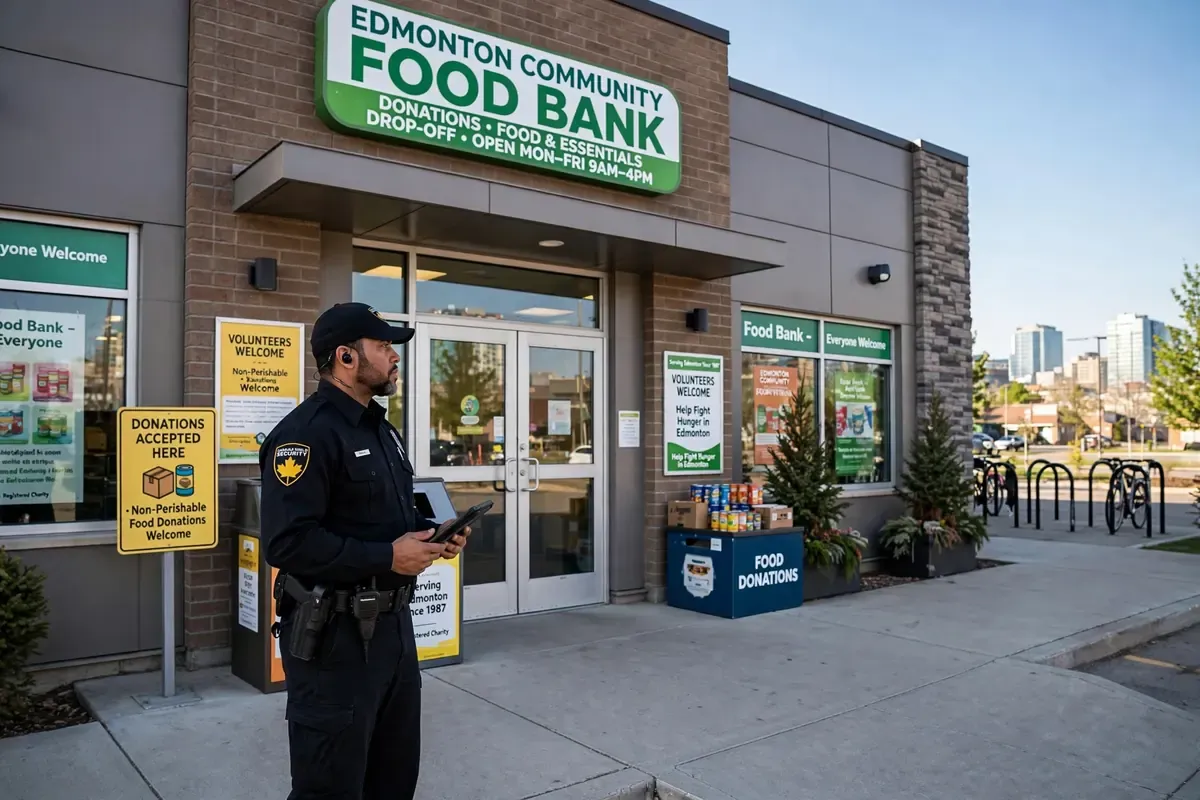
On December 23, 2024, a man stole a van from the Edmonton Food Bank's loading dock while staff prepared it for pickups, Edmonton Police Service reported. Police tracked its GPS and made an arrest. The theft shows that non-profit security Edmonton charities can use starts with simple layers, which is why Canadian Shield Security offers options at different price points.
Non-profits face the same risks as any business, including cash, equipment, and vulnerable people, but with tighter budgets and volunteers who rotate through. Whether your office is Downtown (T5J), in Old Strathcona (T6E), or in Mill Woods (T6K), the first step is the same: find the gaps.
This guide covers six weak points, a seven-step plan, funding options, and when to hire guards licensed under the Security Services and Investigators Act (Alberta) (SSIA).
Quick answer: Non-profit security in Edmonton starts with low-cost basics: lighting, locked cash and keys, visitor sign-in, and a written violence and harassment plan. Add monitored cameras and overnight patrols by SSIA-licensed guards where risk is higher. Some groups qualify for federal funding covering up to 70% of eligible costs, so check eligibility first.
Why Non-Profits in Edmonton Need a Different Security Approach
Non-profits need a different approach because they combine open-door missions, cash and donated goods, and small budgets with rotating staff and volunteers. A charity cannot lock out the public the way a bank can, so each layer must protect people without closing doors.
The risks are varied. A safe holding about $1,200 in cash and cheques, plus tablets and a card machine, was carried out of the lobby at an Edmonton animal rescue shelter in October 2024, as Global News reported. Reception areas are easy targets when nobody is watching.
Alberta law adds a duty. Alberta OHS requires every employer to develop and implement a workplace violence and harassment prevention plan, according to the Government of Alberta. That page does not address volunteers, so ask Alberta OHS how the rules apply to yours.
Where Edmonton Charities Face the Most Risk: Six Weak Points
Non-profit sites fail at six weak points: loading docks and vehicles, cash and donations, reception and front doors, outdoor bins and storage, after-hours buildings, and volunteer and visitor control. Most have a low-cost fix.
Vehicles are a repeat target. CTV News reported that thieves took catalytic converters from Edmonton Food Bank trucks in a third theft in about six months.
Edmonton's Neighbourhood Empowerment Team offers a CPTED self-assessment questionnaire and business safety guides. Edmonton Police Service also promotes CPTED principles such as clear sightlines and good lighting.
| Weak Point | How It Fails | Low-Cost Fix |
|---|---|---|
| Loading dock and vehicles | Open bays let thieves take vans, goods, or parts | Lock keys inside, add GPS trackers, light the dock |
| Cash and donations | An unbolted safe or till sits in a lobby | Bolt the safe down, keep cash out of reception, deposit daily |
| Reception and front door | Anyone can walk past an empty desk | Visitor sign-in, door camera, buzzer entry |
| Outdoor bins and storage | Dark corners invite theft and dumping | Lighting, fencing, scheduled checks |
| After-hours building | An empty site with no checks overnight | Alarm, monitored cameras, patrol visits |
| Volunteers and visitors | Keys and codes get shared widely | Key log, code changes, onboarding briefing |

Legal limit: For active criminal incidents, always contact Edmonton Police Service first. SSIA-licensed security guards are trained to observe and report. They do not replace police authority or emergency services, and volunteers should never confront a thief.
Non-Profit Security Edmonton Groups Can Build in 7 Steps
Build your protection in seven steps, starting with an after-dark walk-through, so each layer covers a gap the last one leaves.
Step 1: Name what you must protect. List your people, cash, vehicles, equipment, and records. Rank each by the harm its loss would cause.
Step 2: Walk the site by day and after dark. Mark dark corners, unlocked doors, and open loading areas. Bring a volunteer who closes the building, because they know the real routine.
Step 3: Secure cash, keys, and vehicles. Bolt down safes, move cash out of reception, store keys in a locked cabinet, and log every key issued.
Step 4: Light it and see it. Fix lighting at doors, docks, and bins. Trim shrubs and keep windows clear so passersby can see inside.
Step 5: Control who comes in. Use visitor sign-in, one monitored main entrance, and a short briefing for every new volunteer.
Step 6: Write a violence and harassment plan. Alberta OHS requires employers to have a prevention plan covering reporting, response, and investigation. Train staff on it and brief volunteers on what to do.
Step 7: Add cameras and patrols where risk is highest. Cover after-hours gaps with monitored cameras and patrol visits. Post signs, limit who can view footage, and check how Alberta's Personal Information Protection Act (PIPA) applies to your organization.
How to Pay for Non-Profit Security: Budget Tiers and Funding
Match spending to risk in three tiers: free and low-cost basics first, equipment second, and staffed protection only where the risk justifies it.
Some groups qualify for federal money. The Canada Community Security Program funds security equipment, vulnerability assessments, training, and time-limited licensed security personnel, covering up to 70% of eligible costs, according to Public Safety Canada.
Eligibility is narrow. The program serves not-for-profits linked to a community at risk of hate-motivated incidents, and it excludes public institutions, for-profit organizations, and clubs. Many charities will not qualify, so check current intake before you plan around it.
| Tier | Examples | Cost Pattern |
|---|---|---|
| 1. Basics | Lighting checks, key log, visitor sign-in, CPTED self-assessment, written plan | Mostly staff time |
| 2. Equipment | Cameras, locks, bolted safe, GPS tracker, brighter lighting | One-time purchase, quotes needed |
| 3. People | Mobile patrol, on-site guard, monitored CCTV | Ongoing, quoted in writing after a free consultation |
Tip: Keep a dated incident log. It helps when you apply for funding, file an insurance claim, or report an incident to police.
When to Call a Professional Security Company in Edmonton
Call a professional when incidents repeat, staff work alone at night, you handle large amounts of cash or donated goods, or your site serves people in crisis. A licensed provider brings trained people, patrol routes, and reports that a volunteer roster cannot cover.
Any guard, alarm responder, or loss prevention worker you hire must hold a security service worker licence under the SSIA. The Government of Alberta sets the fee at $100 for a licence valid 2 years, so ask providers to confirm licensing before you sign.
The Consultation and Planning service starts with a free 15-minute call about your property, concerns, and budget. It continues with an on-site CPTED assessment, a written risk report, and two or three options at different price points.
For busy front desks, ask about concierge security or on-site guards. For after-hours cover, ask about mobile patrols and CCTV monitoring.
| Option | Best For | Limit |
|---|---|---|
| Mobile patrol | Warehouses, thrift stores, and offices with no night staff | Not present between visits |
| On-site or concierge guard | Busy front desks and sites with visitor flow | Ongoing cost for continuous presence |
| Monitored CCTV | Any site with after-hours risk | Needs good lighting and camera placement |
How to Keep Your Non-Profit Protected Through Edmonton Winters
Review your security every quarter, and test lighting, cameras, and locks before the first hard freeze. Edmonton winters reach -40C, which affects cameras, lock mechanisms, vehicle starts, and how long a volunteer can safely wait outside a closed site.
Darkness arrives before 4:30 p.m. in December, so check lighting before evening shifts and food drives end after dark. Edmonton Police Service's Operation Cold Start campaign also warns against leaving running vehicles unattended, so keep keys and idling vans off your lot.

After any incident, review the footage, update the key log, re-score your weak points, and tell volunteers what changed.
Free consultation: Canadian Shield Security serves Edmonton 24/7. Free consultation, no hidden fees. Call 1 (800) 326-7879 or contact us to book your site walk-through.
Conclusion
Non-profit security works when it protects people first and spends where risk is highest. Walk the site after dark, secure cash and keys, write your violence and harassment plan, and add monitoring and patrols only where gaps remain.
Canadian Shield Security can walk your Edmonton site with you and quote each option in writing. The consultation is free, and there are no hidden fees.
Frequently Asked Questions
Are security guards in Edmonton required to be licensed?
Yes. Under the Security Services and Investigators Act (Alberta), anyone working as a security guard, alarm responder, patrol dog handler, loss prevention worker, or body guard must hold a security service worker licence. The fee is $100 and the licence is valid for 2 years. Ask any provider to confirm guard licensing before you sign a contract.
How much does security for a non-profit cost in Edmonton?
Cost depends on site size, guard hours, patrol frequency, and risk, so Canadian Shield Security quotes each organization in writing after a free site consultation. There are no hidden fees. The first call takes about 15 minutes, and options are presented at different price points so you can match spending to your budget.
Does Canadian Shield Security protect non-profits outside Edmonton?
Yes. Canadian Shield Security serves Edmonton, St. Albert, Sherwood Park, Leduc, Beaumont, Nisku, Acheson, Stony Plain, Spruce Grove, and Fort Saskatchewan. Most site assessments are scheduled within 24 hours of your call. Call 1 (800) 326-7879 to confirm coverage and book a free site consultation at your address.
Can a small non-profit get funding for security in Alberta?
Some can. The federal Canada Community Security Program covers up to 70% of eligible costs for not-for-profits linked to communities at risk of hate-motivated incidents, including equipment, assessments, training, and time-limited licensed guards. Public institutions, for-profit organizations, and clubs are excluded. Check the program's application page for current intake before planning around it.
What should a charity do first to improve security on a tight budget?
Start with a walk-through after dark, then fix lighting, lock up cash and keys, add visitor sign-in, and write a workplace violence and harassment prevention plan. These steps cost little and close the most common gaps. Book a free consultation if incidents repeat or staff work alone at night.
