
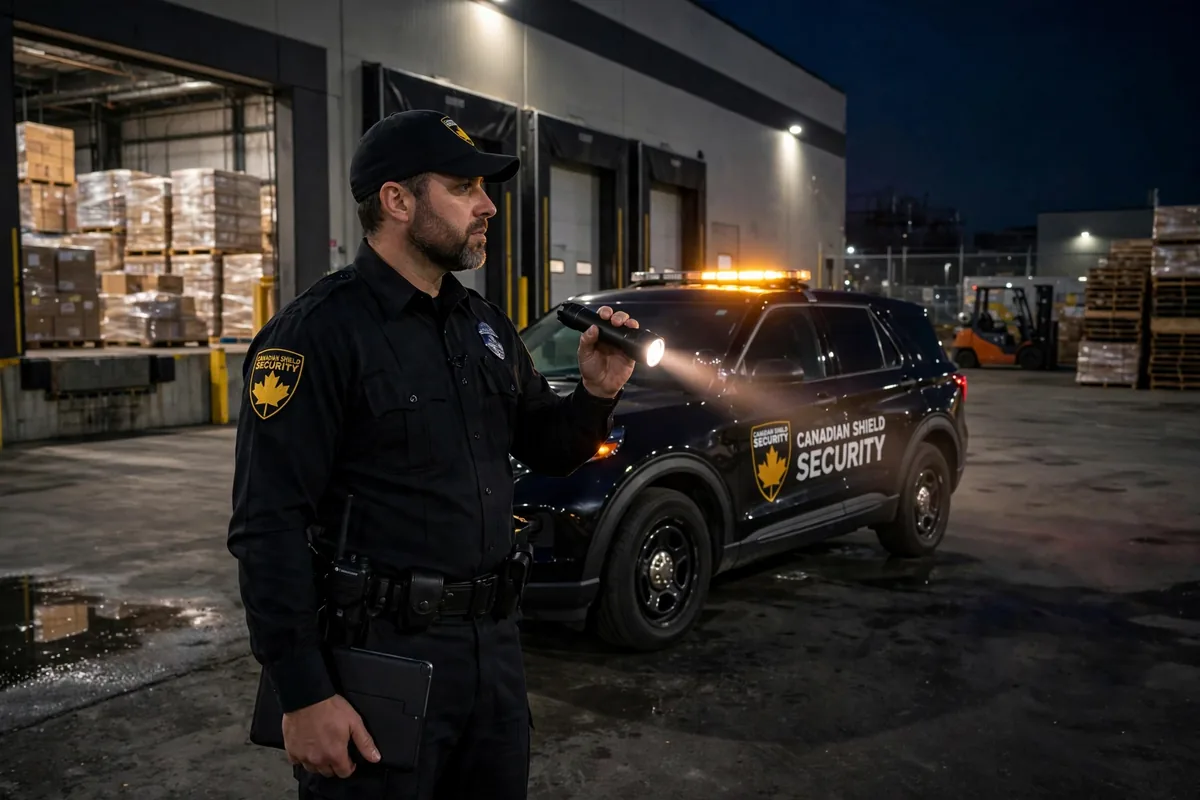
A warehouse manager at a distribution centre in Nisku Industrial Park, T9E, called for help after a weekend break-in left two loading bay doors forced open and several pallets of high-value inventory missing. The site had cameras, but no one was watching the feed at 2 a.m. Within weeks of working with Canadian Shield Security, the facility added randomized mobile patrols and monitored CCTV, and after-hours incidents dropped to zero. That outcome is the standard every warehouse operator in Edmonton and Nisku should demand from a security plan.
Warehouses across Edmonton, Nisku and Acheson face a specific threat profile. Large yards, multiple dock doors, high-value stock and long quiet hours make distribution centres attractive targets for organized theft rings and opportunistic break-ins. Cargo theft rarely looks like a smash-and-grab; it looks like a fake pickup with forged paperwork, or a cut fence discovered on Monday morning.
This guide explains what warehouse crime looks like in the Edmonton region right now, why industrial parks along the QEII corridor are targeted, how mobile patrol compares with on-site guards, which technology actually protects inventory, and what Alberta compliance rules apply. It closes with clear next steps for warehouse managers ready to act.
What Warehouse Crime Looks Like in Edmonton and Nisku Right Now
Warehouse crime in the Edmonton region mostly means inventory shrinkage that is discovered late, not dramatic robberies. Missing pallets found during cycle counts, cut perimeter fencing, forced dock doors and staged pickups by people with no legitimate order are the common patterns. Internal theft is part of the picture too, which is why access control matters as much as perimeter fencing.
The QEII corridor between Edmonton, Nisku and Leduc concentrates an enormous amount of warehousing in a small area. Nisku Industrial Park alone hosts hundreds of industrial tenants, and that density gives theft rings many targets within a short drive. A crew can probe several yards in one night, looking for the site with the weakest lighting and the slowest response.
After-hours timing is the other constant. Most incidents happen between 10 p.m. and 5 a.m., when sites are empty and neighbouring businesses are dark. Facilities that rely on cameras alone learn the hard way that recorded footage helps police after the fact but does nothing to interrupt a theft in progress.
Cargo value raises the stakes. Electronics, pharmaceuticals, auto parts and construction materials stored in Edmonton-area warehouses carry high resale value and are easy to move. A single successful night can cost a distributor more than a full year of professional warehouse security coverage.
Why Nisku Industrial Park and Acheson Warehouses Are Targeted
Nisku Industrial Park grew up around oil and gas servicing, and its yards were designed for equipment access, not security. Wide gates for oversized loads, multiple entry points and sprawling outdoor storage create more ground to cover than a typical urban warehouse. Many sites expanded faster than their security plans.
Acheson presents a similar profile on Edmonton's west side. Large-format distribution centres sit beside open land, and the distance between neighbouring properties means a break-in can go unnoticed for hours. Winter makes it worse: long nights, fewer people around, and snow that muffles sound. Operators across the Nisku and Edmonton industrial corridor face the same arithmetic of risk.
Proximity to major highways cuts both ways. The QEII, Anthony Henday and Highway 60 move freight efficiently, but they also give thieves fast escape routes in every direction. A stolen trailer can be on the QEII within minutes of leaving a Nisku yard.
What separates targeted sites from safe ones is rarely luck. Facilities with marked patrol vehicles, lit perimeters and visible access control get passed over. Theft rings probe first and strike where resistance looks lowest, which means deterrence is a genuine protective layer, not decoration.
Warehouse security in Edmonton and Nisku works best as a layered system: SSIA-licensed guards or randomized mobile patrols for visible deterrence, monitored CCTV and alarms for detection, and access control with inventory audits to close internal gaps. Canadian Shield Security designs custom warehouse plans after a free site consultation. Call 1 (800) 326-7879 to protect your inventory.
Mobile Patrol vs On-Site Guards for Warehouse Protection

Mobile patrol and on-site guards solve different warehouse problems, and the right choice depends on site size, inventory value and hours of risk. Many Edmonton-area operators use both, with patrols covering nights and weekends and a guard posted during high-activity receiving hours.
Mobile patrol suits multi-building sites and large yards. A marked, GPS-tracked vehicle makes randomized visits through the night, checks dock doors and fence lines, and responds to alarms. One mobile patrol route can cover several properties, which keeps hourly costs down for operators with more than one facility.
An on-site guard fits high-value inventory and 24/7 operations. A uniformed officer at the gatehouse or dock office controls who enters, verifies pickup paperwork against real orders, and works from post orders written for the site. That human checkpoint stops the forged-pickup scam that cameras alone cannot catch.
Cost and coverage usually decide the mix. A warehouse manager juggling a Nisku distribution centre and an Acheson overflow yard often finds that nightly mobile patrol plus a guard during receiving hours delivers better protection per dollar than either option alone.
| Attribute | Mobile Patrol | On-Site Guard |
|---|---|---|
| Primary role | Randomized night checks across yards and dock areas | Fixed post at gate, dock office or control room |
| Typical hourly cost | $28-$40/hour per route | $24-$32/hour |
| Best for | Multi-building sites, after-hours coverage | High-value stock, 24/7 access control |
| SSIA licence required | Yes | Yes |
| Reporting | GPS-tracked patrol logs and digital incident reports | Post orders and shift incident logs |
Mobile Patrol vs On-Site Guard for Warehouses
Quick win: verify every pickup against a live order list at the dock door. Forged paperwork is the most common way inventory walks out of Edmonton-area warehouses during business hours, and a simple verification step stops it cold.
CCTV, Access Control and Inventory Protection Technology

Cameras work when someone is watching. Monitored CCTV paired with a patrol response closes the gap that recorded-only systems leave open: an operator sees the fence cut at 1 a.m. and dispatches a patrol car immediately, instead of the manager discovering it on Monday. Unmonitored footage is evidence, not protection.
Access control does the quiet work of inventory protection. Key fobs or codes tied to individual staff, time-restricted dock door schedules and visitor logs create an audit trail for every entry. When shrinkage appears, the log shows exactly who was in the building and when, which shortens investigations dramatically.
Alarm systems need warehouse-specific design. Motion sensors must account for forklift traffic and racking layouts, and dock doors need contacts that distinguish a scheduled receiving window from an after-hours breach. A generic alarm on a 100,000-square-foot facility generates false alarms until staff start ignoring it.
Inventory audits are a security control, not just an accounting task. Regular cycle counts catch shrinkage early, while the trail is still warm. Pairing audit schedules with CCTV monitoring and patrol reports often reveals patterns, such as losses clustering on nights with no coverage, that point straight at the fix.
WHMIS, SSIA and Compliance: What Warehouse Managers Must Know
Under the Security Services and Investigators Act (Alberta), every guard patrolling or stationed at an Edmonton or Nisku warehouse must hold a valid SSIA licence. Licensing requires accredited training, a provincial exam and a police information check. Hiring unlicensed guards exposes the operator to liability and voids the deterrent value of the uniform.
WHMIS intersects with warehouse security more than most managers expect. Guards posted at chemical or industrial storage sites need to understand hazardous material signage and emergency procedures for the products on site. A guard who cannot read a WHMIS label cannot respond safely to a spill or fire involving stored goods.
You can verify licensing requirements directly through the Government of Alberta's Security Programs department at alberta.ca. Reputable firms provide licence numbers on request and never hesitate when asked. If a provider cannot produce licensing documentation, that is a reason to walk away.
For an active break-in or theft in progress, call 911 and Edmonton Police Service first. Security guards document, deter and de-escalate, but they do not replace police authority during a criminal incident.
When to Call a Professional Warehouse Security Company in Edmonton and Nisku
Call a professional firm once shrinkage becomes a pattern rather than a one-off, when insurance asks about mitigation measures, or when a new high-value contract raises the stakes. Waiting until after a major loss means paying for the incident and the fix.
A reputable company starts with a free site consultation, not a quote. Expect a licensed supervisor to walk the perimeter, review dock procedures, check lighting and camera coverage, and ask about inventory value and loss history. The proposal that follows should name guard hours, patrol frequency and cost with no hidden fees.
Canadian Shield Security works with warehouse operators across Edmonton, Nisku and Acheson, from single distribution centres to multi-yard logistics operations. Every engagement starts with a free consultation and a written plan built around the site. Operators comparing options should also review how commercial property protection programs are structured. Call 1 (800) 326-7879 to schedule a walkthrough.
Keeping Warehouse Inventory Safe Long-Term: Ongoing Protection
Warehouse security works best as a standing routine, not a reaction to the last incident. Quarterly reviews of patrol reports, audit results and incident logs reveal whether the plan still matches the risk. Sites change: new tenants in the industrial park, different inventory mix, extended receiving hours.
Edmonton winters add a layer most operators underestimate. At -40C, patrol vehicles need block heaters, gate mechanisms freeze, and camera housings ice over. A winter-ready security plan confirms equipment function in January, not just in the October proposal. Detailed patrol reporting is what makes these seasonal adjustments visible.
Rotating patrol timing keeps coverage unpredictable. A patrol that arrives at 1:15 a.m. every night will eventually be noticed; randomized windows within agreed coverage hours preserve the deterrent. Monthly incident reviews with the security provider keep both sides aligned on what is working.
Conclusion
Warehouse security in Edmonton and Nisku comes down to layers: licensed people, smart technology and disciplined procedures, each covering the gaps the others leave. No single measure, from cameras to fences, protects inventory on its own. Facilities that combine commercial building security planning with active patrols see the best results.
The operators who lose the least inventory treat security as an operating cost with a measurable return, not an afterthought. Start with a free site consultation, build the plan around the actual site, and review it as the business changes.
Canadian Shield Security protects warehouses across Edmonton, Nisku and Acheson with SSIA-licensed guards, mobile patrols and monitored CCTV. Call 1 (800) 326-7879 for a free consultation and a written protection plan.
Frequently Asked Questions
Are warehouse security guards in Edmonton and Nisku required to be licensed?
Yes. Under the Security Services and Investigators Act (Alberta), every guard working at a warehouse in Edmonton, Nisku or Acheson must hold a valid SSIA licence. Licensing requires accredited training, a provincial exam and a police information check. Always ask a security company for licence documentation before signing, since unlicensed guards create liability for the warehouse operator.
How much does warehouse security cost in Edmonton?
Mobile patrol for an Edmonton or Nisku warehouse typically runs $28 to $40 per hour per route, depending on visit frequency and site size. A dedicated on-site guard generally costs $24 to $32 per hour. Most operators combine both, and every site receives a written quote after a free consultation, so exact pricing reflects the facility's real risk profile.
Does Canadian Shield Security cover warehouses in Nisku and Acheson?
Yes. Canadian Shield Security serves warehouses across Edmonton and surrounding industrial areas, including Nisku Industrial Park, Acheson, Leduc and Sherwood Park. Mobile patrol routes already cover the QEII corridor, and on-site guard teams deploy to distribution centres throughout the region. Contact us to confirm coverage for a specific facility address.
What is the difference between mobile patrol and an on-site guard for a warehouse?
Mobile patrol uses a marked, GPS-tracked vehicle making randomized visits, which suits large yards and after-hours coverage across multiple buildings. An on-site guard stays posted at a gate or dock office around the clock, controlling access and verifying pickups. Many Edmonton warehouses use patrols at night and a guard during receiving hours.
Can CCTV alone protect warehouse inventory in Edmonton?
CCTV alone rarely protects inventory because recorded footage only helps after a theft, unless someone watches the feed live. Monitored CCTV paired with a patrol response works far better: an operator spots the breach and dispatches a guard immediately. Cameras should be one layer alongside access control, patrols and inventory audits.
Canadian Shield Security Editorial Team | Edmonton, Alberta
