
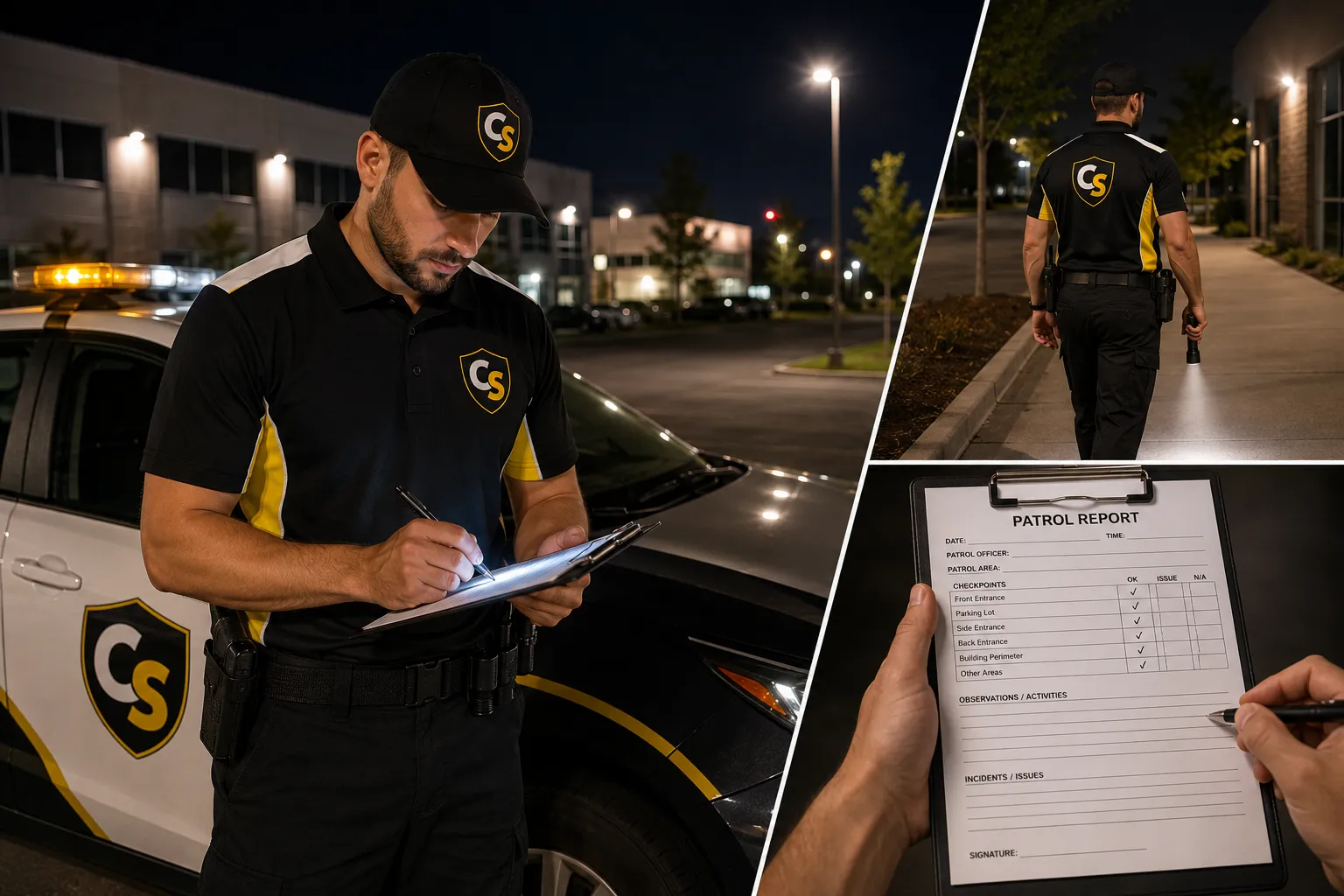
A condo board chair in Edmonton's Mill Woods neighbourhood (T6K) approved a mobile patrol contract, then went four months without seeing a single report. When a resident's vehicle was broken into in the parkade, the board had no record of whether the patrol had actually run that night. Canadian Shield Security took over the contract and started delivering a timestamped digital report after every visit.
A security patrol report Edmonton properties should receive is a written or digital record confirming a patrol happened, when, and what the guard found. It is proof the mobile patrol service you are paying for is actually being delivered, not just a courtesy update.
This guide covers what a patrol report should include, how often you should actually receive one, and how to spot a security company that treats reporting as optional.
|
A security patrol report Edmonton properties receive is a timestamped record of each patrol visit, listing checkpoint times, the status of doors and gates, and any issues found. Most properties should receive a report after every visit, with high-risk sites like construction yards getting same-night delivery rather than a weekly summary. |
What Is a Security Patrol Report?
A patrol report is the documented proof that a scheduled security patrol actually took place, recording exactly when a guard arrived, what they checked, and what they observed at each stop on the route.
Without a report, a patrol contract runs on trust alone. Property managers have no way to confirm a guard walked the full route, checked every door, or noticed a problem before it became a claim.
A report also protects the security company. A timestamped record showing a door was locked and secure at a specific time is the clearest evidence available if a liability question comes up weeks after the fact.
For condo boards specifically, a reliable report trail also supports budget conversations. Showing a pattern of recurring issues at the same checkpoint makes it far easier to justify a capital repair than a vague sense that something feels unsafe.
A missing report also complicates renewal conversations. Without a documented history, a property manager has no easy way to compare this year's incident pattern against last year's, or to show a board or ownership group that the security spend is working.
What Should Be Included in Every Report
A complete security patrol report lists the property name, patrol date and time, checkpoint arrival times, the status of each door, gate and light checked, and any anomaly found along the route.
The table below breaks down the core fields a property manager should expect on every report.
|
Report Field |
What It Confirms |
|
Property name and date |
Which site was patrolled and when |
|
Checkpoint arrival times |
The guard's exact route timing |
|
Door, gate and light status |
Physical verification results at each stop |
|
Anomalies found |
Issues needing maintenance or follow-up |
|
Photos |
Visual proof of any flagged issue |
Photos matter as much as the written notes. A photo of a propped door or a burnt-out light fixture confirms the issue far faster than a written description, and gives maintenance staff exactly what they need to act.
This is distinct from a guard's internal daily activity report, which covers an entire shift. A patrol report is scoped to one route, one round, and is meant for the client, not just the guard's supervisor.
Property managers overseeing multiple Edmonton sites, from a T5J office tower to a Mill Woods residential complex, should expect the same report format across every property, so reviewing five reports takes minutes, not an hour of decoding different templates.
Some Edmonton providers still rely on handwritten logs passed along at the end of a shift. These are harder to search, easy to lose, and nearly impossible to produce quickly if an insurer or lawyer requests a specific date months later.
How Often Should You Receive One in Edmonton
Most Edmonton commercial properties should receive a patrol report after every single visit, not batched into a weekly summary that arrives after the fact.
High-risk sites, including active construction yards near Nisku and Acheson, warrant same-night delivery so a broken lock or missing equipment gets addressed before the next shift starts, rather than sitting in an inbox until Monday.
Lower-risk properties, like a stable Downtown Edmonton office tower with consistent tenants, may reasonably receive a rolled-up weekly summary alongside individual visit confirmations, as long as each visit is still logged the night it happens.
Condo boards should request monthly report summaries for board meetings, in addition to the same-visit reports property management reviews, so volunteer board members are not digging through months of raw logs before a vote.
Seasonal properties, or those with fluctuating tenancy, should revisit their reporting frequency every time a security risk assessment is updated, since a route or risk profile change usually means the reporting cadence needs to change too.
Industrial and construction clients near the Nisku Industrial Park often request an additional same-shift text or call for any anomaly, on top of the standard digital report, given how quickly equipment theft can escalate once a gap is found.
Why Digital, GPS-Timestamped Reports Matter
Digital, GPS-timestamped reports solve the biggest weakness of paper logs: verification. A written note claiming a guard was on-site proves nothing on its own, while a GPS-stamped checkpoint scan confirms exactly where and when.
Under the Security Services and Investigators Act (Alberta), licensed guards are expected to maintain accurate records of their duties. Digital reporting makes that standard easy to meet and easy for a property manager to audit at any time.
Digital reports also survive longer than paper. Insurance providers reviewing six months of patrol history after a claim need records that are still legible and complete, something a stack of handwritten logs rarely delivers intact.

GPS-stamped reports also remove a common dispute entirely: whether a guard patrolled the far side of a large property or a satellite building. The scan record settles the question without relying on anyone's memory of the shift.
For multi-tenant commercial buildings, digital reports also make it simple to share relevant excerpts with a specific tenant after an incident in their leased space, without handing over the full report for the entire property.
Red Flags in Your Provider's Reporting
The clearest warning sign in any patrol contract is silence. If a security company cannot produce a report from a specific visit within a day of the request, assume the patrol may not have happened as billed.
Vague reports are the second red flag. Entries like 'all clear, no issues' with no checkpoint times or photos give a property manager nothing to verify and nothing useful if an incident is later disputed.
A reporting gap after a known incident, such as a break-in with no corresponding patrol log from that night, should prompt an immediate conversation with the provider and, if unresolved, a review of the contract.

A provider unwilling to share sample reports or explain their reporting technology before signing a contract is unlikely to become more transparent after the ink dries. Treat that reluctance as a decision point, not a minor inconvenience.
None of this means a single missing report is proof of fraud. Equipment fails, staff change, and a one-time gap deserves a direct question before it becomes a reason to end a contract. A pattern of gaps is a different matter entirely.
How to Request Better Patrol Reporting
Ask any prospective security provider for a sample patrol report before signing a contract. A vague or generic sample is a strong signal that reporting will be an afterthought once the contract is in place.
Put reporting frequency and format directly into the contract or post orders, not just a verbal agreement. Specifying same-night digital delivery in writing gives a property manager a concrete standard to hold the provider to.
Review a sample month of reports quarterly, even if nothing has gone wrong. Consistent, detailed reporting during a quiet month is usually a good predictor of how a provider will perform during an actual incident.
Canadian Shield Security includes reporting cadence directly in the post orders drafted for every Edmonton client during onboarding, so the expectation is documented from day one rather than negotiated after a gap is noticed.
For existing contracts, a mid-term reporting review costs nothing and takes one phone call. Most reputable Edmonton providers will adjust format or frequency on request rather than risk losing the account over a fixable process gap.
Conclusion
A security patrol report is not paperwork for its own sake. It is the evidence that a patrol happened, what the guard found, and whether your property's checkpoints are actually being verified night after night.
Canadian Shield Security delivers digital, timestamped patrol reports after every visit for Edmonton properties, with no hidden fees and a free consultation to set the reporting frequency your property actually needs.
If your current provider cannot answer a simple question, such as when the last patrol occurred, that gap alone is worth a conversation before the next contract renewal comes up.
|
Canadian Shield Security serves Edmonton 24/7. Free consultation, no hidden fees. Call 1 (800) 326-7879. |
Frequently Asked Questions
Are the guards filing my patrol reports required to be licensed?
Yes. Every Canadian Shield Security guard filing a patrol report holds a valid licence under the Security Services and Investigators Act (Alberta). A licensed guard's signature or badge ID on a report is what makes it a reliable, admissible record for insurance, liability or lease disputes, not just a casual note about the shift.
Does a patrol report cost extra on top of the patrol service?
A patrol report is included in the cost of your mobile patrol or on-site guard service, typically $35 to $60 per patrol visit or $28 to $45 per hour for on-site coverage, rather than billed as a separate add-on. Canadian Shield Security offers a free consultation to scope reporting frequency into your quote.
Does Canadian Shield Security deliver reports for Sherwood Park and Nisku properties?
Yes. Canadian Shield Security delivers patrol reports for properties across Edmonton, including Downtown (T5J), Mill Woods (T6K) and Whyte Avenue (T6E), plus Sherwood Park, St. Albert, Leduc and Nisku. Reports are timestamped and generated the same way regardless of which Edmonton area your property is in.
How often should a property manager receive a patrol report?
Most Edmonton commercial properties should receive a patrol report after every visit, with a summary rolled up weekly or monthly for easier review. High-risk sites, like active construction yards, often warrant same-night delivery so issues get addressed before the next shift, rather than waiting for a weekly digest.
What information should be on every security patrol report?
A complete patrol report lists checkpoint times, the status of each door and gate checked, lighting or camera issues, and photos of anything unusual. Canadian Shield Security delivers these digitally through GPS-tracked dispatch software, so property managers can review each report the same night the patrol happened.
