
A facilities manager overseeing a 22-storey office tower in Downtown Edmonton's T5J core noticed on lobby camera footage that visitors were tailgating behind badged employees through the main turnstile an average of six times a day. Adding a staffed concierge desk during peak morning hours cut that number to less than one incident daily within a month, without requiring any change to the building's existing fob system.
Office building security in Edmonton is rarely one single decision. It combines access control hardware, guard staffing choices such as our office building security services, visitor policy, and building design, and most facilities managers only discover the gaps in that layering after an incident, not before.
This guide walks through what actually belongs in an Edmonton office building's security plan, from CPTED design principles to the SSIA licensing that applies to any guard or concierge working your lobby.
|
Office building security in Edmonton combines access control, staffed or unstaffed lobby coverage, visitor management, and after-hours patrol. Effective buildings apply CPTED principles like clear sightlines and controlled entry points alongside licensed guards. Multi-tenant towers also need PIPA-compliant visitor logs and close coordination between property management and each individual tenant's own security needs. |
What Does Office Building Security Actually Include in Edmonton?
Office building security covers four connected layers: physical access control at entry points, staffing decisions for the lobby and after-hours coverage, visitor and contractor management, and the building's underlying design and sightlines. A gap in any one layer tends to show up as a weakness in the others.
For a Downtown T5J tower or a T6H commercial corridor building, this usually means fob or key card access at exterior doors, a decision on whether the lobby is staffed during business hours, a visitor sign-in process, and clear coordination between property management and individual tenants who may want additional floor-level security.
Facilities managers new to the role often assume upgrading the access control hardware solves most problems. In practice, the buildings with the fewest incidents usually have unremarkable hardware paired with clear post orders, consistent visitor policy, and a lobby presence that actually pays attention, not the newest fob system on the market.
Insurance and lease agreements sometimes specify minimum security standards that a facilities manager inherits without ever seeing the original negotiation. Reviewing these requirements early avoids the awkward discovery that a building falls short of its own insurance policy's baseline expectations.
|
Multi-tenant buildings often assume security is entirely the landlord's responsibility. In practice, tenant-specific risks, such as a law firm handling sensitive documents, usually need additional measures beyond the building's baseline coverage. |
How CPTED Principles Apply to Office Lobbies and Entrances
Crime Prevention Through Environmental Design, or CPTED, uses building layout and lighting rather than hardware alone to make unauthorized access harder and more visible. Edmonton Police Service runs CPTED training courses and works directly with property managers and architects on applying these principles to local buildings.
For an office lobby, CPTED means clear sightlines from the reception desk to all entry points, well-lit parkade entrances, and landscaping that does not create hiding spots near loading docks or side doors. None of this replaces a guard or access control system, it makes both more effective by removing the blind spots where problems tend to start.
Territorial reinforcement, one of the core CPTED principles, applies directly to shared office towers. Clear signage distinguishing public lobby space from tenant-only floors, combined with a staffed or clearly monitored transition point between the two, signals to both legitimate visitors and potential intruders exactly where oversight begins.
Access Control Systems for Edmonton Office Towers
Most Edmonton office towers use fob or key card systems at exterior doors and elevator banks, sometimes paired with a PIN pad for after-hours entry. Higher-security floors, such as those housing legal, financial, or healthcare tenants, increasingly add biometric or two-factor access on top of the base building system.
Access control is only as strong as its weakest common door. A fob system on the main entrance means little if a loading dock or stairwell door is regularly propped open by staff on a smoke break, which is one of the most common access control failures facilities managers discover during a security review.
Elevator restriction adds another layer worth reviewing separately from door access. Programming elevators so a fob only calls the car to a tenant's specific floor, rather than allowing access to every floor in the building, closes a gap that a lobby-only access control review often misses entirely.
Office Building Access Control Options Compared
|
Method |
Best For |
Limitation |
|
Fob or key card |
Base building entry, elevator restriction |
Can be shared, lost, or cloned |
|
PIN pad |
After-hours or secondary entry points |
Codes get shared informally over time |
|
Biometric or two-factor |
High-security tenant floors |
Higher cost, slower throughput at peak hours |
|
Staffed reception or concierge |
Lobby-level visitor screening |
Only covers hours the desk is staffed |
Should Your Building Have an On-Site Guard or Concierge?
A staffed lobby adds a layer no access control system replicates: judgment. A concierge or on-site guard can question someone who tailgated through the door, notice a visitor heading toward a restricted floor, and respond to a medical or safety issue in the lobby immediately rather than after camera review.
Every guard or concierge working an Edmonton office lobby, regardless of the job title used, must hold a valid licence under the Security Services and Investigators Act (Alberta). Canadian Shield Security confirms this licensing and runs background checks before assigning anyone to a building lobby.
The decision between a full-time staffed lobby and a lighter-touch model usually comes down to tenant mix and foot traffic rather than building size alone. A 15-storey building with a single anchor tenant may need less lobby presence than an 8-storey building with dozens of small tenants and constant visitor turnover.
|
Buildings with lower foot traffic sometimes pair a part-time staffed desk during business hours with mobile patrol checks after hours, rather than paying for full-time 24/7 lobby coverage they do not need. |
Visitor Management and Tailgating Prevention
A visitor sign-in process, whether paper-based or digital, creates a record of who entered the building and when. Under Alberta's Personal Information Protection Act, this visitor data counts as personal information and should be collected only for the stated security purpose and retained no longer than necessary.
Tailgating, where an unauthorized person follows a badged employee through a door without swiping their own credential, is one of the hardest access control failures to eliminate through hardware alone. Turnstiles that only release for one person per badge swipe help, but a staffed lobby that visibly greets everyone entering remains the most effective deterrent.
Contractor and delivery access deserves its own policy separate from general visitor sign-in. A recurring contractor working in the building for weeks needs a different check-in process than a one-time courier delivery, and treating both identically usually means one of the two groups gets either too much friction or too little oversight.
|
Visitor logs collected under PIPA should have a clear retention schedule. Keeping years of visitor data with no defined deletion point creates unnecessary privacy exposure for the building. |
After-Hours and Parking Garage Security
Office towers empty out predictably every evening, which makes after-hours coverage a different problem than daytime lobby security. Mobile patrol checks, motion-triggered lighting, and restricted after-hours elevator access all address the specific risk of an unstaffed building overnight.
Underground and attached parking garages deserve separate attention from the lobby itself. Edmonton winters make garage entrances a common point where doors get propped open to avoid repeated fob swipes in the cold, quietly defeating the building's access control for the sake of convenience.
A mobile patrol check that walks the full parking structure, not just the pedestrian entrance, catches propped doors and burnt-out lighting that a stationary camera angle often misses. This is typically the single most cost-effective addition a building can make to after-hours coverage.
How Canadian Shield Security Supports Edmonton Office Buildings
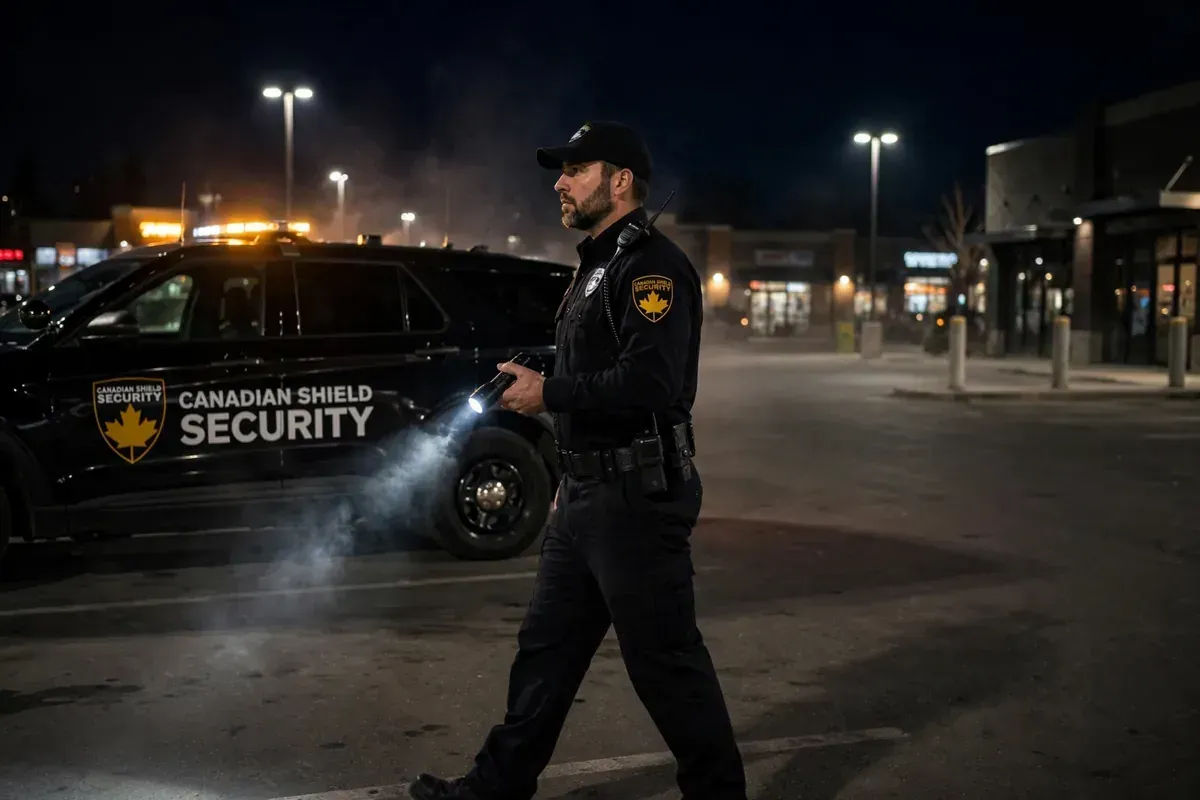
Canadian Shield Security provides licensed on-site guards, concierge-style lobby coverage, and after-hours mobile patrol for office towers across Downtown T5J, T6H commercial corridors, and greater Edmonton. Every guard is SSIA-licensed and background checked before deployment.
A free consultation and site assessment reviews your building's current access control, lobby staffing, and visitor process against CPTED principles, then identifies the specific gaps worth closing first rather than recommending a blanket upgrade to everything at once.
This same review approach applies whether the building is a single-tenant Downtown tower or a multi-tenant T6H commercial property with a dozen different businesses and a dozen different opinions about what security should look like.
Conclusion
Office building security in Edmonton works best as a layered system, not a single purchase. Access control, CPTED-informed design, visitor management, and the right staffing decision for your building's traffic all reinforce each other, and a weakness in one usually shows up as a failure in another.
Most facilities managers only map out these layers after an incident forces the question, at which point the fix costs more and the tenant confidence damage is already done. Call 1 (800) 326-7879 for a free consultation to review your Edmonton office building's security before that happens.
|
Canadian Shield Security serves Edmonton 24/7. Free consultation, no hidden fees. Call 1 (800) 326-7879. |
Frequently Asked Questions
Do concierge or lobby ambassadors need to be SSIA licensed in Alberta?
Yes. Any lobby ambassador, concierge, or on-site guard working in your Edmonton office tower must hold a valid licence under the Security Services and Investigators Act (Alberta). Canadian Shield Security confirms SSIA licensing and background checks for every guard before deployment, regardless of whether the role is called concierge, ambassador, or security officer.
How much does office building security cost in Edmonton?
On-site office building security in Edmonton typically runs $18 to $28 per hour for an unarmed, licensed guard, depending on shift coverage and lobby traffic. A free consultation and site assessment gives an exact quote based on your building's tenant count, hours, and existing access control systems.
Does Canadian Shield Security provide office building security in Sherwood Park and St. Albert?
Yes. Canadian Shield Security provides office building security across Downtown T5J towers, T6H commercial corridors, Sherwood Park, St. Albert, and greater Edmonton. Coverage runs 24/7, including after-hours and weekend patrol for buildings that do not need a full-time staffed lobby. Call 1 (800) 326-7879 to discuss your building's specific hours.
What is CPTED and how does it apply to office buildings?
CPTED, or Crime Prevention Through Environmental Design, uses lighting, sightlines, and layout to make unauthorized access harder and more visible rather than relying only on locks and guards. Edmonton Police Service runs CPTED training and reviews building designs, and many Downtown Edmonton towers already apply these principles at the lobby and parkade level.
How do you stop tailgating at office building entrances?
Tailgating happens when an unauthorized person follows an authorized employee through a badged door without swiping their own credential. Staffed lobbies, turnstiles that only allow one person per badge swipe, and visitor sign-in policies all reduce tailgating, though no single measure eliminates it completely on a busy floor.
