
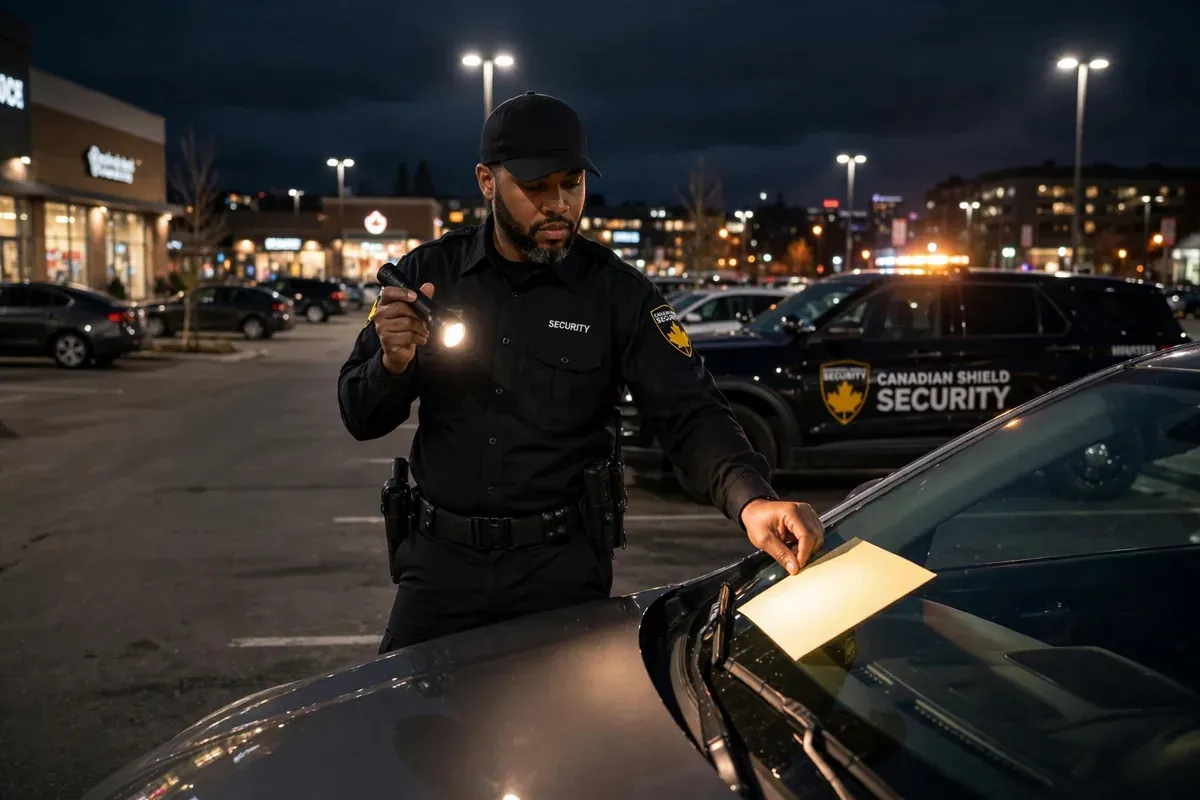
A retail plaza owner near South Edmonton (T6H) called three security companies asking one simple question: how fast can you actually get here? Two gave vague answers like "as soon as possible." Canadian Shield Security's mobile patrol team gave her an exact number based on the nearest patrol vehicle's live location, and beat that estimate by four minutes the first time her alarm actually triggered.
That gap between a vague promise and a real, specific number is exactly what most Edmonton business owners run into when comparing security companies side by side. Response time is the one factor that actually determines whether a guard arrives while something is still happening, or shows up only after it is already over.
This guide breaks down what actually determines how fast a guard reaches you, real Edmonton response figures by district, how the technology behind dispatch works, and how to get faster coverage for your specific property.
|
FEATURED SNIPPET -- DIRECT ANSWER A licensed security guard typically reaches a property in Edmonton within 15-30 minutes for mobile patrol dispatch, or 30-60 minutes for a full on-site guard deployment. Actual response time depends on your location, current call volume, and time of day. GPS dispatch routes the closest available officer to cut that time down further. |
Response Time Is the Number One Thing Edmonton Business Owners Compare
When business owners compare security companies side by side, response time comes up more than price, more than guard headcount, and more than years in business. It is the one number that predicts whether a security service actually helps during an incident or just documents it afterward.
The problem is that most companies answer the question with marketing language instead of a number. Phrases like "rapid response" or "as quickly as possible" sound reassuring, but they tell you nothing you can actually compare between providers or plan around.
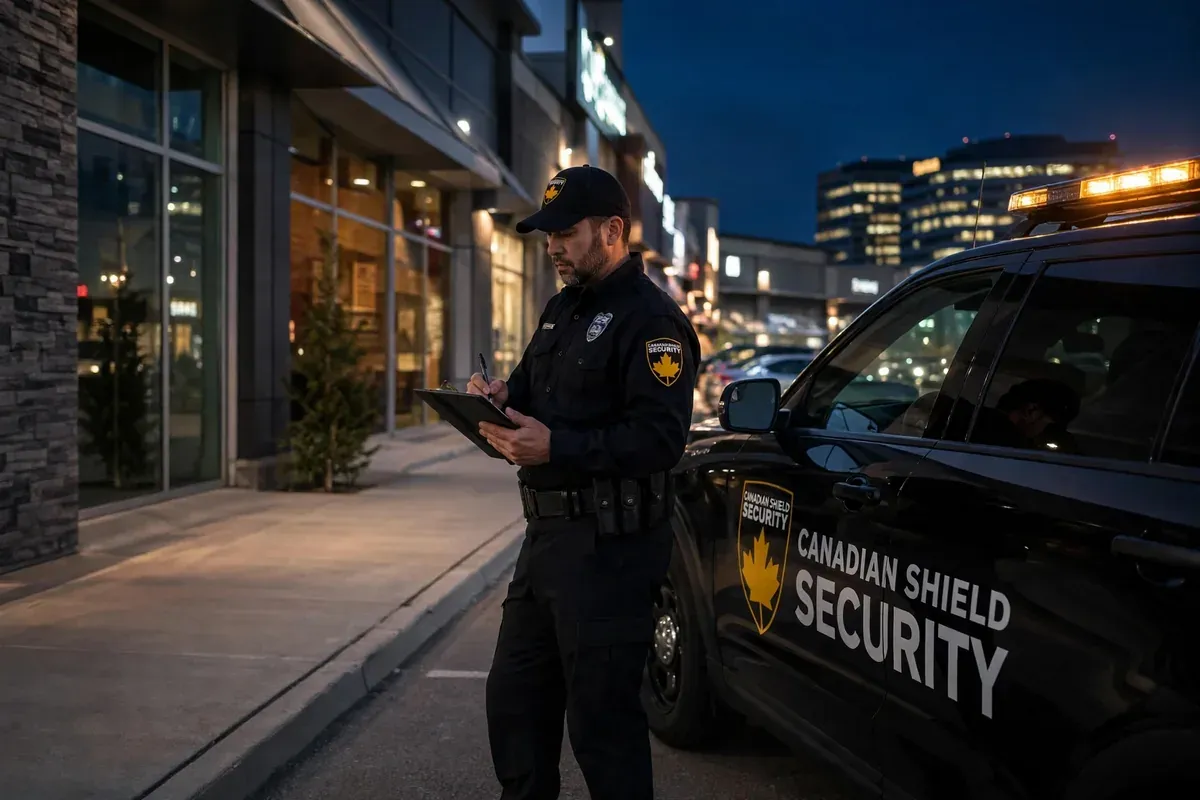
A real response time is measurable: minutes from the moment a call or alarm comes in to the moment a licensed officer is physically on your property. That number changes based on where you are and how coverage is structured, but it should always be a number, not a slogan.
This matters most in the moments that actually justify calling security in the first place: an alarm triggering after hours, a trespasser spotted on camera, or a break-in discovered mid-incident rather than the next morning.
A five-minute difference sounds small until it is the five minutes between a guard arriving while a thief is still loading a trailer versus arriving to an empty lot and a broken lock. That is the entire reason response time deserves a real number rather than a reassuring phrase.
What Actually Determines How Fast a Guard Reaches You
Five factors drive response time more than anything else: patrol route density near your property, current call volume across the service area, time of day and traffic, weather, and whether your property is on a scheduled route already or needs a reactive dispatch. Every SSIA-licensed guard responds under the same Security Services and Investigators Act (Alberta) training standard regardless of how fast they arrive, which you can confirm through alberta.ca's security services page.
Properties already on a scheduled patrol route tend to see faster average response, since an officer is already nearby on a regular basis rather than being dispatched cold from a distant base. This is one reason ongoing coverage often outperforms one-off emergency calls on pure speed.
|
AMBER -- WINTER FACTOR Edmonton winters are a real factor too. When temperatures drop toward -40C, road conditions slow every vehicle on the road, including patrol units, which is why response windows widen slightly during the coldest months compared to a clear summer night. |
Location matters more than most people expect. A property in Downtown Edmonton (T5J) sits inside a dense patrol zone with multiple routes nearby, while a site near Nisku Industrial Park (T9E) may have fewer vehicles covering a wider area, which naturally extends the average response window.
None of these factors are fixed forever. A provider that adds vehicles to a growing area, or a client who moves onto a scheduled route instead of relying on reactive calls, can meaningfully change their own expected response time without changing anything about their actual location.
How GPS Dispatch Cuts Response Time in Real Time
GPS dispatch tracks every patrol vehicle's live location on a digital map rather than assuming where a unit "should" be based on a fixed schedule. When a call comes in, the system identifies the closest available officer instantly and redirects them, instead of a dispatcher manually guessing or calling around.
This matters because a scheduled route is never perfectly predictable. An officer might be finishing a check three streets from your property, or forty minutes away on the other side of the same patrol zone, and only GPS dispatch actually knows which one is true at that moment.
Geofencing adds another layer. Some properties set up alerts that trigger automatically if a patrol vehicle enters or leaves a zone at an unexpected time, giving both the client and dispatch an extra layer of verification on top of the response itself.
|
GREEN -- KEY INSIGHT None of this replaces a licensed, trained officer. It just makes sure the closest one gets sent, rather than whichever one happens to be easiest to reach by radio. |
Clients occasionally ask whether GPS dispatch means a computer is making the decision instead of a person. It does not. The system surfaces the closest available officer, but a human dispatcher still confirms the assignment and communicates directly with that officer before and during the response.
Average Security Response Times by Edmonton District
Response time varies by district based on patrol density and typical call volume. The table below reflects typical Canadian Shield Security response windows across the Edmonton area.
These are averages built from real dispatch history, not theoretical best-case numbers. A specific call can beat these windows when a patrol vehicle happens to be right around the corner, or run slightly longer during an unusually high-volume night across the whole service area.
Average Security Response Times by Edmonton District
|
District |
Typical Mobile Patrol Response |
Typical On-Site Guard Deployment |
|
Downtown Edmonton (T5J) |
15-25 minutes |
30-45 minutes |
|
South Edmonton (T6H) |
15-30 minutes |
30-50 minutes |
|
Mill Woods (T6K) / Whyte Avenue (T6E) |
20-30 minutes |
35-55 minutes |
|
Nisku / Leduc Industrial (T9E) |
25-40 minutes |
40-60 minutes |
These figures assume normal conditions and available coverage. During Edmonton winters, high call-volume periods, or major weather events, add roughly 5-10 minutes to any of the windows above. Properties with construction site security already scheduled on a route typically see faster, more consistent response than these general averages.
Mobile Patrol vs On-Site Guard vs Police: Which Is Fastest?
Mobile patrol is the fastest option for most situations, since a vehicle already circulating nearby can redirect immediately rather than needing to be dispatched from a fixed post. On-site guard deployment takes longer because an officer has to be assigned and travel from wherever they currently are.
Compared to police, Edmonton Police Service response times vary significantly by priority level, and non-emergency calls can wait considerably longer during busy periods, since police resources are allocated by threat level across the entire city rather than a single patrol zone. For situations that do not require police authority, a licensed guard is very often the faster first responder on scene.
|
AMBER -- TRUST / LIMITATION That said, response speed is not a reason to skip 911 in an actual emergency. SSIA-licensed guards observe, document, and secure a scene, but they do not replace police authority for an active crime in progress, no matter how quickly they arrive. |
Think of the two as complementary rather than competing. A fast guard response can secure a scene, deter further loss, and gather evidence in the minutes before police arrive, which often makes the eventual police response more effective rather than replacing the need for it.
For fastest coverage on an already-monitored alarm, pairing alarm response with a scheduled patrol route gives you both a fast reactive option and a consistent proactive presence.
How to Get the Fastest Possible Response for Your Property
The single biggest lever for faster response is putting your property on a scheduled patrol route rather than relying only on reactive, one-off dispatch calls. A route that already passes near your address most nights will almost always beat a cold dispatch sent from across the city during a genuine incident.
Keeping your address, gate codes, and keyholder list current with your provider also matters more than people expect. A free site assessment is the easiest way to confirm your exact address is correctly mapped in the GPS dispatch system, since an outdated or mistyped address adds real minutes to any response.
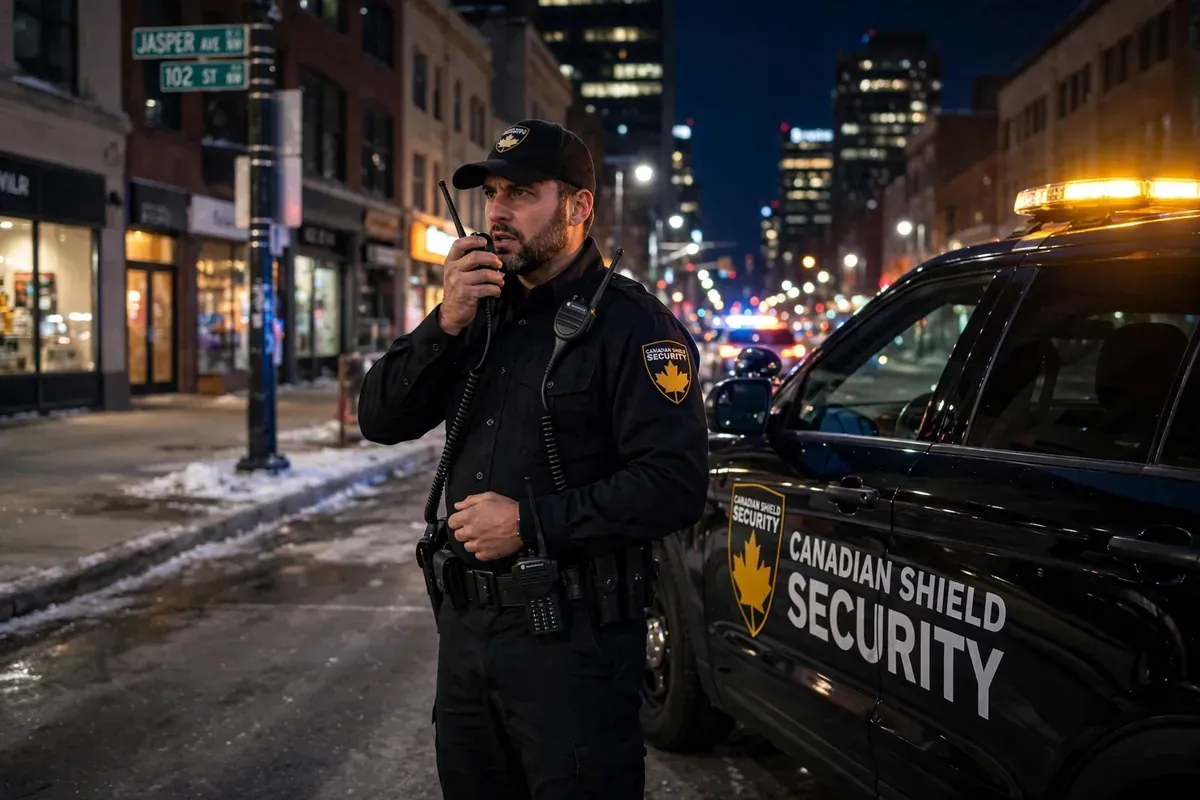
Properties with clear signage, accessible gates, and unobstructed entry points also see faster on-scene times in practice, since an officer who has to search for the right entrance loses minutes that a clearly marked property would not cost them.
Finally, ask any provider you are comparing for a specific number, not a description. A company that can tell you your property's typical response window, and explain why, is showing you they actually track this data rather than guessing at it.
Conclusion
Response time is not a marketing detail, it is the single number that decides whether security actually helps during an incident or simply documents one after the fact. Real numbers, not slogans, are what let you compare providers honestly and plan your coverage around your property's actual risk.
Canadian Shield Security gives every Edmonton property a real, GPS-based response estimate, not a vague promise. Call 1 (800) 326-7879 for a free site assessment and your property's actual expected response time.
|
SOFT CTA Canadian Shield Security serves Edmonton 24/7. Free consultation -- no hidden fees. Call 1 (800) 326-7879. |
Frequently Asked Questions
Are Canadian Shield Security's guards SSIA licensed?
Yes. Every officer Canadian Shield Security dispatches holds a valid licence under the Security Services and Investigators Act (Alberta). Licensing is verified before deployment, and GPS dispatch does not change that standard. Whether you get a 15-minute or 45-minute response, the officer arriving is background-checked and SSIA-licensed every time.
Does faster response cost more in Edmonton?
Not directly. Response time depends more on your property's location relative to our patrol routes and current call volume than on a premium pricing tier. A scheduled patrol route, which already has an officer nearby on a regular basis, often produces faster average response than a one-off dispatch call at the same hourly rate.
Is response time the same in Sherwood Park or Nisku as downtown Edmonton?
Response times stay broadly consistent across Edmonton and nearby communities, though outer areas like Nisku or Sherwood Park can run slightly longer than dense downtown zones. Our GPS dispatch system routes the closest available officer regardless of district, so the gap between downtown and suburban response is smaller than most people expect.
What is the average police response time in Edmonton compared to a security guard?
Edmonton Police Service response times vary widely by priority level, often 10 to 30 minutes or more for non-emergency calls during busy periods. A licensed security guard typically reaches a property in 15-30 minutes for mobile patrol dispatch, making a guard the faster first responder for situations that do not require police authority.
How does GPS dispatch actually reduce response time?
GPS dispatch tracks every patrol vehicle's live location and automatically identifies the closest available officer to your address, rather than dispatching from a fixed base. That officer is redirected in real time, cutting out the delay of a dispatcher manually checking vehicle locations or guessing which unit happens to be nearby.
