
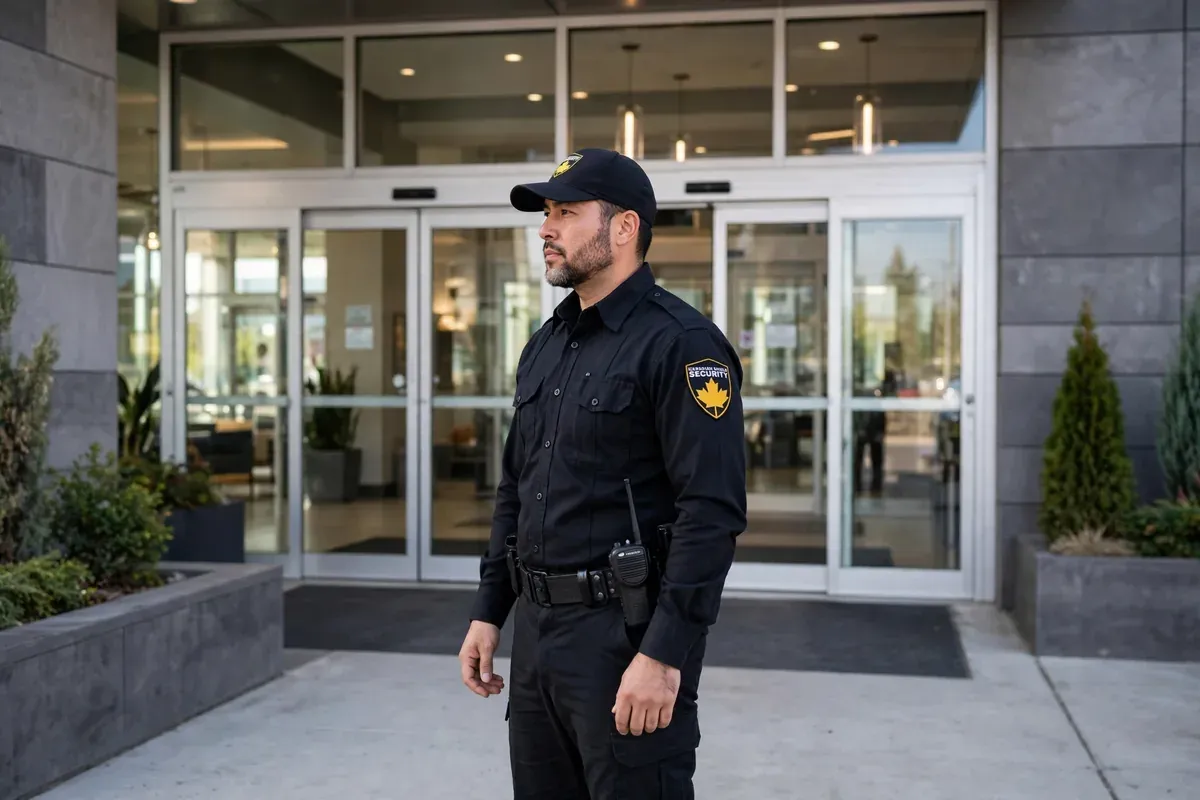
A boutique clothing retailer near West Edmonton Mall lost more than $18,000 in merchandise over a single holiday season before switching to Canadian Shield Security's retail security in Edmonton program. Within two months of adding a uniformed guard and a plainclothes loss prevention officer, incidents dropped by roughly half.
Edmonton now has the highest shoplifting rate per capita among Canada's larger cities, and shoplifting under $5,000 rose 30 percent in 2025 alone. Retail shrinkage nationally has climbed to 1.5 percent of total sales, close to $9 billion a year, according to the Retail Council of Canada. A retail security plan built for Edmonton's risk profile is the fastest way to reverse that trend.
This guide covers what causes shrinkage in Edmonton stores, how uniformed guards and plainclothes loss prevention officers work together, what CPTED store design does for theft prevention, and when it makes sense to call a professional security company.
|
Effective retail security in Edmonton combines SSIA-licensed uniformed guards, plainclothes loss prevention officers, CPTED store layout, and monitored CCTV working together. Uniformed guards deter opportunistic theft at store entrances. Plainclothes officers catch organized retail crime crews before checkout. CPTED design removes blind spots and hiding places. Together, these four layers cut shrinkage without turning an Edmonton store into a lockdown. |
What Is Retail Shrinkage and Why Is It Rising in Edmonton Stores?
Retail shrinkage is the gap between recorded inventory and what a store actually has on hand, caused by external theft, employee theft, administrative error, and vendor fraud. It is the single biggest line item eating into margin for most Edmonton retailers today.
Shrinkage is rising in Edmonton because property crime increased 10.1 percent in 2025, driven largely by shoplifting, mischief, and theft from vehicles in retail parking lots. Edmonton Police Service data confirms shoplifting under $5,000 rose 30 percent last year alone.
The city now records the highest per-capita shoplifting rate among large Canadian municipalities. Retailers near high-traffic corridors such as West Edmonton Mall (T6M) and Southgate (T6H) report the steepest year-over-year increases in reported incidents.
For a mid-size Edmonton retailer, even a shrinkage rate near the national 1.5 percent average can mean tens of thousands of dollars a year in lost inventory, on top of staff time spent on cycle counts and insurance claims that never fully offset the loss.
What Causes Retail Shrinkage in Edmonton Retail Stores?
External theft is the largest driver of shrinkage, split between opportunistic shoplifters and organized retail crime (ORC) crews who work in teams and resell stolen goods online. Employee theft, mispriced inventory, and vendor fraud make up most of the remainder.
Organized retail crime is a distinct problem from casual shoplifting. ORC crews target high-value, easily resold items and often hit multiple stores along the same corridor in a single day using coordinated roles and distraction tactics.
Self-checkout technology has also widened the gap. Industry research on Canadian grocery and retail chains found self-checkout lanes added 36 percent more shrink compared to stores without them, since fewer staff are watching each transaction in real time.
This is why Edmonton Police Service runs coordinated Retail Crime Blitzes at malls including Southgate and Kingsway, working with the Northern Alberta Shopping Centres Association and the Alberta Retail Crime Council to target repeat ORC offenders directly.
In 2025 those blitz operations led to more than 70 major arrests at Southgate and Kingsway malls alone, including one Canada-wide warrant and the prevention of an armed robbery, according to the Edmonton Police Service annual report.
Uniformed Guards vs Plainclothes Loss Prevention Officers
Uniformed guards and plainclothes loss prevention officers solve different problems, and most Edmonton retailers benefit from using both rather than choosing one over the other.
A visible, SSIA-licensed guard at the entrance deters opportunistic shoplifters and reassures staff and customers simply by being present. This works especially well during peak shopping hours and holiday seasons.
A plainclothes officer blends in with shoppers and is trained to identify concealment behaviour and ORC crew patterns before merchandise ever reaches the door, gathering evidence a uniformed presence alone would miss.
Many Edmonton retailers start with a uniformed guard for weekends and holiday peaks, then add plainclothes coverage once shrinkage data shows a pattern of repeat visits from the same individuals or crews.
Both roles require ongoing training beyond the base SSIA licence, including de-escalation and the legal limits of a citizen's arrest, so an Edmonton retailer should confirm what training a provider actually delivers, not just whether staff are licensed.
Uniformed Guard vs Plainclothes Loss Prevention Officer
|
Attribute |
Uniformed Guard |
Plainclothes LP Officer |
|---|---|---|
|
Primary role |
Visible deterrence, entrance control |
Covert observation, ORC detection |
|
Typical hourly cost |
$22-$30/hour |
$28-$38/hour |
|
Best for |
High-traffic single stores, malls |
Multi-item theft, organized crews |
|
SSIA licence required |
Yes |
Yes |
|
Reporting |
Digital incident reports, post orders |
Detailed surveillance logs, court-ready notes |
CPTED: Designing Your Edmonton Store to Prevent Theft Before It Happens
CPTED, or Crime Prevention Through Environmental Design, reduces shrinkage by removing the blind spots and hiding places that make theft easy in the first place.
In practice this means lowering shelf height near entrances, keeping sightlines clear from the till to the back of the store, and placing high-value items away from exits and blind corners where concealment is easiest.
A CPTED walkthrough is one of the first things a security consultant should complete for any Edmonton retail property, whether it is a standalone store on Whyte Avenue (T6E) or a unit inside a larger shopping centre.
Combined with a guard presence, CPTED changes typically cut opportunistic shoplifting within the first month of implementation, since they remove the easy concealment spots that untrained thieves rely on most.
Simple, low-cost fixes make the biggest early difference. Convex mirrors on blind corners and brighter aisle lighting cost little to install.
Moving small high-value items, such as electronics accessories or cosmetics, closer to the till instead of near a side exit removes an easy grab-and-go opportunity entirely.
|
GREEN -- KEY INSIGHT Quick win: convex mirrors and brighter aisle lighting are same-week fixes most Edmonton retailers can make before a full CPTED walkthrough is even scheduled. |
CCTV, Access Control and EAS Tags: Technology That Works With Guards
Cameras and electronic article surveillance (EAS) tags do not replace guards, but they multiply what a small security team can cover across a busy retail floor.
Monitored CCTV lets a guard or dispatcher watch blind aisles in real time, while EAS tags trigger an alarm at the exit if merchandise leaves without being deactivated at the till first.
Any CCTV footage an Edmonton retailer stores must comply with Alberta's Personal Information Protection Act (PIPA), including limits on how long footage is kept and who can access it. Guards trained in evidence handling know how to preserve footage properly for police reports and prosecution.
Digital incident reports tie the technology together. A guard who logs a shoplifting attempt with a timestamp and matching camera clip gives Edmonton Police Service a far stronger file than a verbal description alone, which matters more now that federal sentencing rules for repeat and organized retail theft took effect in July 2026.
Access control on stockrooms and loading docks closes a gap many Edmonton retailers overlook. Employee theft and vendor fraud both rely on unsupervised access to back-of-house inventory, and a simple keycard log paired with periodic guard checks removes much of that opportunity.
When to Call a Professional Retail Security Company in Edmonton
Call a professional security company once shrinkage climbs above industry norms, when staff report feeling unsafe confronting shoplifters, or after any incident involving aggression, weapons, or an organized crew.
Under the Security Services and Investigators Act (Alberta), only SSIA-licensed guards may legally detain a suspected shoplifter using reasonable force. Untrained staff who attempt this expose themselves and the business to serious liability.
For active violence or an in-progress robbery, always call Edmonton Police Service first. SSIA-licensed guards and loss prevention officers are trained to observe, deter, and report; they do not replace police authority in a criminal emergency, and no store should rely on staff alone to physically confront an aggressive suspect.
A free site assessment is a low-risk starting point. A security consultant can walk an Edmonton store, flag CPTED gaps, and recommend a guard schedule sized to actual shrinkage data rather than guesswork.
|
AMBER -- COMPLIANCE / SAFETY For active violence or an in-progress robbery, always call Edmonton Police Service first. SSIA-licensed guards observe, deter, and report -- they do not replace police authority in a criminal emergency. |
Keeping Shrinkage Down Long-Term: Ongoing Retail Security in Edmonton
Shrinkage prevention is not a one-time fix. Retailers who keep shrinkage low run a security audit twice a year and treat it as an ongoing operational discipline rather than a reaction to a single bad quarter.
Rotating guard shift patterns so they aren't predictable to repeat offenders, and reviewing CCTV incident data monthly, helps spot new theft trends before they become a pattern that costs real margin.
Edmonton retailers with exterior parking, loading docks, or after-hours deliveries should also plan for winter. At -40C, guard vehicles need cold-start capability and parking lot lighting needs regular checks, since dark, poorly lit lots are a known draw for vehicle break-ins and after-hours theft.
A twice-yearly audit should cover CCTV coverage gaps, guard post orders, EAS tag compliance at the till, and a quick review of any incidents flagged during the Edmonton Police Service's seasonal Retail Crime Blitz operations.
New federal sentencing rules for organized and repeat retail theft took effect across Canada on July 15, 2026, which means better documentation from guards and loss prevention officers now carries more weight when a case reaches court.
Conclusion
Shrinkage in Edmonton retail stores is rising, but it is not inevitable. Combining SSIA-licensed uniformed guards, plainclothes loss prevention officers, CPTED store design, and properly managed CCTV addresses both opportunistic shoplifters and organized retail crime crews without treating every customer like a suspect.
Canadian Shield Security works with retailers from West Edmonton Mall to Whyte Avenue to build a security plan that fits the store, the budget, and the risk level. A free site assessment is the fastest way to find out exactly where an Edmonton store is exposed.
|
GET A FREE RETAIL SECURITY ASSESSMENT Canadian Shield Security serves Edmonton 24/7. Free consultation -- no hidden fees. Call 1 (800) 326-7879 | WhatsApp 1 (780) 203-4535 | cssecurity.ca |
Frequently Asked Questions
Are retail security guards in Edmonton required to be licensed?
Yes. Under the Security Services and Investigators Act (Alberta), every uniformed guard and plainclothes loss prevention officer working in an Edmonton retail store must hold a valid SSIA licence. Hiring unlicensed security staff exposes a retailer to legal liability and voids the protection a properly licensed guard provides during a detention or police report.
How much does retail security cost in Edmonton?
Uniformed retail guards in Edmonton typically run $22 to $30 per hour, while plainclothes loss prevention officers run $28 to $38 per hour due to specialized surveillance training. Most retailers combine a part-time guard schedule with periodic loss prevention sweeps, keeping monthly costs proportional to store size and shrinkage risk.
Does Canadian Shield Security cover retailers near West Edmonton Mall and Southgate?
Yes. Canadian Shield Security provides retail security coverage across Edmonton, including the West Edmonton Mall corridor (T6M), Southgate and South Edmonton (T6H), Whyte Avenue (T6E), and surrounding areas such as St. Albert, Sherwood Park, and Leduc, with 24/7 dispatch and free site assessments.
What is the difference between a uniformed guard and a plainclothes loss prevention officer?
A uniformed guard is visible and deters opportunistic shoplifters through presence alone, typically stationed near the entrance. A plainclothes loss prevention officer blends in with shoppers and is trained to spot concealment behaviour and organized retail crime patterns, gathering evidence before approaching a suspect near the exit.
Can security guards stop and detain a shoplifter in Alberta?
An SSIA-licensed guard can detain a suspected shoplifter using reasonable force under Alberta's citizen's arrest provisions, but only after directly witnessing the theft. Guards are trained on the legal limits of detention and must hand the suspect over to Edmonton Police Service promptly rather than attempting further investigation themselves.
