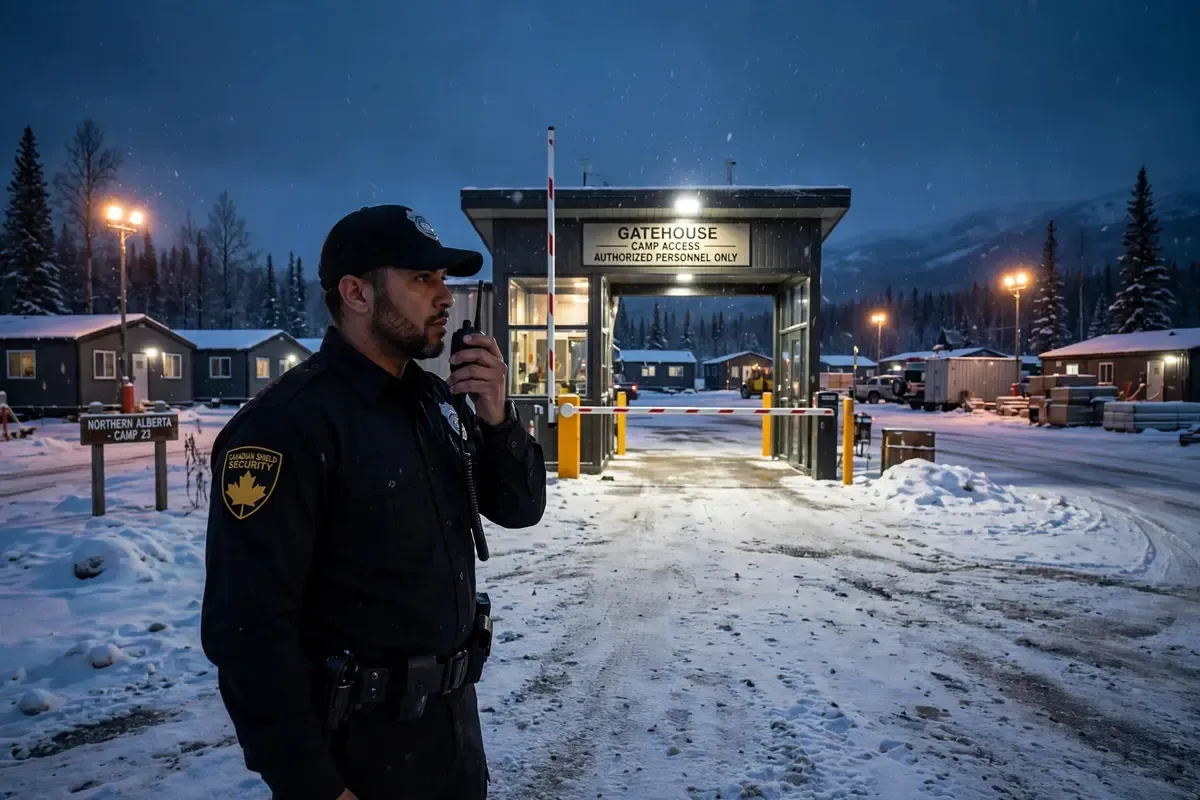
It is 2 a.m. at a work camp gatehouse off Highway 63 north of Fort McMurray, and a pickup truck with no camp pass pulls up to the barrier. The driver says he is here for a contractor, but his name is not on the crew list, so the guard holds him at the gate, calls the camp office, and keeps the camp closed until the answer comes back. Our Canadian Shield Security team plans camp coverage from our Edmonton base at 3536 33 Ave NW, Mill Woods, T6L 5G6.
This guide is for a camp manager or site supervisor who has to keep a remote Alberta work camp safe around the clock. It covers what camp security involves, what Alberta law requires, and how to set it up so the camp runs without trouble. Our camp site security service and our mobile patrol service both cover remote camps across northern Alberta, staged from Edmonton.
Remote work camp security in Alberta means SSIA-licensed guards running gatehouse access control, ID and vehicle checks, perimeter patrols and CCTV monitoring at camps that house oil sands and construction workers. Fort McMurray sits about 435 kilometres northeast of Edmonton on Highway 63, so camps there need coverage that works around the clock, in winter cold and wildfire season alike.
Why Remote Camps Are Hard to Secure
A remote work camp is a small town with no town around it. Hundreds of workers sleep, eat and live on site, often on fly-in fly-out rotations, while contractors, delivery trucks and visitors come and go every day. The camp holds fuel, equipment, tools and personal property, and the nearest police detachment can be an hour or more away by road.
Distance is the first problem. Fort McMurray sits about 435 kilometres northeast of Edmonton on Highway 63, the main road link between the city and the Athabasca oil sands, and many camps sit farther north still, past Fort MacKay. A guard team that is not already on site cannot reach the camp quickly, so the security plan has to work with the people and tools already there.
The Camp Gatehouse: Who Gets In
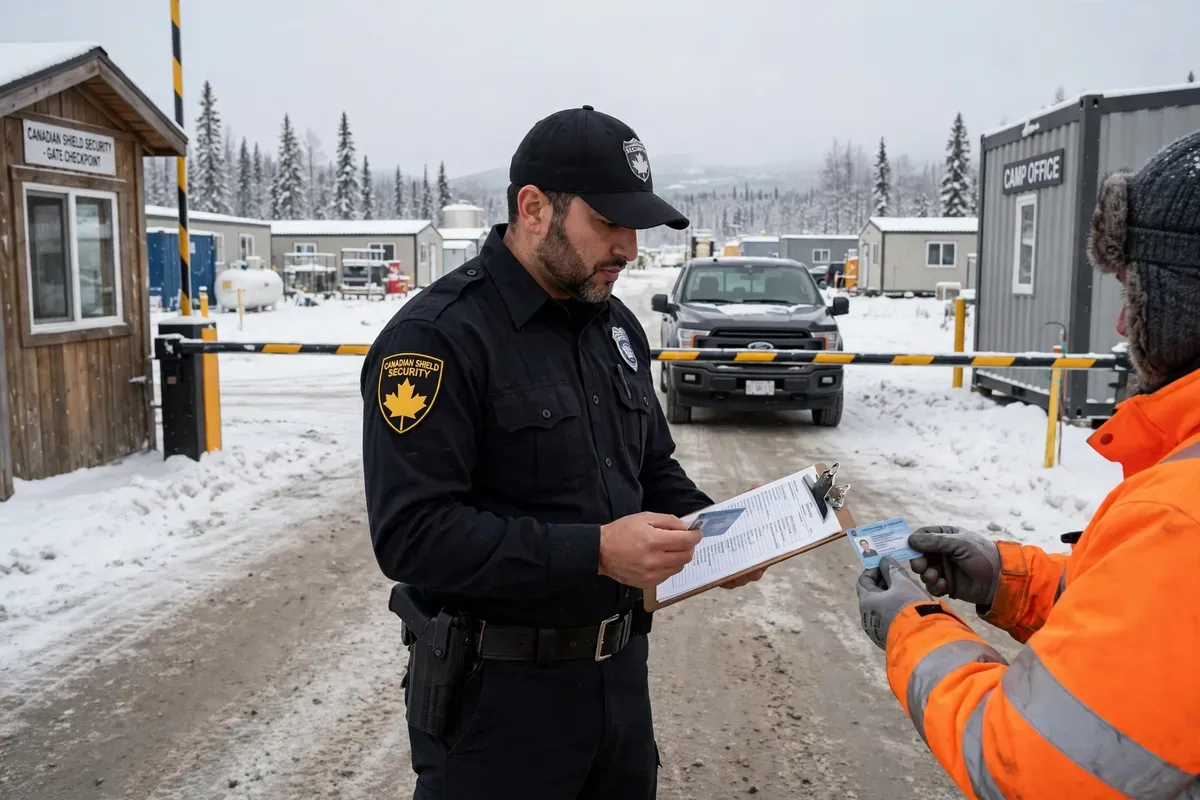
Every camp needs one controlled way in and out, and that is the gatehouse. The guard checks identification against the crew list, logs every contractor and visitor, checks vehicles before they enter, and turns away anyone who cannot show a reason to be there. A clean log of who is on site matters twice over: it keeps strangers out, and it tells the camp manager exactly who is inside if an evacuation is called.
Contractor sign-in needs care. Crews arrive in groups, often before dawn, and a guard under pressure to keep the line moving can wave a whole bus through on one name. The fix is simple: every person shows ID, every name is checked, and nobody enters until the check is done. Orientation gating works the same way: a worker who has not done the site safety orientation does not pass the gate.
Curfews and camp rules are part of the job too. Guards enforce quiet hours, check that visitors leave on time, and keep unauthorised vehicles out of the dormitory rows. The rules sit in the post orders, the guards apply them the same way every shift, and the camp manager backs them up.
| Camp Post | What the Guard Does | Why It Matters |
|---|---|---|
| Gatehouse | Checks ID, crew lists and vehicles against the camp roster | Stops unauthorised people entering the camp |
| Contractor sign-in | Logs every contractor, checks orientation, issues passes | The camp knows exactly who is on site |
| Perimeter patrol | Walks and drives fence lines, gates and dark corners | Catches damage and intrusion early |
| Dormitory and common areas | Patrols dorm rows, checks doors and common rooms | Keeps workers safe where they sleep |
| Fuel and equipment | Checks tanks, locks and parked machines on every round | Stops fuel theft and equipment loss |
| CCTV monitoring | Watches gate, yards and fuel areas live | A record of what happened overnight |
| Fire and hazard checks | Looks for leaks, blocked exits and hot work left running | A small fire is caught before it spreads |
Patrols, Fences and CCTV
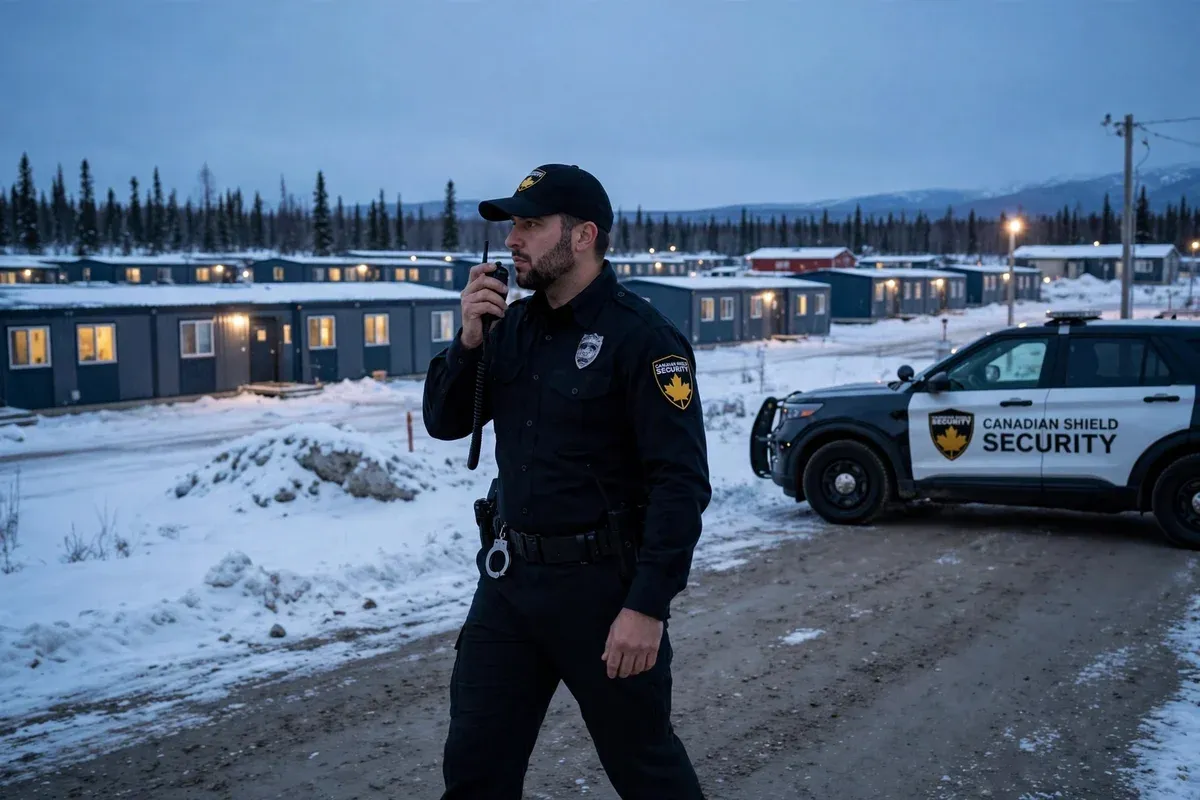
A gatehouse alone does not cover a camp. Foot and vehicle patrols work the perimeter on a set route, checking fences, gates and fuel stores, and after-hours patrols visit at random intervals so nobody can time them. Cameras at the gate, the fuel farm and the equipment yard fill the gaps between patrols, and alarm monitoring turns a sensor trip into a guard on site instead of a note in the morning. Our industrial security service covers the same patrol thinking across Edmonton industrial sites.
The dormitory rows need patrols of their own. Guards walk the rows, check common areas, and watch for trouble that starts quietly: a door propped open, a stranger in the laundry room, a dispute that is getting loud. A guard who can calm a dispute at midnight saves the camp manager a problem at breakfast.
Safety Tickets Your Camp Guards Must Hold
A camp guard in the oil sands needs more than a licence. Guards working at remote Alberta camps are expected to hold current safety tickets before they arrive on site: WHMIS for hazardous products, H2S Alive for hydrogen sulphide awareness, Construction Safety Training System (CSTS) and standard First Aid, plus the site-specific orientation for that camp. A guard who arrives without the tickets cannot work, and the camp loses a shift while a replacement is found. Our WHMIS guide for guards explains the hazardous-products training that matters when a camp stores diesel, propane and chemicals.
Emergencies at a Remote Camp
A remote camp must be ready for the night nothing goes to plan. In May 2016 a wildfire forced the evacuation of Fort McMurray and the surrounding area, moving more than 80,000 people, and Highway 63 carried much of that traffic south. A camp evacuation plan has to name the muster points, the headcount method, the buses, and the route out, and guards run the headcount at the muster point.
Medical emergencies need the same planning. The nearest hospital can be hours away, so the guard team carries first aid training and a radio that reaches the camp medic, and the plan names who calls the ambulance and who meets it at the gate. Winter storms, power failures and wildlife on the road belong on the same list.
What Alberta Law Requires
A camp guard starts with the same licence as every guard in the province. Under the Security Services and Investigators Act (Alberta), a guard must complete an approved training course, score 80 percent or higher on the provincial exam, and hold a licence that costs $100 and lasts two years. Applicants must be 18 or older, eligible to work in Canada, fluent in English, and free of a criminal record or outstanding charges. See the official licensing page on alberta.ca.
Guards must carry the original licence card while working, and the company that employs them must hold a business licence of its own. Canadian Shield Security holds SSIA business licence B001449. Our truck yard security guide shows the same system thinking at industrial yards near Edmonton.
How to Set Up Camp Security in Five Steps
- Walk the camp with the manager and list every risk: the gate, the fuel farm, the dormitory rows, the equipment yard and the blind spots.
- Write the post orders: who guards what, how often patrols run, what the gatehouse checks, and what happens when something goes wrong.
- Staff it with licensed guards who hold the safety tickets the site needs, brief them on camp rules before the first shift, and give them the camp office number.
- Put the tools in place: gatehouse lighting, CCTV at the gate and fuel area, radios that reach the whole camp, and a patrol vehicle that starts at minus forty.
- Test it on shift: run a gate check, a patrol and an evacuation headcount, then write the fix into the post orders.
Our oil sands camp security guide shows the same system thinking at oil sands sites. Remote work camp security is not a single guard at a gate. It is a system: a gatehouse that checks every person and vehicle, patrols between cameras, guards with the right licence and tickets, and a log that answers for every person on site.
Are security guards at remote work camps in Alberta required to be licensed?
Yes. Every guard in Alberta must hold a licence under the Security Services and Investigators Act (Alberta). Guards complete an approved training course, pass a provincial exam at 80 percent or higher, and pass a criminal record check. The licence costs $100 and lasts two years, and guards must carry the card while working.
How much does remote work camp security cost in Alberta?
It depends on the size of the camp, the number of guards, the hours of cover, and whether you need a staffed gatehouse, mobile patrols or both. A camp with a busy gate and hundreds of workers costs more than a small seasonal camp. Ask for a written quote that lists guards, hours and patrols.
Does Canadian Shield Security cover work camps near Fort McMurray?
Yes. We cover remote work camps near Fort McMurray, Fort MacKay and Anzac from our Edmonton base, day and night, with gatehouse guards and mobile patrols. Guards arrive with the safety tickets your site needs and briefed on your camp rules. Call 1 (800) 326-7879 to arrange coverage for your camp today.
What security do I need for a fly-in fly-out work camp in Alberta?
A fly-in fly-out camp needs a staffed gatehouse, because crews arrive and leave in groups and every person must be checked against the roster. Add perimeter patrols, CCTV at the gate and fuel areas, and guards who hold WHMIS, H2S Alive and First Aid. The plan must also cover evacuation headcounts and the charter flight schedule.
Do camp security guards need WHMIS and H2S Alive tickets?
Yes, for most oil sands and industrial camps. Guards are expected to hold WHMIS, H2S Alive, Construction Safety Training System and First Aid tickets before they arrive on site, plus the camp's own safety orientation. A guard without the right tickets cannot work, so check every ticket before the rotation starts.
Canadian Shield Security Editorial Team, Edmonton, Alberta
Canadian Shield Security places SSIA-licensed, safety-ticketed guards at remote work camps across northern Alberta, 24/7. Free consultation -- call 1 (800) 326-7879 or request a free consultation.
