
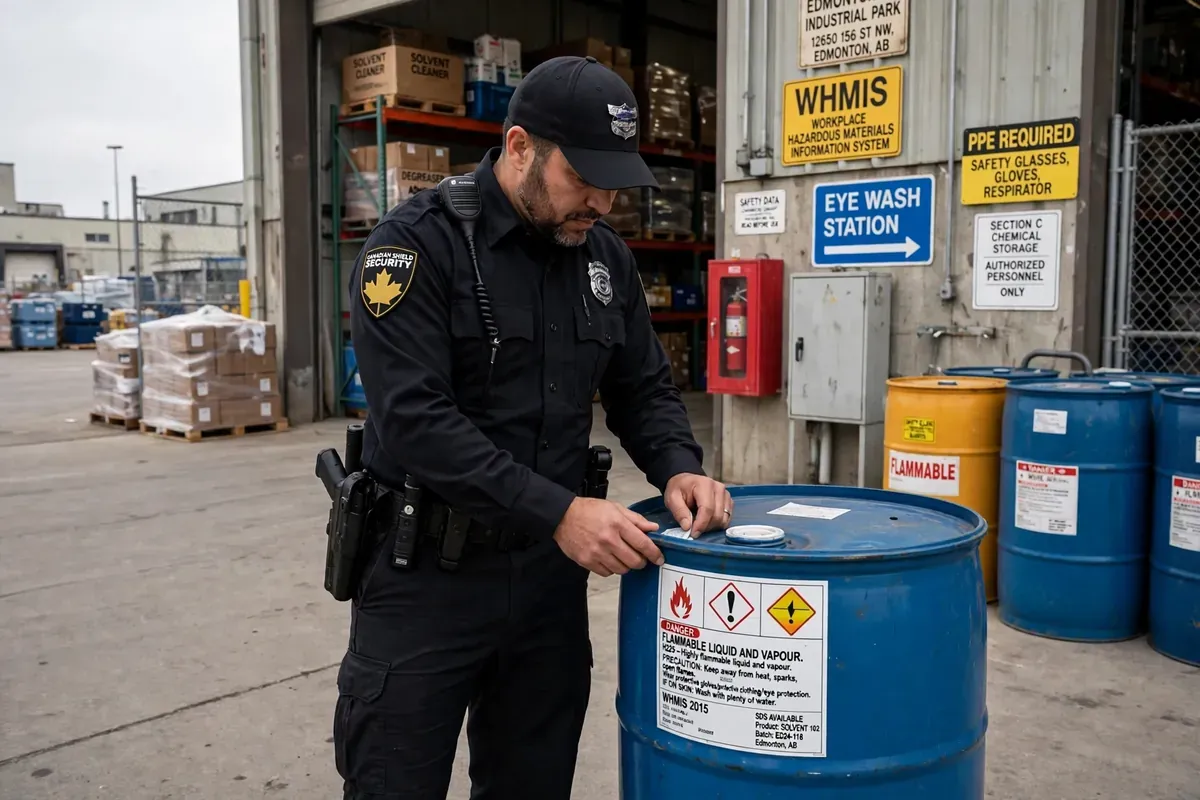
It is 2 a.m. in a truck yard in Nisku, T9E 7Y9, and the guard on patrol finds a drum tipped on its side. Liquid is spreading across the gravel, and the drum carries a red diamond pictogram. The guard can step in blind, or stop and read the label first. That choice is what WHMIS training is for. Our Canadian Shield Security team works nights like this across Edmonton and Nisku.
This guide is for a security manager or site supervisor deciding whether the guards on an industrial site, a work camp or a truck yard need WHMIS training. It covers what WHMIS is, what Alberta law requires, and how to get ready. Our camp site security service and our truck yard security service both place guards where hazardous products are part of the working day.
WHMIS is Canada's system for telling workers what hazardous products are on site and how to handle them safely. It works through three parts: labels on every container, a 16-section safety data sheet for every product, and worker training. In Alberta the rules sit in Part 29 of the OHS Code.
What WHMIS Is, in Plain Words
WHMIS stands for Workplace Hazardous Materials Information System. It is a Canada-wide hazard communication system, not a single course or certificate. Its job is simple: before a worker touches a chemical, that worker should know what it is, what harm it can do, and what to do if something goes wrong. It began in 1988 and moved to WHMIS 2015 in February 2015, in line with the United Nations Globally Harmonized System (GHS).
Federal law -- the Hazardous Products Act and the Hazardous Products Regulations -- sets how products are classified and what suppliers must put on labels and safety data sheets. Alberta law -- Part 29 of the Occupational Health and Safety Code -- sets what employers must do at the work site. Part 29 was updated to match the federal WHMIS 2015 rules, effective December 1, 2018.
The Three Parts Every Guard Should Recognise
WHMIS has three parts, and a guard who can use all three is far safer than a guard who only knows one. Labels give the fast warning. The safety data sheet gives the detail. Training ties the two together so the guard knows what to do on a real shift.
| Pictogram | What It Warns About | Where a Guard Sees It |
|---|---|---|
| Flame | Flammable gases, liquids and solids | Fuel stores, propane cages |
| Corrosion | Burns skin and eyes, corrodes metal | Cleaning chemicals, acids, battery storage |
| Skull and crossbones | Fatal or toxic if swallowed or breathed in | Pesticides, solvents, chemical stores |
| Exclamation mark | Irritation or lower-level toxicity | Aerosols, detergents, adhesives |
| Gas cylinder | Gases under pressure | Welding gas bottles, propane tanks |
| Health hazard | Long-term harm to organs and breathing | Dusts, fumes, solvents |
| Biohazardous material | Infectious material | Medical waste, camp clinics |
Supplier Labels and Workplace Labels
A supplier label comes on the product from the manufacturer. It carries the product name, the pictograms, a signal word such as Danger or Warning, hazard statements, precautionary statements, and supplier contact details. A guard should read one in under a minute: the pictogram names the harm, and the signal word names how serious it is.
A workplace label is the one the employer puts on. It is used when a product is poured from its original container into another one, or when a container arrives without a supplier label. It carries the product name, safe handling notes, and a pointer to the safety data sheet. An unlabeled drum is a stop-and-report moment, not a guess-and-carry moment.
Safety Data Sheets: The 16 Sections That Matter
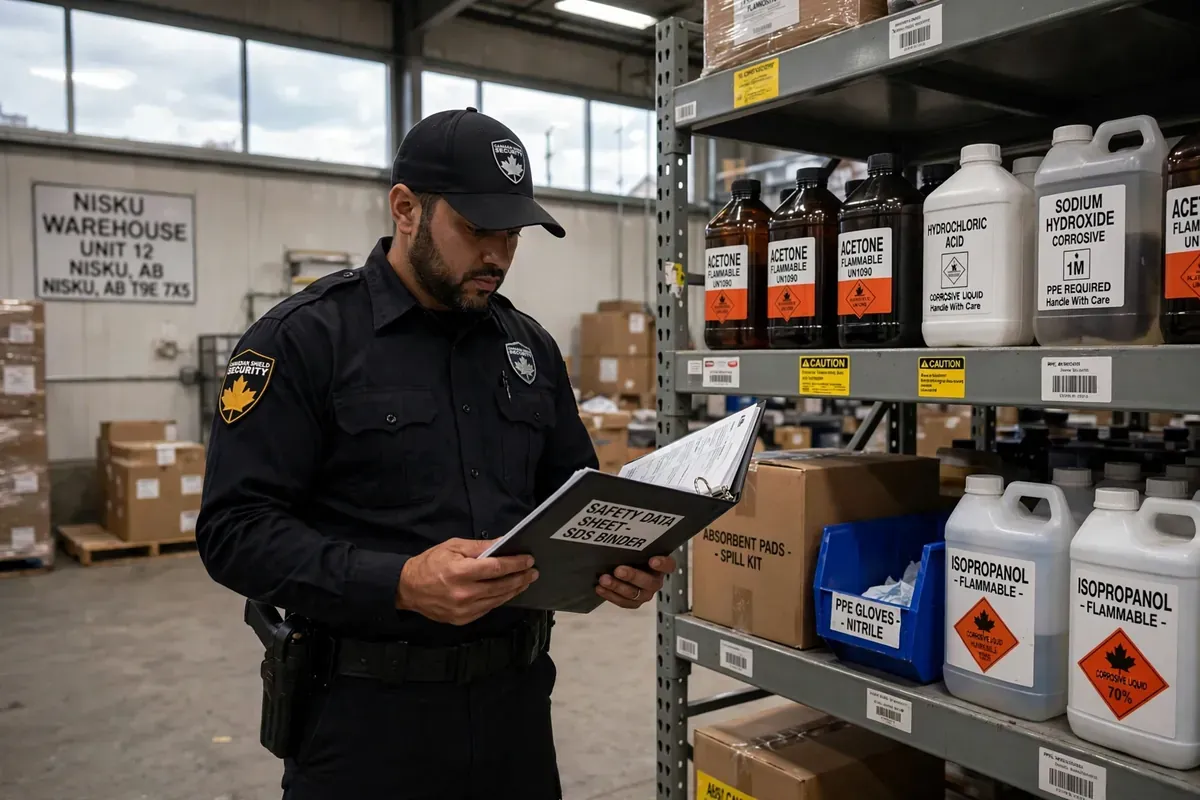
A safety data sheet, or SDS, is a fixed 16-section document for every hazardous product. Section 1 identifies the product and the supplier. Section 2 lists the hazards, pictograms and signal word. Section 3 lists the ingredients. Section 4 covers first aid, section 5 covers firefighting, section 6 covers spills, section 7 covers handling and storage, and section 8 covers exposure controls and personal protective equipment.
A guard does not need to memorise all 16 sections. The working habit is narrower: know where the SDS binder lives on your site, know how to find sections 2, 4 and 7 in a hurry, and never start clean-up or first aid without checking them. Alberta law says the safety data sheet must be readily available to workers. On nights, the guard is often the first to reach the binder.
What Alberta Law Actually Requires of Employers
Part 29 of the Alberta Occupational Health and Safety Code applies to hazardous products at a work site, and section 397 sets out the training duty. An employer must ensure that a worker who works with or near a hazardous product is trained in what labels and safety data sheets mean, the procedures for safe storage, use and handling, the steps to follow if there are fugitive emissions, and the steps to follow in an emergency involving the product. Those procedures must be developed with the joint health and safety committee or representative, where one exists. (Full text: Part 29 of the Alberta OHS Code.)
Note the words in that rule: with or near. A guard does not have to pour chemicals or mix products to fall under it. Walking a yard where fuel, solvents and cleaning chemicals are stored, or checking a storage room, is working near a hazardous product. That is why WHMIS training belongs in a guard's onboarding for industrial sites.
Where Edmonton Guards Meet Hazardous Products
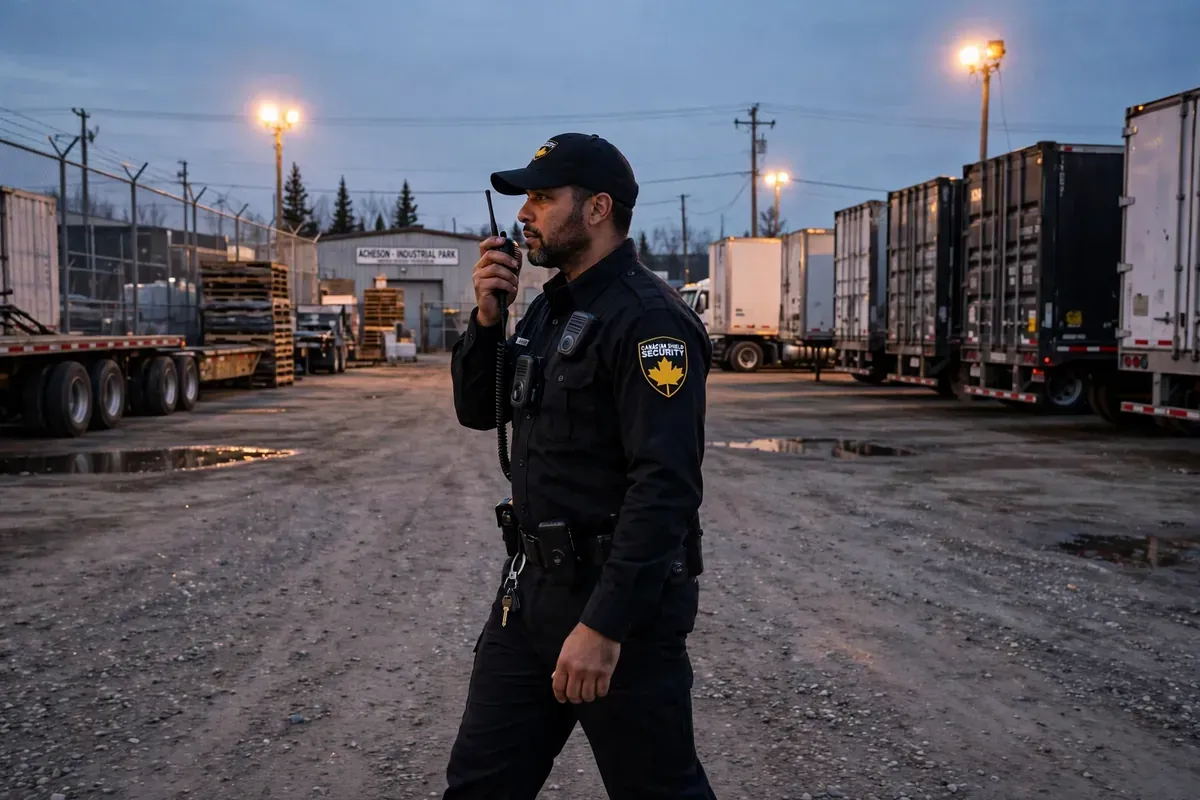
A truck yard in Nisku or Acheson stores diesel, hydraulic fluid and solvents. A construction site stores generator fuel, propane, adhesives and paints. A warehouse stores cleaning chemicals, aerosols and batteries. Our warehouse security guide covers the wider site picture, and our construction site security guide covers active builds.
The risk is that a guard will be the first person to find a leak, a spill, a damaged container or an unlabeled drum -- usually at night and alone. A WHMIS-trained guard reads the label, checks the safety data sheet, keeps people away, and calls the right person.
What a WHMIS-Trained Guard Does Differently
The difference shows up in small decisions. A trained guard checks the label before touching a container, and leaves an unlabeled one alone until it is identified. The guard knows where the SDS binder is and can pull the right sheet in a minute. The guard knows when a product needs ventilation and when it needs evacuation. And when a spill is found, the guard follows the site emergency procedure: raise the alarm, keep people clear, and call the supervisor.
WHMIS and the SSIA Licence
WHMIS training is not the same as a security guard licence. Every security guard in Alberta must hold a valid licence under the Security Services and Investigators Act (Alberta). Guards must be over 18, eligible to work in Canada, and fluent in English, with an approved training course and 80 percent or higher on the provincial exam. The licence costs $100, lasts two years, and a guard must carry the original card while working. Check the official licensing requirements on alberta.ca.
WHMIS, by contrast, is employer-provided training, not a provincial licence. There is no WHMIS licence card and no provincial exam. The employer arranges the general education and the site-specific training, keeps records of who was trained and when, and refreshes the training when a new product arrives or a procedure changes. Alberta law sets no fixed expiry date for WHMIS training.
How to Get Your Guards WHMIS-Ready
- List every hazardous product on each site the guards patrol, and confirm each one has a supplier label and a safety data sheet on file.
- Put the safety data sheets where a night guard can reach them fast, and tell every guard where that place is.
- Give every guard general WHMIS education: pictograms, labels, safety data sheets, and the three parts of the system.
- Add site-specific training for the products on that site: where they are stored, what the labels mean, and the emergency procedure.
- Test the knowledge on shift: ask the guard to find a safety data sheet and read a label during a patrol.
WHMIS is not paperwork for its own sake. It turns a guard who finds a leaking drum at 2 a.m. into one who knows what is in it and who to call. If your site stores fuel, solvents or cleaning chemicals and your guards have never had WHMIS training, ask us about a WHMIS-ready team for your site.
Are security guards in Edmonton required to be licensed?
Yes. Every guard in Edmonton must hold a licence under the Security Services and Investigators Act (Alberta). Guards complete an approved training course, pass a provincial exam at 80 percent or higher, and pass a criminal record check. The licence costs $100 and lasts two years.
How much does WHMIS training cost for security guards in Edmonton?
It depends on the provider, the number of guards, and whether the training is general education only or site-specific as well. A short general course costs far less than a full site program with records and refreshers. Ask for a written quote that covers the general course, the site-specific session, and the training records.
Does Canadian Shield Security provide WHMIS-trained guards in Nisku and Acheson?
Yes. We provide WHMIS-trained guards in Edmonton, Nisku, Acheson, Leduc, St. Albert and Sherwood Park, day and night. Guards are briefed on the hazardous products at your site before the first shift. Call 1 (800) 326-7879 to arrange coverage for your yard, camp or warehouse today.
Do security guards need WHMIS training in Alberta?
Yes, when they work with or near hazardous products. Part 29 of the Alberta Occupational Health and Safety Code requires the employer to train any worker who works with or near a hazardous product. Guards on industrial sites, camps and truck yards work near fuel, solvents and cleaning chemicals.
How long does WHMIS training last, and when is a refresher needed?
Alberta law sets no fixed expiry date for WHMIS training. A refresher is needed when a new hazardous product arrives, when a procedure changes, or when a supervisor spots a gap in what a guard knows. Many employers review the training program every year.
Canadian Shield Security Editorial Team, Edmonton, Alberta
Canadian Shield Security places WHMIS-trained guards on industrial sites, camps and truck yards across Edmonton 24/7. Free consultation -- call 1 (800) 326-7879 or request a free consultation.
