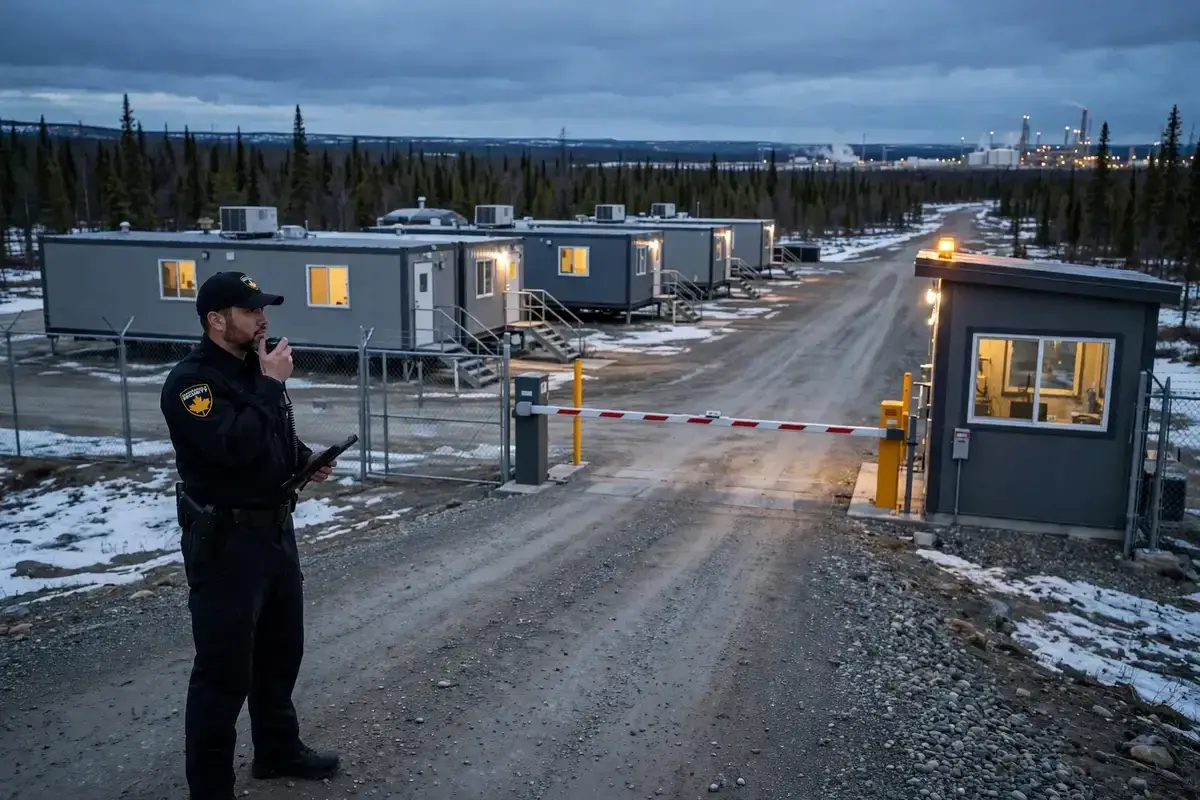
It is 4 a.m. at an oil sands camp north of Fort McMurray, 435 kilometres northeast of Edmonton, and the night guard at the gatehouse logs a contractor bus arriving two hours early. Thirty cold, tired workers need to be checked in, matched to the camp roster and sent to the right accommodation block before first light. Our Canadian Shield Security team plans camp coverage from our Edmonton base at 3536 33 Ave NW, Mill Woods, T6L 5G6.
This guide is for a camp manager or site supervisor who has to keep a remote Alberta work camp safe. It covers what camp security involves, what Alberta law requires, and how to set it up. Our camp site security service and our industrial security service both cover remote sites across northern Alberta.
Oil sands camp security in Alberta means SSIA-licensed guards running gatehouse access control, perimeter patrols and emergency response at remote work camps, mostly around Fort McMurray in the Regional Municipality of Wood Buffalo. Guards also need WHMIS awareness, first aid and cold-weather training, and the camp operator must meet its duties under Alberta's Occupational Health and Safety Act.
What an Oil Sands Camp Actually Is
An oil sands camp is a self-contained community built to house workers near a mine or plant. Fort McMurray is the largest community in the Athabasca oil sands, in the Regional Municipality of Wood Buffalo, and most of the big camps sit north and southeast of town, near the Suncor, Syncrude and CNRL sites. Workers live in modular blocks, eat in a central dining hall, and work rotations of days on and days off.
The Risks a Remote Camp Faces
Isolation is the first risk. Some camps sit hundreds of kilometres from the nearest town, so police and ambulance response takes time. That gap is why camp security exists: the guard team holds a situation steady until help arrives. Rotational schedules add a second risk, because shift changes create busy windows when dozens of workers and vehicles move through the gate at once.
Theft is the third risk. Fuel, tools and heavy equipment are all valuable, and a remote yard with a weak gate is an easy target. Unauthorized access is the fourth: a camp holds sleeping workers, so a stranger in an accommodation block is a serious matter. Medical emergencies and winter storms add to the list. In May 2016 a wildfire forced the evacuation of Fort McMurray itself, and every camp manager in the region still plans for that kind of event.
| Camp Post | What the Guard Does | Why It Matters |
|---|---|---|
| Gatehouse | Checks ID against the roster and logs every vehicle | One controlled way in and out |
| Perimeter patrol | Drives fence lines, fuel stores and laydown yards | Catches damage and intrusion early |
| Accommodation blocks | Foot patrols, room checks and noise response | Workers sleep safely at night |
| Fuel and equipment yards | Checks tanks, locks and parked machines | Stops fuel and equipment theft |
| CCTV monitoring | Watches gate, yards and common areas live | A record of what happened overnight |
| Emergency response | Raises the alarm, meets responders, runs muster | Fast action when minutes count |
Gatehouse and Access Control: The First Line
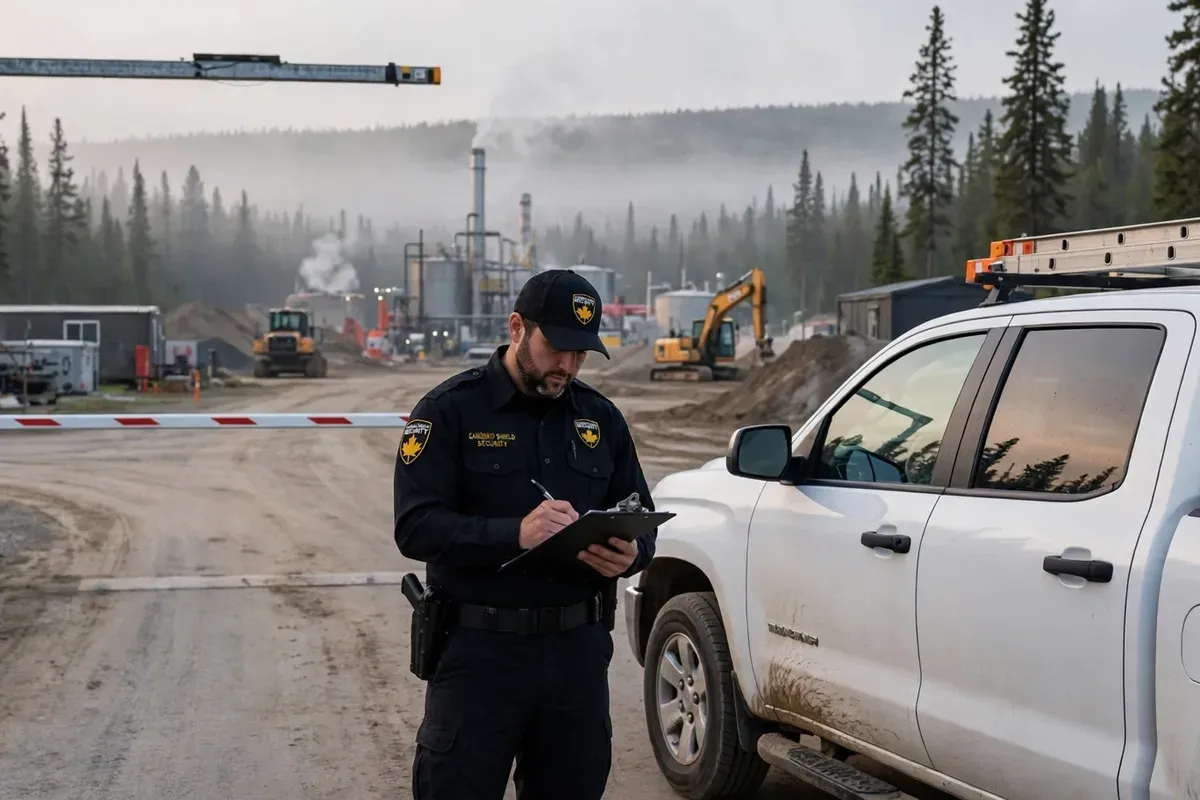
Every camp needs one controlled way in and out, and that way in is the gatehouse. The guard checks identification against the camp roster, logs every vehicle, and turns away anyone who is not expected. Contractor buses get a manifest check. Bag checks at shift change keep alcohol, drugs and weapons out of a camp where people live and work. It is slow, deliberate work, and it is the single most effective control a camp has.
Patrols, Perimeter and CCTV
A gatehouse alone does not cover a camp. Mobile patrols drive the perimeter and the interior roads on a set route, checking fences, gates and fuel stores. Foot patrols cover the accommodation blocks, the dining hall and the common areas where a vehicle cannot go. Both kinds of patrol work from post orders: a written set of instructions that says what to check, how often, and what to do when something is wrong. Cameras at the gate, fuel farm and equipment yard fill the gaps between patrols. Our construction site security guide covers the same patrol thinking on city construction sites.
The Training a Camp Guard Needs
A camp guard starts with the same licence as every guard in the province. Under the Security Services and Investigators Act (Alberta), a guard must complete an approved training course, score 80 percent or higher on the provincial exam, and hold a licence that costs $100 and lasts two years. Guards must carry the original licence card while working. See the official licensing page on alberta.ca.
On top of the licence, oil sands sites ask for site tickets. The usual set is H2S Alive, first aid, WHMIS awareness and CSTS, plus a valid Class 5 driver's licence for patrol vehicles. Camp operators ask for these tickets before a guard is allowed on site. Our security guard training guide explains the Alberta licensing path step by step, and our WHMIS guide for guards explains why WHMIS matters on industrial sites.
Winter in the North: Minus 40 and Still on Patrol
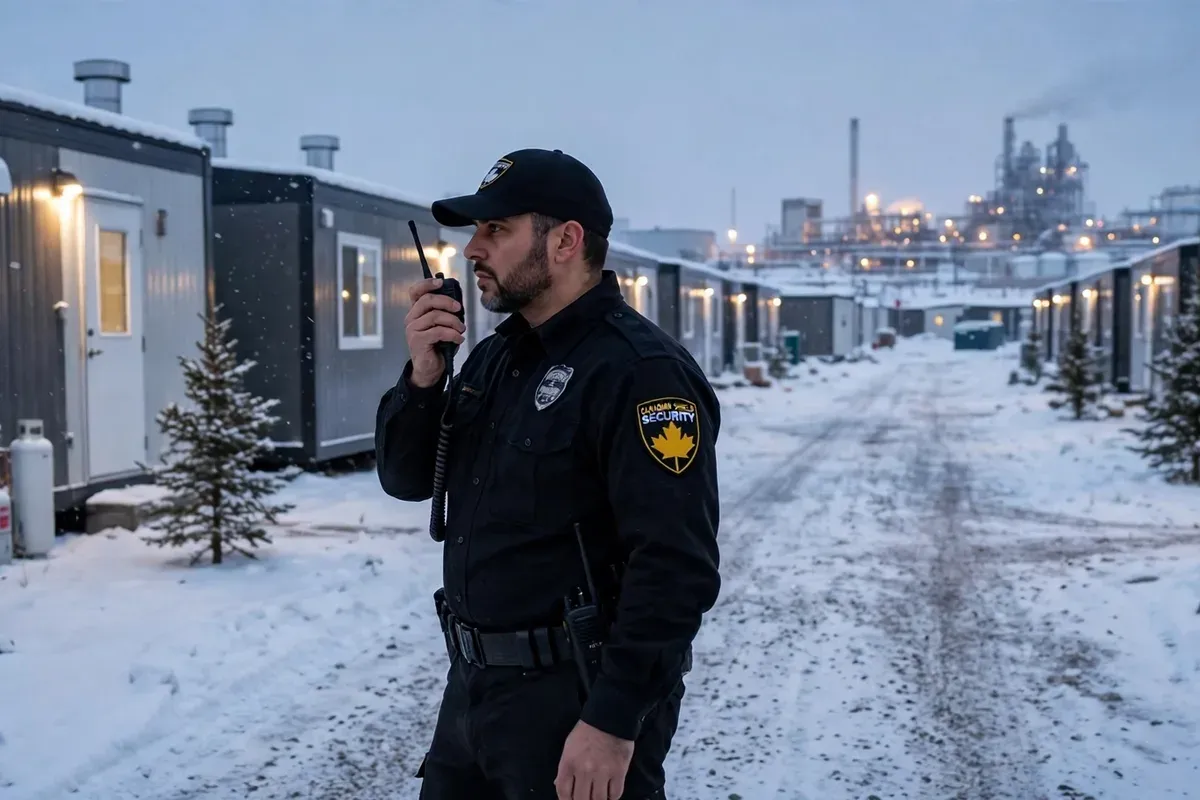
Fort McMurray winters are severe. January averages around minus 17 degrees, and temperatures can fall to minus 35 or minus 45. A patrol vehicle that will not start, a gate lock frozen shut, or a guard without the right clothing can shut a camp down. Winter patrols need block heaters, cold-weather gear, and a vehicle check at the start of every shift.
What Alberta Law Requires
Alberta's Occupational Health and Safety Act puts a clear duty on employers. Section 3 says every employer must ensure, as far as it is reasonably practicable, the health, safety and welfare of workers at the work site, and must make sure workers are adequately trained for the work they do. That duty covers the camp operator, the prime contractor and the security company. (Full text: Part 1 of the Alberta OHS Act.)
WHMIS adds a second layer. Part 29 of the Alberta Occupational Health and Safety Code requires employers to train workers who work with or near hazardous products, and a camp stores plenty of them: diesel, propane, cleaning chemicals and solvents. A guard who finds a leaking drum needs to know what is in it before touching it. Our WHMIS guide for guards covers the label and safety data sheet habit in detail.
Emergency Response: When the Camp Has to Move
Evacuation is the hardest test a camp faces. The May 2016 wildfire showed how fast a northern Alberta community can be told to leave, and a camp must be able to move hundreds of people to a muster point, account for every name on the roster, and hand the list to the incident commander. Guards run the muster: they check the blocks room by room and keep the radio link to the Edmonton office open until the last bus is out. Our fire watch guide covers fire watch duties on Edmonton sites, and the same discipline applies at a camp.
How to Set Up Camp Security in Five Steps
- Walk the camp with the manager and list every risk: gate, fuel farm, equipment yard, accommodation blocks and blind spots.
- Write the post orders: who guards what, how often patrols run, what the gatehouse checks, and what happens when something goes wrong.
- Staff it with licensed guards who hold the site tickets the operator requires, and brief them on camp rules before the first shift.
- Put the tools in place: camp-wide radios, CCTV at the gate, lighting on the patrol route, and a vehicle that starts at minus 40.
- Test it on shift: run a gate check, a patrol and a muster drill, then write the fix into the post orders.
Oil sands camp security is not a single guard at a gate. It is a system: a roster that matches the gate, patrols between cameras, guards with the right tickets, and a plan that works at minus 40.
Are security guards at Alberta oil sands camps required to be licensed?
Yes. Every guard in Alberta must hold a licence under the Security Services and Investigators Act (Alberta). Guards complete an approved training course, pass a provincial exam at 80 percent or higher, and pass a criminal record check. The licence costs $100 and lasts two years.
How much does oil sands camp security cost in Alberta?
It depends on the size of the camp, the number of guards, the length of the rotation, and whether you need 24-hour gatehouse cover, mobile patrols or both. Remote sites cost more than city sites because of travel, camp allowance and winter gear. Ask for a written quote that lists guards, hours and patrols.
Does Canadian Shield Security cover Fort McMurray and northern Alberta camps?
Yes. We stage camp crews from our Edmonton base and cover Fort McMurray, the Fort MacKay corridor, Anzac, Cold Lake and Grande Prairie, day and night. Guards arrive briefed on your camp rules and the site tickets your operator requires. Call 1 (800) 326-7879 to arrange coverage for your camp today.
What training do oil sands camp security guards need?
A camp guard needs an Alberta security licence first, then the site tickets the operator asks for. The usual set is H2S Alive, first aid, WHMIS awareness and CSTS, plus a valid Class 5 driver's licence. Guards need cold-weather training for northern Alberta winters and a briefing on the camp's own rules.
How do oil sands camps handle security in winter?
Winter security runs on preparation. Patrol vehicles get block heaters and a start check at the beginning of every shift, gate locks are kept free of ice, and guards work to a cold-weather routine with warm-up breaks. Post orders spell out how long a guard stays outside.
Canadian Shield Security Editorial Team, Edmonton, Alberta
Canadian Shield Security places SSIA-licensed guards at oil sands camps and remote work sites across northern Alberta, 24/7. Free consultation -- call 1 (800) 326-7879 or request a free consultation.
