
A South Edmonton property manager once asked a prospective security provider a simple question: “Can you show me your guard's licence before the first shift?” The provider hesitated, then admitted the guard's training certificate had expired two months earlier.
Security guard training Alberta requirements exist precisely to prevent situations like that. Business owners comparing our on-site guard services deserve to understand exactly what training stands behind every officer before signing a contract, not after an incident exposes a gap.
This guide walks through the full training and licensing path a security guard follows in Alberta, from the mandatory course through ongoing renewal, so you know what to verify before you hire.
|
Security guards in Alberta are trained through the 40-hour Alberta Basic Security Training course, approved by Alberta Justice and Solicitor General, followed by a proctored provincial exam requiring an 80 percent pass score. After passing, guards apply for their SSIA licence. Guards handling batons or handcuffs complete additional Use of Force certification. |
What Training Does a Security Guard Need in Alberta?
Every security guard working in Alberta must complete the Alberta Basic Security Training course, pass a proctored provincial exam, and hold a valid licence issued under the Security Services and Investigators Act before working a single paid shift, including in Edmonton.
This training path applies regardless of whether the guard works a static post, a mobile patrol route, or a specialized assignment like event or healthcare security. The base requirement is the same across every role covered by the SSIA.
Alberta's approach differs from some other provinces in a useful way for employers: the training standard is set provincially by Alberta Justice and Solicitor General rather than left to individual training providers, so a licence earned through one approved course carries the same legal weight as one earned through another.
Inside the Alberta Basic Security Training Course: What Guards Actually Learn
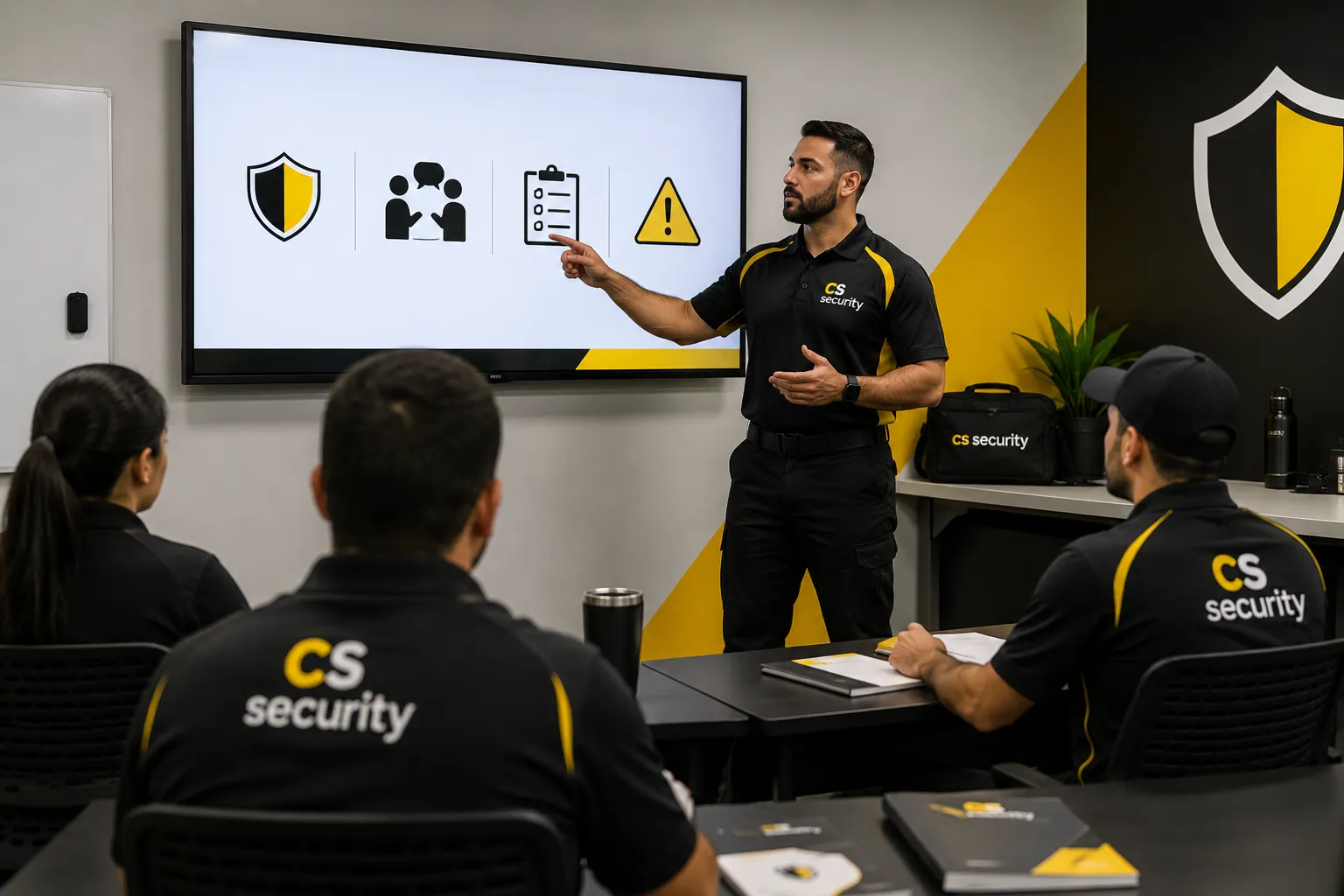
The Alberta Basic Security Training course, commonly called ABST, runs a minimum of 40 hours and is delivered across seven core modules covering the roles and responsibilities of a security professional, relevant legislation including the SSIA itself, communication skills, and emergency response procedures.
Communication training covers more than politeness. Guards learn de-escalation language, how to give clear instructions during an evacuation or emergency, and how to communicate effectively with police, paramedics, and other emergency services when handing off an incident.
Patrol and monitoring duties form another major component, teaching guards how to conduct proper checks, document observations, and recognize situations that require escalation rather than direct intervention. This module builds the foundation for both static guard posts and mobile patrol routes.
Legal authority and limitations receive significant attention in the curriculum, since guards must understand precisely what they are and are not permitted to do under Alberta law, including the difference between a security guard's authority and that of a police officer.
This distinction matters in practice more than many clients realize. A guard can observe, document, and in limited circumstances detain someone under citizen's arrest provisions, but cannot conduct searches, make arrests in the way police can, or use force beyond what is reasonable and proportional to the situation.
The course can be completed online or in person, and each module typically ends with a short quiz to confirm the material was understood before the guard moves on, rather than allowing gaps to carry through to the final exam.
|
ABST Module Focus |
What It Covers |
|
Roles and legislation |
Security professional responsibilities and the SSIA itself |
|
Communication |
De-escalation, emergency instructions, coordination with police/EMS |
|
Patrol and monitoring |
Proper checks, documentation, and recognizing escalation triggers |
|
Legal authority |
Scope and limits of a guard's authority versus police powers |
|
Emergency response |
Procedures for medical, fire, and security incidents on site |
The Provincial Exam and SSIA Licensing Process
After completing the 40-hour course, guards must pass a proctored provincial exam with a minimum score of 80 percent. The exam is administered under supervision, whether online or in person, to confirm the guard genuinely retained the material rather than simply completing the course.
Once the exam is passed, the guard applies for their Security Services and Investigators Act licence through Alberta Justice and Solicitor General, the government body responsible for regulating the private security industry across the province.
The licence application includes a criminal background check, and licences are issued for a two-year term before renewal is required. This background check is repeated at renewal, not just at initial application, which is part of why a guard's licence status can change over time.

The licence itself carries a government fee, separate from the cost of the training course and provincial exam, and the guard's licence number becomes the reference point any employer or client can use to confirm current standing with the regulator.
Canadian Shield Security confirms every officer's SSIA licence number directly before deployment and keeps renewal dates tracked internally, so a client never has to wonder whether the guard on their property is currently in good standing. Read more in our SSIA licence guide.
Use of Force Certification: Training Beyond the Base Licence
The base ABST course and SSIA licence do not include Use of Force certification, which is a separate requirement for any guard authorized to carry a baton or handcuffs on the job.
Use of Force training typically runs an additional course focused on physical intervention techniques, legal boundaries around reasonable force, and de-escalation principles, since guards must understand precisely when force is legally justified and how to apply it responsibly.
The course also covers handcuffing procedures and post-incident documentation requirements, since a guard who uses any level of force must be able to explain and justify that decision clearly in a written incident report afterward.
This certification is added to the guard's existing SSIA licence rather than replacing it, and typically remains valid for two years before recertification is required, similar to the base licence renewal cycle.
Armed guards face an additional layer entirely. Beyond Use of Force certification, an armed guard in Alberta needs a valid firearms possession and acquisition licence, which itself requires completing the Canadian Firearms Safety Course, on top of every requirement already covered for unarmed guards.
Given this stacked requirement, armed guard roles remain a small fraction of the industry, reserved for the specific high-risk assignments, such as cash-in-transit or certain client-mandated posts, where the added liability and cost are genuinely justified by the risk.
|
Canadian Shield Security only assigns Use of Force certified officers to roles that specifically require it, based on site risk assessment rather than applying the higher certification level uniformly across every contract. |
How Canadian Shield Security Vets and Trains Guards Beyond the Minimum
Meeting the legal minimum is the floor, not the standard Canadian Shield Security builds around. Every officer's SSIA licence, background check, and any specialized certification is verified and logged before the first shift, not taken on the applicant's word.
New hires also complete site-specific orientation before their first solo shift, covering the property's post orders, emergency contacts, and any details unique to that location, so the formal provincial training translates into practical readiness for the actual site.
Officers assigned to healthcare facilities, industrial sites, or event venues typically hold additional training relevant to that environment, such as first aid and CPR certification, WHMIS awareness for industrial sites, or crowd management principles for large events.
A guard assigned to a Nisku industrial site, for example, needs a meaningfully different practical skill set than one assigned to a Downtown Edmonton office lobby, even though both hold the same base SSIA licence and completed the same core ABST course.
Supervisors conduct periodic site visits and review incident reports to confirm guards are applying their training correctly in practice, not just holding a valid certificate on paper. This ongoing oversight catches gaps that a one-time licence check alone would miss.
How Often Do Guards Need to Renew Their Training?
A guard's SSIA licence must be renewed every two years, which requires an updated criminal background check and confirmation that the guard's standing remains in good order with the regulator.
Use of Force certification follows a similar two-year cycle, though many employers, including Canadian Shield Security, schedule refresher training more frequently than the legal minimum to keep physical intervention skills current between formal recertification dates.

Ongoing professional development beyond the mandatory minimums often includes updated de-escalation training, site-specific refreshers, and periodic review of post orders, since regulations and best practices both evolve over the length of a guard's career.
Supervisors also review each guard's incident reports over time, looking for patterns that might indicate a need for additional coaching or targeted refresher training, rather than waiting for a formal recertification date to address a developing gap.
How to Verify a Security Provider's Training Claims Before You Hire
Ask any prospective security provider to confirm they will show you the assigned guard's SSIA licence number before the contract begins, not after you request it following an incident.
Ask specifically whether the guards assigned to your property hold any certification beyond the base licence that your site actually requires, such as Use of Force for a higher-risk location or first aid certification for a site with regular public traffic.
Confirm how the provider tracks licence and certification renewal dates internally. A provider who cannot answer this clearly is a signal that a guard could end up working past their renewal date without anyone noticing until it becomes a problem.
Ask what happens if an assigned guard's licence lapses mid-contract. A provider with a clear replacement and coverage process demonstrates the kind of operational discipline that matters far more day-to-day than any single credential on paper.
Final Thoughts
Understanding how Alberta trains and licenses security guards gives you a real basis for evaluating any provider's claims, rather than taking “fully licensed and trained” at face value without knowing what that actually requires.
This knowledge also helps set realistic expectations for what a guard can and cannot do on your property. A well-trained guard is a strong deterrent and a capable first responder, but training does not turn a security guard into a police officer, and understanding that distinction avoids disappointment later.
Canadian Shield Security's SSIA-licensed guards serve Edmonton businesses 24/7, with every officer's training, licensing, and certification verified before deployment and a free consultation to discuss the right coverage for your property.
|
Canadian Shield Security serves Edmonton 24/7. Free consultation, no hidden fees. Call 1 (800) 326-7879 or WhatsApp 1 (780) 203-4535. |
Frequently Asked Questions
Is training mandatory for every security guard in Alberta?
Yes, without exception. Under the Security Services and Investigators Act (Alberta), every security guard must complete the 40-hour Alberta Basic Security Training course, pass the provincial exam with 80 percent or higher, and hold a valid SSIA licence before working anywhere in the province, including Edmonton.
How much does it cost for a guard to become licensed in Alberta?
SSIA licensing typically costs the guard around $100 for the two-year licence plus separate ABST course and provincial exam fees, often totalling a few hundred dollars. Canadian Shield Security covers these costs as part of hiring and confirms every licence before deployment, so there is no separate charge to clients for basic licensing.
Does the base SSIA licence include Use of Force training?
No. The base SSIA licence and Alberta Basic Security Training course do not include Use of Force certification. Guards who carry a baton or handcuffs must complete a separate 40-hour Use of Force course and add that qualification to their licence, which Canadian Shield Security tracks for every officer who needs it.
Does Canadian Shield Security verify guard licences for Edmonton clients?
Yes. Canadian Shield Security only deploys guards holding a current, verified SSIA licence to Downtown Edmonton, South Edmonton, Nisku, Sherwood Park, St. Albert, and every other area we serve. Licence numbers are confirmed before the first shift and tracked for renewal well before the two-year expiry date.
How often do security guards need to renew their training in Alberta?
Guards must renew their SSIA licence every two years, which requires an updated background check and confirmation that training remains current. Use of Force certification also expires after two years, and many employers require refresher training more often to keep skills sharp between formal recertification dates.
