
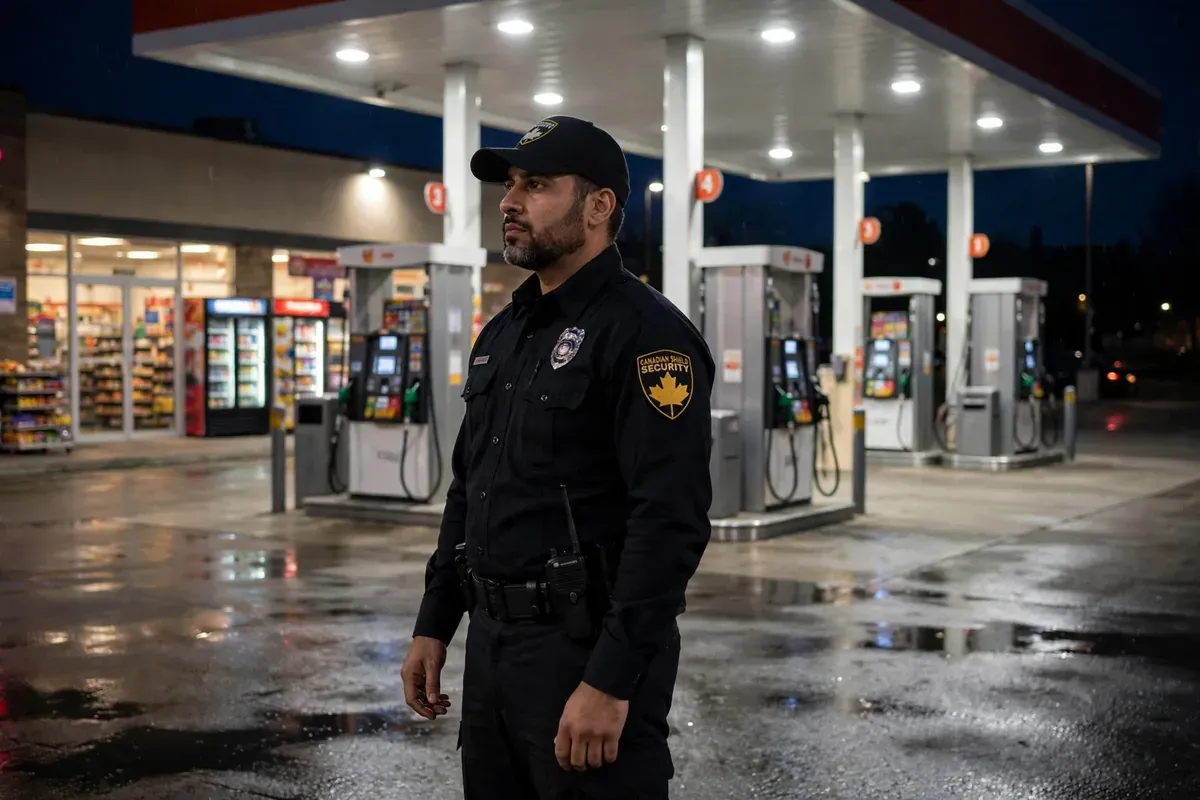
A property manager overseeing a mid-rise office tower on Jasper Avenue in the T5J core learned her building's after-hours risk the hard way when a cleaning crew propped open a rear service door for ventilation and a transient individual wandered in undetected for nearly an hour before a tenant working late noticed and called the front desk. No guard was on-site to catch it, and the building had no after-hours access log to even confirm how long the door had been open.
Downtown Edmonton offices face a different risk profile after the workday ends. Foot traffic drops, LRT stations empty out, and the same streets that feel routine at noon change character by 9 p.m. Canadian Shield Security places licensed guards in T5J towers specifically because after-hours coverage requires different planning than a standard daytime post order.
This guide covers what makes downtown Edmonton's after-hours environment unique, the core security measures office buildings need in place, and how to build a plan that holds up whether your tower has one late-working tenant or a full overnight cleaning crew.
|
Downtown Edmonton office security after hours typically requires controlled building access, a monitored alarm or CCTV system, and a clear escalation plan naming Edmonton Police Service for active incidents. Multi-tenant towers near Jasper Avenue and Edmonton Centre often add a static guard or scheduled patrol sweeps, since a locked door alone does not cover shared lobbies, parkades, or service entrances. |
Why After-Hours Security Is Different for Downtown Edmonton Offices
A downtown office building's daytime security relies heavily on natural surveillance: reception staff, foot traffic, and other tenants moving through common areas. All three disappear after hours, leaving gaps that do not exist during business hours.
T5J towers near Jasper Avenue and Edmonton Centre typically share lobbies, parkades, and loading docks across multiple tenants, which means one company's after-hours risk is shared by every other tenant in the building whether they know it or not.
Employees working late alone face a different experience of the same building than they do at 2 p.m. An empty parkade, a dark stairwell, or a lobby with the reception desk unstaffed all feel different after hours, even when nothing has actually changed about the building's underlying risk level.
Edmonton Police Service reported crime and disorder trending down across central Edmonton in 2026, crediting a more proactive policing approach. That is a genuinely positive trend, but downtown advocacy groups have continued pushing for further safety improvements, and police leadership has acknowledged officers still respond to disorder situations overnight in the core.
None of this means downtown Edmonton is unsafe for employees working late. It means the risk profile after 6 p.m. is different enough from the daytime environment that a building's security plan needs to account for it specifically, rather than assuming daytime measures simply carry over.
What Makes Downtown Edmonton's After-Hours Environment Unique
Three factors specific to the downtown core shape after-hours risk in ways a suburban office park does not experience.
|
Factor |
Why It Matters After Hours |
|---|---|
|
Shared building access (T5J towers) |
One tenant's unlocked door or propped entrance affects every tenant sharing that lobby or parkade |
|
LRT and transit proximity |
Stations near Jasper Avenue and Edmonton Centre see reduced ridership and different foot traffic patterns after dark |
|
Downtown disorder calls overnight |
Police response to non-criminal disorder situations concentrates in the core during late-night hours |
|
Service and loading dock access |
Cleaning crews, deliveries, and maintenance staff often use less-monitored entrances after business hours |
None of these factors make downtown Edmonton unusually dangerous. They simply mean an after-hours security plan built for a suburban office park does not transfer directly to a T5J tower without adjustment.
Edmonton Centre and the Jasper Avenue corridor also see later foot traffic than most downtown side streets, thanks to retail and restaurant hours extending into the evening. That later activity is not necessarily a risk, but it does mean a building's after-hours window often starts later than the standard 6 p.m. office close, and a security plan built around an early cutoff can leave a real gap in the hours right after closing.
Core After-Hours Security Measures for Downtown Edmonton Office Buildings
These measures apply whether your building has one after-hours tenant or a full overnight operation. Start with the basics before adding guard coverage on top, since a guard cannot compensate for an access system that lets anyone walk in through a propped service door.
1. Install controlled access on every entrance used after business hours, including service doors and loading docks, not just the main lobby.
2. Set building access to automatically lock after a defined cutoff time, rather than relying on staff to manually lock up each night.
3. Maintain a digital access log showing who entered the building and when, so any after-hours incident can be traced afterward.
4. Position CCTV coverage at every entrance and common area, with footage retained according to Alberta's Personal Information Protection Act requirements.
5. Add a static guard or scheduled mobile patrol for towers with shared lobbies, parkades, or multiple after-hours tenants.
6. Post emergency contact information, including Edmonton Police Service's non-emergency line, at every after-hours entrance and reception area.
7. Brief cleaning crews and maintenance staff on after-hours access protocol directly, since they are often the ones opening service doors.
A guard's post order for an after-hours downtown shift should explicitly cover shared-tenant access points, not just the space one company occupies, since a gap anywhere in a shared building becomes everyone's problem.
|
COMPLIANCE ALERT Under the Security Services and Investigators Act (Alberta), every after-hours guard must hold a valid SSIA licence, the same as daytime guards. Confirm licensing before assigning any guard to an overnight or evening shift. |
After-Hours Risk by Building Type
Not every downtown office building faces the same after-hours exposure. Building configuration changes what actually needs coverage.
|
Building Type |
Primary After-Hours Risk |
Typical Coverage Needed |
|---|---|---|
|
Single-tenant office (T5J) |
Isolated late-working employees, limited natural surveillance |
Access control plus monitored alarm, guard optional |
|
Multi-tenant tower with shared lobby |
One tenant's access gap exposes all tenants |
Static lobby guard or scheduled patrol sweeps |
|
Building with attached parkade |
Vehicle-level access separate from building entrances |
Parkade patrol and camera coverage, gate control |
|
Building with loading dock/service entrance |
Cleaning and delivery access outside normal hours |
Access logging plus staff briefing on protocol |
When to Call Police vs. Security for Downtown After-Hours Incidents
Most after-hours issues in downtown office buildings are access and presence problems: a propped door, an unauthorized person in a common area, or an alarm trigger with no clear cause. These are exactly what a licensed guard is trained to handle first.
A guard's response to a routine access issue looks different from a criminal incident, and knowing which category a situation falls into is part of the guard's training. A person sleeping in a stairwell is usually a disorder or wellness matter handled through observation and reporting. A forced door or an active threat is immediately a police matter, no judgment call required.
For active criminal incidents, always contact Edmonton Police Service first. SSIA-licensed security guards are trained to observe and report; they do not replace police authority or emergency services, and this distinction matters as much downtown as anywhere else in Edmonton, regardless of how quiet the core has been recently.
Canadian Shield Security's guards coordinate directly with Edmonton Police Service when an after-hours situation escalates beyond routine access control, giving downtown property managers a documented handoff rather than a guessing game about who should respond.
Building a Long-Term After-Hours Security Plan for Your Downtown Edmonton Office
A one-time security setup rarely stays adequate for long in a downtown tower with tenant turnover. Review your after-hours plan whenever a new tenant moves in, hours change, or shared common areas get renovated.
Coordinate with other tenants in shared buildings rather than treating after-hours security as a single-company decision. A property manager or building association setting one consistent access standard closes gaps that individual tenant policies leave open.
Set a recurring quarterly walk-through of your after-hours access points, checking that automatic locks are functioning, cameras have not drifted out of position, and signage naming emergency contacts is still current. A plan that looked complete at installation can quietly develop gaps over a year of normal wear, tenant turnover, and maintenance work.
Document every after-hours incident, no matter how minor, in the same way you would a daytime one. A pattern of small issues, such as the same service door being found unlocked twice in one month, is far easier to catch across a documented log than through memory alone.
Edmonton winters shift after-hours risk timing further, since darkness falls earlier and fewer people linger downtown after work in cold months. Adjust guard patrol timing and lighting checks seasonally rather than running the same schedule year-round.
Conclusion
Downtown Edmonton's after-hours environment is genuinely different from a suburban office park, not more dangerous by default, but different enough that a copied security plan leaves real gaps. Controlled access, logging, CCTV, and the right level of guard coverage close those gaps before they become an incident.
If your T5J building's after-hours plan has not been reviewed since your last tenant change, that review is worth doing now rather than after a door gets propped open on the wrong night.
|
Canadian Shield Security serves Edmonton 24/7. Free consultation -- no hidden fees. Call 1 (800) 326-7879. |
Frequently Asked Questions
Do after-hours office guards in downtown Edmonton need to be licensed?
Yes. Every guard covering an after-hours shift in a downtown Edmonton office building must hold a valid licence under the Security Services and Investigators Act (Alberta), the same as daytime guards. Canadian Shield Security confirms licensing for every guard assigned to T5J towers before their first overnight or evening shift.
How much does after-hours security cost for a downtown Edmonton office building?
After-hours coverage typically runs $18 to $28 per hour per guard, depending on whether you need a static lobby guard, mobile patrol sweeps, or both. Canadian Shield Security provides a free site assessment and a custom quote reflecting your building's actual after-hours risk, with no hidden fees.
Does Canadian Shield Security cover office buildings outside the downtown core?
Yes. Canadian Shield Security provides office security across Edmonton and surrounding areas, including Sherwood Park, St. Albert, Leduc, Beaumont, Nisku, Acheson, Stony Plain and Spruce Grove, alongside downtown towers along Jasper Avenue and throughout the T5J district. Coverage includes both after-hours guard placement and mobile patrol for buildings outside the downtown core.
Is downtown Edmonton safe for employees working late?
Edmonton Police Service has reported crime and disorder trending down across central Edmonton in 2026 due to proactive policing efforts. Downtown remains generally safe, though after-hours disorder calls still occur overnight. A licensed guard and clear access control meaningfully reduce risk for employees working late in T5J towers.
What security measures do downtown Edmonton office towers need after hours?
At minimum, controlled building access, a monitored alarm or CCTV system, and a clear escalation plan naming Edmonton Police Service for active incidents. Multi-tenant towers with shared lobbies or parkades typically add a static guard or scheduled patrol sweeps to cover access points a locked door alone cannot secure.
