
It is 4 a.m. on a January morning in Nisku Industrial Park, T9E, and the alarm at a warehouse on 8th Street has gone off twice in one night. The first time, the patrol guard finds a side door hanging open and a padlock cut clean through. The second time, the same guard catches two men loading copper cable into a van at the back dock. Our Canadian Shield Security team plans warehouse coverage from our Edmonton base at 3536 33 Ave NW, Mill Woods, T6L 5G6.
This guide is for a warehouse manager or owner in Edmonton, Nisku, Acheson or Leduc who wants to stop break-ins before they happen. It covers how thieves get into warehouses, what actually stops them, what Alberta law requires, and what to do in the first hour after a break-in. Our warehouse security service and our CCTV monitoring service work together across the Edmonton region, day and night.
A warehouse break-in costs more than the stock that walks out the door. Doors, locks and alarm panels need repair, insurance claims take weeks, and staff lose a working day while police take statements. Prevention costs less than one break-in.
Warehouse break-in prevention in Edmonton means layered security: strong locks and reinforced dock doors, CCTV at every entry point, alarm monitoring, and after-hours patrols by SSIA-licensed guards. Warehouses in Nisku and Acheson are targeted after hours, when yards sit empty and dark. The strongest setup pairs physical barriers with guards who check the site at random times.
Why Edmonton Warehouses Get Targeted
Edmonton sits at the centre of a large industrial region. Nisku Industrial Park lies just south of the city, minutes from Highway 2 and Edmonton International Airport, and Acheson sits west of the city along Highway 16, a planned industrial park of about 10,000 acres with more than 400 businesses. Amazon runs a 2.9 million square foot distribution centre in Acheson. Warehouses in these parks hold tools, copper, electronics and parts that thieves can sell fast.
Copper is one of the main targets. Edmonton Police Service reported about 424 copper-wire theft reports this year and 40 arrests, and investigated four incidents between January 2025 and February 2026, including two break-ins at telecommunications tower sites, with more than $80,000 in damage and stolen property. Warehouses store the same copper cable and fittings, often in open racks near the dock.
Yards sit empty after hours, and Edmonton winter nights are long and dark. A warehouse with no guard, no camera and no alarm response is an easy choice for a thief. A site that shows lights, cameras and a patrol vehicle is a harder choice, and thieves usually move on.
How Thieves Get Into a Warehouse
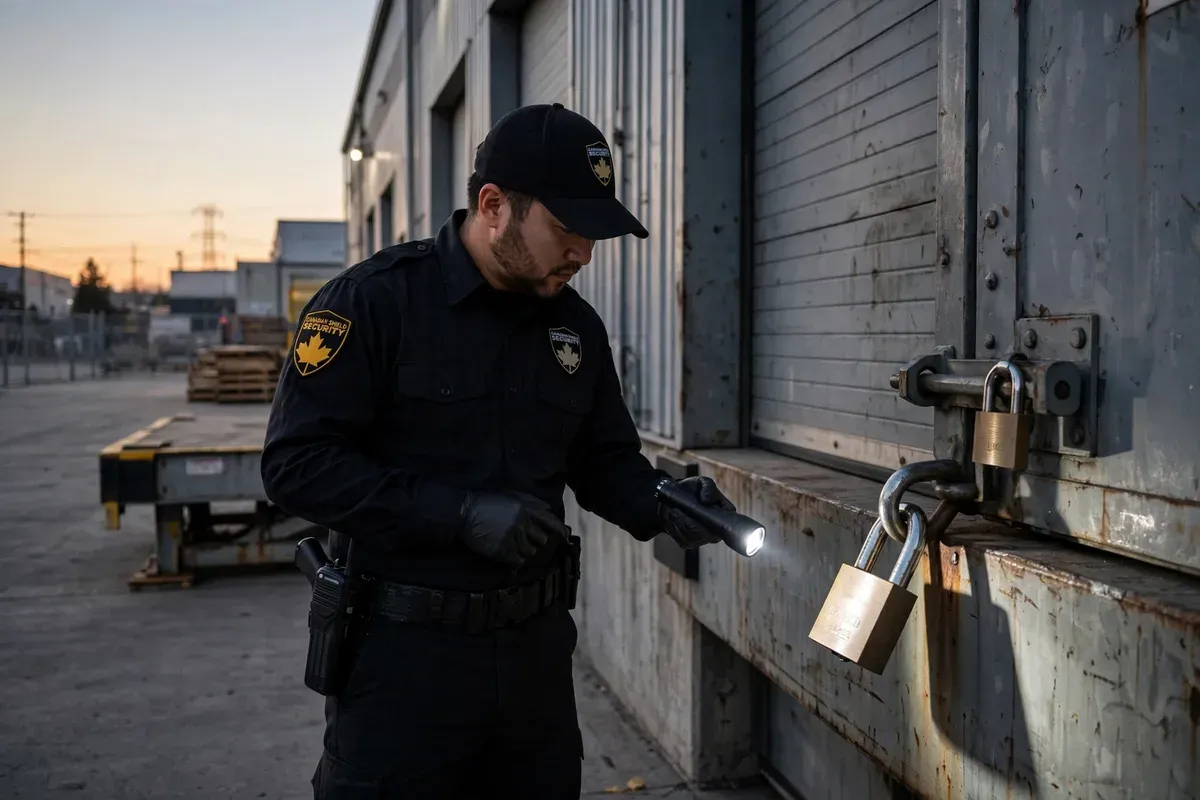
Most warehouse break-ins use the same few entry points. Loading dock doors are left open or unlocked during deliveries and never checked at closing time. Side and rear doors have weak locks or glass beside the lock that a thief can smash and reach through. Roof hatches and skylights give quiet access from above, and fences get cut at the far corner where nobody looks.
Insider knowledge is the other way in. Former staff, delivery drivers and contractors know the layout, the alarm codes and the shift pattern. A code that has not changed in two years is a code that too many people know. Change alarm codes and collect keys whenever staff leave.
Edmonton winters add their own problems. Temperatures reach minus 40, and frozen locks, dead batteries in wireless sensors and cameras that stop working in the cold all leave gaps in a security setup. Our construction site break-in guide shows the same winter thinking at Edmonton build sites.
The Warehouse Security Checklist
Walk your warehouse with this checklist and fix the weak points before a thief finds them. Start at the street and work inward: the fence, the gate, the yard, the dock, the doors and the alarm panel.
| Weak Point | What to Fix | Why It Works |
|---|---|---|
| Loading dock doors | Reinforced doors, deadbolts, dock locks, close after every delivery | Docks are the first target after hours |
| Side and rear doors | Solid-core doors, commercial deadbolts, no glass near locks | Stops quick pry attacks at quiet doors |
| Windows and skylights | Bars or security film, sensors on ground-floor windows | Blocks quiet entry after dark |
| Yard and fence | Full fence, locked gate, clear sightlines, no pallets by the fence | No cover and no climbing aid |
| Lighting | Bright lights at docks, doors and yard corners on motion sensors | Thieves avoid lit sites |
| Alarm and CCTV | Monitored alarm, cameras at every door, signs posted | Response in minutes, evidence on record |
| Keys and codes | Change codes when staff leave, log keys, no shared codes | Stops access from former staff |
CCTV and Alarm Monitoring That Actually Helps
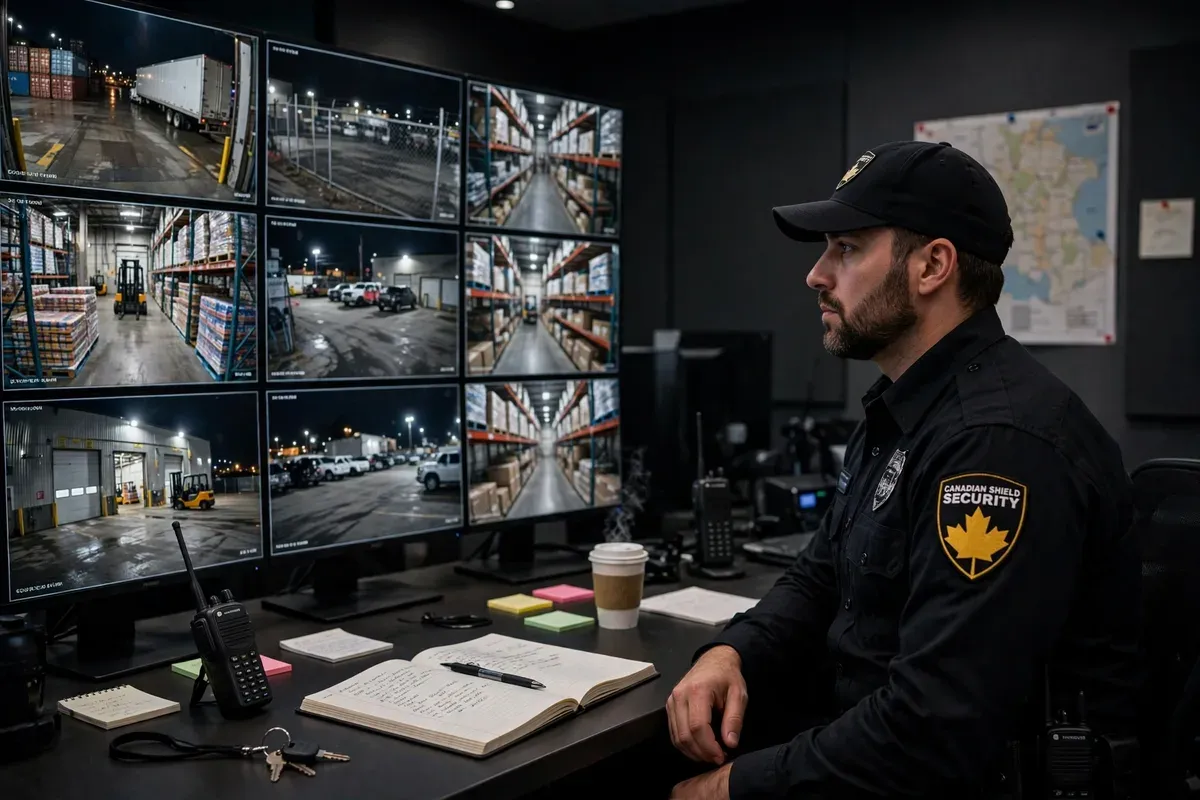
Cameras must cover every door, dock, yard gate and roof access point, and the recording must be stored off site so a stolen recorder does not take the evidence with it. Check every camera weekly, because a dead camera is no help after a break-in. A camera nobody watches is only a record, not protection, so pair cameras with live monitoring.
Alarm monitoring turns a sensor trip into a response. When a sensor trips after hours, the monitoring centre calls the guard or the police. Test the alarm every month and keep the contact list current so the call reaches the right person. Our alarm response service answers alarm calls across Edmonton around the clock.
After-Hours Patrols and On-Site Guards
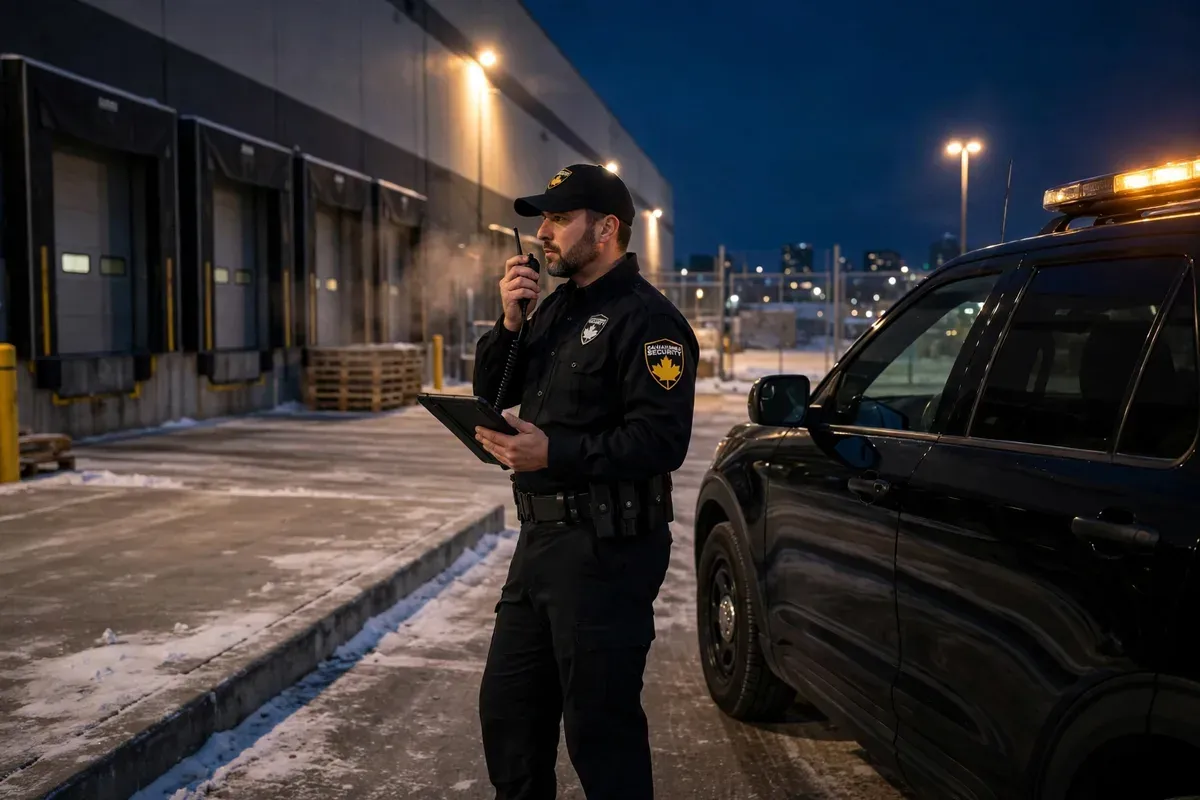
Patrols work because thieves cannot time them. A patrol guard visits at random intervals, checks every door and lock, walks the yard, and logs each check. The patrol vehicle in the yard is a clear sign the site is watched. Our mobile patrol service runs these checks across Nisku, Acheson and Edmonton industrial zones.
An on-site guard suits a warehouse with high-value stock or a history of repeat break-ins. The guard stays on the property, controls the gate and checks every delivery. A patrol suits a site that needs regular checks at a lower cost. Both options use SSIA-licensed guards. The right choice depends on what you store.
What Alberta Law Requires
Every guard at your warehouse must hold a licence. Under the Security Services and Investigators Act (Alberta), a guard must complete an approved training course, score 80 percent or higher on the provincial exam, and hold a licence that costs $100 and lasts two years. Applicants must be 18 or older, eligible to work in Canada, fluent in English, and free of a criminal record. Guards must carry the original licence card while working. See the official licensing page.
Canadian Shield Security holds SSIA business licence B001449, and every guard we place at a warehouse holds an individual licence of their own. Ask any security company for its business licence number before you sign, and check that the guards it sends carry their cards.
CCTV brings its own rules. Alberta's Personal Information Protection Act (PIPA) governs how a business collects, uses and keeps camera footage, so post clear signs that cameras are in use, limit who can view the footage, and keep recordings only as long as you need them.
One honest limit matters here. For an active break-in, always call Edmonton Police Service first. SSIA-licensed security guards are trained to observe and report, and they do not replace police authority or emergency services.
What to Do in the First Hour After a Break-In
- Call Edmonton Police Service first, and do not enter the building alone if the intruder may still be inside.
- Preserve the scene: do not touch doors, locks or broken glass, and keep staff out of the area until police arrive.
- Save CCTV footage before it is overwritten, and note the exact times the alarm tripped.
- Walk the site with the guard or manager and list every damaged door and lock and every missing item for the police report.
- Call your insurer, then book a security review so the same entry point cannot be used twice.
Our truck yard security guide applies the same thinking to industrial yards. Warehouse break-in prevention is not a single lock on a single door. It is a system: a fence and gate that slow entry, doors and locks that hold, cameras and alarms that raise the alert, and guards who check the site at random times.
Are security guards for Edmonton warehouses required to be licensed?
Yes. Every guard in Alberta must hold a licence under the Security Services and Investigators Act (Alberta). Guards complete an approved training course, pass a provincial exam at 80 percent or higher, and pass a criminal record check. The licence costs $100 and lasts two years, and guards must carry the card while working.
How much does warehouse security cost in Edmonton?
It depends on the size of the warehouse, the number of guards, the hours of cover, and whether you need an on-site guard, mobile patrols, CCTV monitoring or all three. A large distribution centre with a busy dock costs more than a small storage warehouse. Ask for a written quote that lists guards, hours and patrols.
Does Canadian Shield Security cover warehouses in Nisku and Acheson?
Yes. We cover warehouses in Nisku Industrial Park, Acheson, Leduc and Sherwood Park from our Edmonton base, day and night, with on-site guards and mobile patrols. Guards arrive with the right licence and briefed on your site rules. Call 1 (800) 326-7879 to arrange coverage for your warehouse today.
What is the most common way thieves break into a warehouse?
Thieves enter through loading dock doors left open or unlocked, side and rear doors with weak locks, or roof hatches and skylights. Fences get cut at the far corner, and delivery trucks let thieves tailgate through the gate. Most break-ins happen after hours, when the yard is empty and dark, so check every door at the end of each shift.
Should I hire a guard or install CCTV for my warehouse?
Both work best together. CCTV records what happened and gives police evidence, but a camera alone cannot stop a thief in the act. A guard or a mobile patrol responds on the spot, checks doors and locks, and calls police. Pairing cameras with patrols gives you a record and a response for less than a full-time guard.
Canadian Shield Security Editorial Team, Edmonton, Alberta
Canadian Shield Security guards warehouses across Edmonton, Nisku, Acheson and Leduc, 24/7. Free consultation -- call 1 (800) 326-7879 or request a free consultation.
