
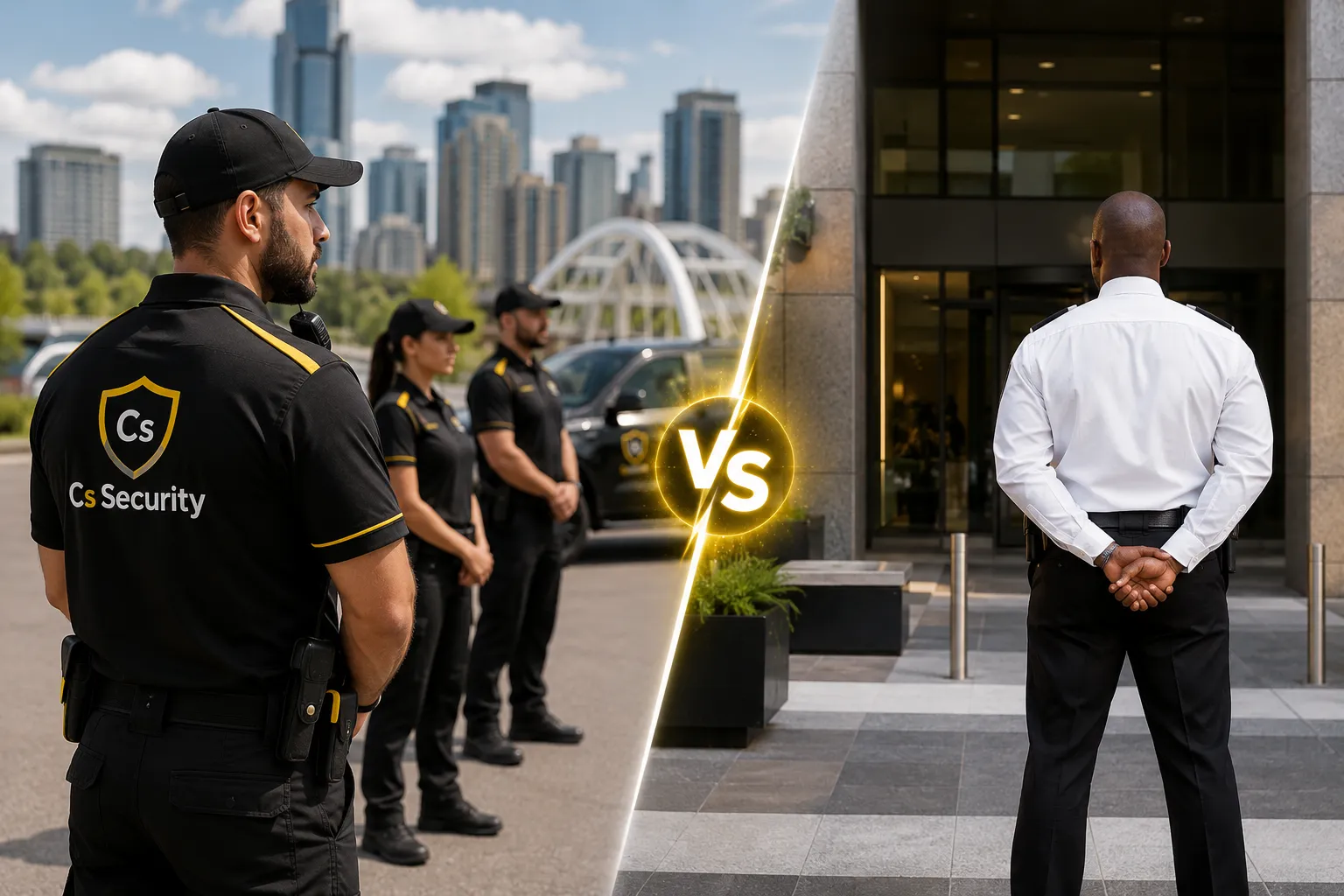
An HR manager at a growing logistics company near Edmonton's T6H office corridor spent weeks pricing out an in-house security team, assuming it would sidestep the complexity of hiring through an agency. Alberta's own licensing rules made it clear that going in-house does not mean going unregulated.
Under the Security Services and Investigators Act (Alberta), a business that hires its own guards needs its own security business licence, the same law that governs every contracted on-site guard placement in the province.
This guide compares staffing agencies and in-house guards on cost, liability, and licensing obligations, so Edmonton HR managers can make the decision with full information, not assumptions.
|
Security staffing agencies in Edmonton hold a contract business licence and handle guard licensing, insurance, and scheduling directly. Building an in-house team requires the hiring business to obtain its own registered-user security business licence, carry at least one million dollars in liability insurance, and report incidents to Alberta Justice, the same obligations an agency already carries. |
Security Staffing Agencies vs In-House Guards: The Core Difference
The core difference between a security staffing agency and an in-house team is who carries the licensing and administrative burden, not just who signs the paycheque. A staffing agency already holds a contract business licence under the Security Services and Investigators Act (Alberta), meaning it can legally provide guards to other businesses, and it absorbs the ongoing work of licensing, scheduling, and replacing individual guards as staff turn over.

An in-house team means the hiring business itself becomes a licensed security business, specifically under a registered-user licence category built for exactly this situation, distinct from a contract licence in what it permits and requires. Both paths end with licensed, background-checked guards on site, doing the same core work of observing, deterring, and reporting.
The difference is entirely in who carries the regulatory weight of getting them there and keeping them compliant year after year, renewal after renewal, and that weight is heavier than most HR managers expect going in.
|
Going in-house is not a way to avoid SSIA licensing. It shifts which type of business licence applies, from contract to registered-user, not whether one is required. |
The Licensing Requirement Most Businesses Miss About In-House Guards
Most businesses researching in-house security assume hiring guards directly is a simple HR decision, and this is the single biggest misconception in the comparison. Under the Security Services and Investigators Act, a business that employs its own security staff must hold a registered-user business licence, separate from and in addition to each guard's individual SSIA licence.
This registered-user licence costs 1,200 dollars for a 3-year term, requires at least 1 million dollars in liability insurance, and comes with ongoing obligations to report incidents, new hires, and terminations to Alberta Justice, the same reporting duties a contracted agency already handles as part of its normal operations. A registered-user licence also cannot be used to provide services to the public or other businesses, which matters if a company ever considers offering security services beyond protecting its own property, since that would require an entirely different licence category.
Businesses that skip this step and simply add security duties to existing staff without licensing are operating outside the law, regardless of intent, and risk fines or forced closure of the arrangement if Alberta Justice identifies the gap during an audit or complaint review.
|
Factor |
Contract Business (Agency) |
Registered-User Business (In-House) |
|
3-year licence fee |
$1,500 |
$1,200 |
|
Can serve other businesses |
Yes |
No -- own property only |
|
Liability insurance minimum |
$1 million |
$1 million |
|
Owner/director criminal record check |
Required |
Not required |
|
Incident/hire/termination reporting |
Required to Alberta Justice |
Required to Alberta Justice |
|
Individual guard SSIA licence |
Required for every guard |
Required for every guard |
What a Security Staffing Agency Actually Handles for You
A security staffing agency operating under a contract business licence handles the entire licensing and compliance burden as part of its core business, not as a side task bolted onto another department. This includes verifying every guard's individual SSIA licence before deployment, maintaining the 1 million dollar liability insurance the province requires, managing uniform and identification compliance down to lettering size, and absorbing the criminal record check requirements that apply to a contract business's owners and directors.
Agencies also handle the operational reality of running a security team: covering sick days and vacations without gaps, replacing guards who leave for other jobs, and managing the training pipeline for new hires so a client never sees a coverage gap. For an Edmonton HR manager, this means the agency route converts an ongoing regulatory and staffing responsibility into a single vendor relationship and a predictable monthly invoice, rather than a permanent addition to the HR department's workload.
Comparing the Real Costs: Agency Fees vs In-House Payroll
Comparing costs requires looking past the hourly rate on an agency invoice versus an in-house guard's wage, since the two numbers are not measuring the same thing. An agency's rate already includes the guard's wage, the agency's own licensing and insurance costs, training, scheduling coverage, and a margin for administrative overhead built into every hour billed.
An in-house guard's wage looks lower in isolation, but the true cost adds the business's own registered-user licence fee, 1 million dollar liability insurance premium, WCB coverage, recruitment and training costs, and the administrative time spent managing scheduling gaps and turnover, none of which shows up on a simple wage comparison. Smaller Edmonton businesses needing one or two guard positions typically find the agency route more cost-efficient once these hidden costs are counted line by line, while larger operations with a dedicated security department and enough guard headcount may find the economics shift toward in-house at sufficient scale, where fixed licensing costs spread across many positions.
A useful exercise is pricing out both models for the exact same coverage hours over a full year, not a single shift, since annual totals reveal patterns an hourly rate comparison alone tends to hide.
Liability: Who's on the Hook When Something Goes Wrong
Liability exposure differs meaningfully between the two models, and this is often the deciding factor for HR managers once they understand it fully. When a business contracts a staffing agency, the agency carries primary liability for its guards' conduct as their actual employer, though the client business can still face secondary exposure depending on the contract terms and the specific incident involved.
When a business builds an in-house team, that business is the direct employer of record for every guard, meaning it carries full employer liability for hiring decisions, training adequacy, supervision, and any incident a guard is involved in while on duty, with no intermediary absorbing part of that exposure. This shifts risk that many businesses do not realize they are taking on simply by choosing to hire security staff directly rather than through a licensed intermediary already built, insured, and staffed to carry that exposure as its core function.
Insurance underwriters are increasingly aware of this distinction too, and some commercial policies price coverage differently depending on whether security staff are direct employees or contracted through a licensed agency.
|
Neither model changes a guard's legal authority, which never exceeds that of a private citizen. The difference is which business bears employer liability if something goes wrong. |
Which Option Fits Your Edmonton Business
Choosing between a staffing agency and an in-house team comes down to scale, risk tolerance, and how much administrative capacity a business actually wants to dedicate to security operations rather than its core work. A single Edmonton office, retail location, or small commercial property is almost always better served by a staffing agency, since the fixed costs of a registered-user licence and insurance do not make sense for one or two guard positions running only a handful of shifts each week.
A large campus, multi-building portfolio, or organization with an existing HR and compliance infrastructure may find in-house staffing worthwhile once guard headcount is high enough to spread the fixed licensing costs across many positions and justify a dedicated internal security manager. Businesses uncertain which category they fall into should run the actual numbers, licensing fees, insurance, turnover costs, and administrative time, before assuming either option is automatically cheaper based on wage comparisons alone.
A hybrid approach, contracting an agency for baseline coverage while building limited in-house capacity for a specific need, is also worth considering for businesses that do not fit neatly into either category.
How Canadian Shield Security Supports Both Paths
Canadian Shield Security operates as a licensed contract business, carrying the full licensing, insurance, and guard management burden so Edmonton clients never have to weigh a registered-user licence application against their core business operations. Every guard deployed holds an active individual SSIA licence, verified before the first shift, with scheduling and coverage gaps handled internally rather than becoming the client's problem to solve on short notice.

For businesses still weighing agency versus in-house, Canadian Shield Security's consultation and planning service walks through the real cost and liability comparison for that specific property, using actual guard counts and risk factors rather than a generic industry estimate. This gives HR managers an honest, specific answer before committing to either path, grounded in their actual guard count, property risk profile, and internal administrative capacity, not a one-size-fits-all sales pitch toward whichever option is easier to sell.
Clients who start with an agency contract and later consider building internal capacity can revisit that comparison at any point, using real usage data instead of projections.
Conclusion
Security staffing agencies and in-house guards are not simply two different prices for the same service. They are two different licensing structures under Alberta law, each with its own insurance, reporting, and liability obligations that most side-by-side comparisons skip entirely in favour of a simple wage number.
Edmonton HR managers who understand the registered-user licence requirement before building an in-house team avoid a costly surprise partway through the process, once applications and insurance quotes are already underway. Canadian Shield Security helps clients run the real comparison, cost, liability, and licensing together, before a decision gets made rather than after.
|
Canadian Shield Security serves Edmonton 24/7. Free consultation, no hidden fees. Call 1 (800) 326-7879. |
Frequently Asked Questions
Does an in-house security team need its own Alberta business licence?
Yes. Under the Security Services and Investigators Act, a business that employs its own security staff must hold a registered-user business licence, separate from each guard's individual SSIA licence. This requires at least 1 million dollars in liability insurance and ongoing incident reporting to Alberta Justice, the same obligations a staffing agency already carries.
Is a security staffing agency more expensive than in-house guards in Edmonton?
Not necessarily once hidden costs are counted. An agency's rate includes licensing, insurance, and scheduling coverage built in, while in-house guards add a separate business licence fee, liability insurance, WCB coverage, and turnover costs on top of wages. Smaller businesses typically find agencies more cost-efficient once these factors are included.
Does Canadian Shield Security provide staffing in Sherwood Park and St. Albert?
Yes. Canadian Shield Security operates as a licensed contract security business serving Edmonton, Sherwood Park, St. Albert, Leduc, Beaumont, and Nisku, with 24/7 coverage including nights, weekends, and holidays. Every guard holds an active SSIA licence verified before deployment to any client site.
Can a business avoid SSIA licensing by hiring guards directly?
No. Hiring guards directly still requires the business to obtain its own registered-user security business licence under the Security Services and Investigators Act, in addition to each guard holding an individual SSIA licence. There is no path to legally employing security staff in Alberta without licensing at both levels.
What's the difference between a contract and registered-user security business licence?
A contract business licence allows a company to provide security guards to other businesses, which is how staffing agencies operate. A registered-user licence allows a business to employ guards only to protect its own property, and cannot be used to offer security services to the public or other companies.
