
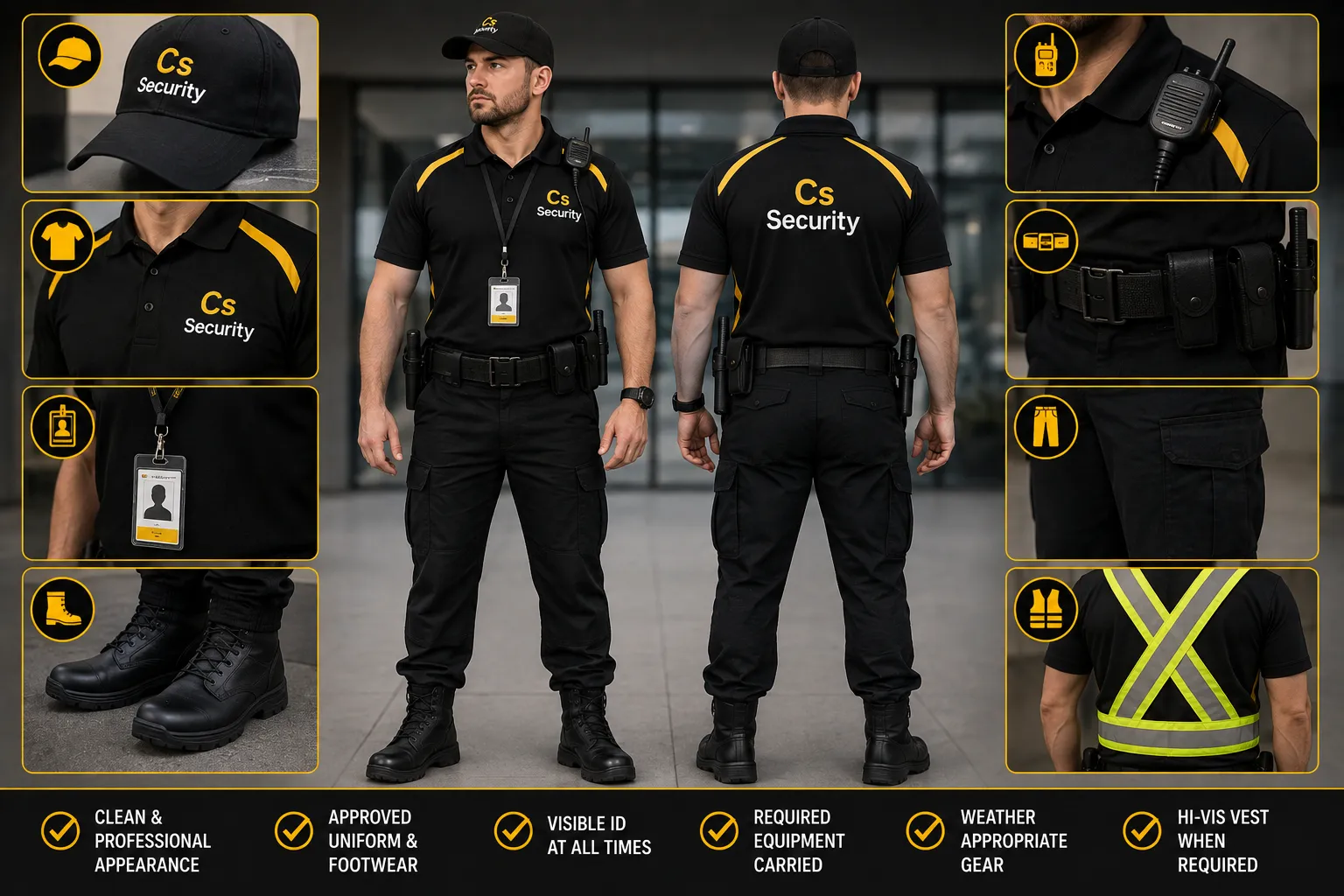
An HR manager overseeing vendor contracts for a Downtown Edmonton (T5J) office campus once flagged a subcontracted guard whose uniform carried no visible identification at all, just a plain black polo shirt with no lettering anywhere on it. The vendor's explanation, that the guard was between uniform shipments, was not good enough.
Alberta law does not treat visible identification as optional, and the regulation spells out exactly what is required.
That identification requirement comes directly from the regulation under the Security Services and Investigators Act (Alberta), the same law that governs every on-site guard contract in the province.
This guide explains exactly what Alberta requires on a security guard's uniform, what counts as acceptable identification, and what HR managers should check before signing a vendor contract.
|
Alberta requires a security guard's uniform to display SECURITY, SECURITY GUARD, or SECURITY AGENT on the front, back, and both shoulders in contrasting lettering, plus a shoulder flash showing the employer's name. Guards wearing a suit or blazer need a lapel identification tag instead. Uniforms cannot resemble police attire, and every guard must carry their licence card while working. |
What Alberta Law Actually Requires on a Security Guard Uniform
Alberta's uniform rules for security guards come from the Security Services and Investigators (Ministerial) Regulation, made under the Security Services and Investigators Act (Alberta). Every shirt, sweater, vest, coverall, and jacket a guard wears on duty must display the word SECURITY, SECURITY GUARD, or SECURITY AGENT clearly on the front, the back, and both shoulders.
The lettering must be a colour that contrasts with the uniform itself, at least 1.5 centimetres high on the front and shoulders, and at least 5 centimetres high on the back, where it needs to be readable from a distance.

Guards also need a shoulder flash on the upper sleeve showing the name of the business they work for, separate from the SECURITY lettering itself. These are not suggestions or best practices.
They are specific, measurable requirements a business licensee is expected to meet for every uniformed guard deployed in Alberta, and a vendor that cannot produce a uniform meeting these exact specifications is not meeting its licensing obligations, regardless of how professional the uniform looks otherwise.
|
Uniform Element |
Alberta Requirement |
|
Front lettering |
SECURITY / SECURITY GUARD / SECURITY AGENT, contrasting colour, min 1.5cm high |
|
Back lettering |
Same wording, contrasting colour, min 5cm high |
|
Shoulder lettering |
Same wording on both shoulders, min 1.5cm high |
|
Shoulder flash |
Employer business name, upper sleeve, both arms |
|
Suit or blazer alternative |
Lapel identification tag with same wording plus employer name |
|
Police resemblance |
Prohibited -- uniform and shoulder flash cannot resemble police attire |
Why Security Uniforms Cannot Resemble Police Attire
Alberta specifically prohibits a security guard's uniform from resembling a uniform used by police officers or other law enforcement agencies, and this rule exists to prevent public confusion about who actually holds police authority. A guard in a uniform that could be mistaken for police creates a serious problem, since the public, and sometimes the guard themselves, may assume the guard has powers they do not actually have, such as the authority to conduct searches or make arrests beyond a narrow citizen's arrest.
This also protects legitimate police work, since impersonation concerns can complicate an actual police response if bystanders cannot tell who is who during an active incident. Shoulder flashes are held to the same standard: they cannot resemble a shoulder flash used by a police agency or other peace officer agency, even if the colours or general style happen to be similar by coincidence.
This distinction matters more than it might seem, since a security company choosing uniform colours and badge styles has real legal boundaries to work within, not just aesthetic preferences to consider.
|
Security guards hold the same legal authority as any private citizen, never police powers. Uniform and shoulder flash rules exist partly to keep that distinction clear to the public. |
What Guards Must Carry for Identification, Beyond the Uniform
Beyond the uniform itself, every Alberta security guard must carry identification that goes further than a name tag. Guards are required to carry their original licence card with them while working, and to provide their employer with a photocopy of that same card on file before the first shift.
For guards whose uniform is a suit or blazer rather than a standard uniform shirt, the lettering requirement is replaced with a lapel identification tag that clearly displays SECURITY, SECURITY GUARD, or SECURITY AGENT along with the business licensee's name. This means a guard working a corporate reception desk in business attire still needs visible, verifiable identification, just in a different format than a guard in a standard uniform shirt.
An HR manager verifying compliance should ask to see both the uniform lettering and confirmation that guards are carrying their licence cards, since the two requirements are separate and both are mandatory, and a vendor meeting only one of them is still out of compliance.
|
Every guard must carry their original SSIA licence card while working and give their employer a photocopy on file. This is separate from, and in addition to, uniform lettering requirements. |
Which Guards Are Exempt from Uniform Requirements
Not every licensed security role in Alberta is subject to the same uniform requirements. Certain licence classes are exempt from the standard uniform rules altogether, which typically applies to roles where a uniform would work against the job itself, such as certain investigative or plainclothes functions where blending in is the point.
Executive security workers and loss prevention workers fall into a specific middle category: if their employer requires them to wear a uniform, that uniform must still meet the same lettering, contrast, and shoulder flash standards as any other security uniform, even though the base licence class is technically exempt. This distinction matters for HR managers hiring for different roles, since a loss prevention worker in a retail environment may reasonably work in plainclothes for the job to function, while a static guard stationed at a building entrance is expected to be visibly identifiable at all times.

Confirming which category a role falls into before deployment avoids a compliance gap that is easy to miss, particularly when a single vendor contract covers multiple guard types across one property, such as a static entrance guard alongside a plainclothes loss prevention worker in the same retail complex.
What HR Managers Should Check Before Signing a Security Vendor Contract
HR managers vetting a security vendor should verify uniform and identification compliance directly rather than assuming a licensed company automatically gets every detail right. Ask to see a photo of the actual uniform being deployed, not a stock photo from a sales brochure, and confirm the lettering meets the size and contrast requirements rather than taking a verbal assurance at face value.
Request written confirmation that guards carry their individual licence cards on shift and that the vendor keeps photocopies on file for each guard assigned to the contract, updated whenever staffing changes. For any role using a suit or blazer instead of a standard uniform, confirm the lapel tag requirement specifically, since this detail is easy for a vendor to overlook when their default answer focuses on standard uniform shirts.
A vendor that answers these questions specifically and quickly is a stronger signal of genuine compliance than one that responds with general reassurances about professionalism or experience, since specificity is hard to fake and vague reassurance is easy to offer regardless of what is actually happening on site.
What Happens When a Guard's Uniform or ID Doesn't Comply
A guard whose uniform or identification does not meet Alberta's requirements creates real exposure for both the security company and the client business that hired them. The business licensee is responsible for ensuring its guards comply with uniform standards, and repeated violations can affect that company's standing with Alberta Justice, including complaints or licence review that put every one of that company's contracts at risk, not just the one where the gap was found.
For the client business, an improperly identified guard weakens the legal and practical basis for anything that guard does on their behalf, since proper identification is part of what makes a guard's presence and actions defensible if questioned later by a tenant, visitor, or investigator. It also creates a straightforward public trust problem: a guard who cannot be immediately identified as security, rather than an unknown person on the property, undermines the entire point of having visible security in the first place.
HR managers should treat uniform and ID compliance as a contract term worth verifying periodically, not just at the start of an engagement.
How Canadian Shield Security Handles Uniform and ID Compliance
Canadian Shield Security equips every uniformed guard with lettering, shoulder flashes, and identification that meet Alberta's requirements exactly, checked before deployment rather than assumed to be correct. Guards working in business attire, such as concierge or reception-style roles, carry the required lapel identification tag rather than being left without visible ID simply because they are not in a standard uniform shirt.
Every guard carries their individual licence card while on shift, with photocopies kept on file and available for client review on request at any point during the contract. HR managers evaluating Canadian Shield Security as a vendor can review the company's background and licensing approach directly, and request uniform photos and identification confirmation as part of any service agreement before a single guard is deployed to their site, which turns compliance from an assumption into something verified in writing.
Conclusion
Security guard uniform requirements in Alberta are specific and measurable, not a matter of general professionalism or vendor preference. Lettering size, contrast, shoulder flashes, and licence card carry rules exist so the public, and the hiring business, can always tell who a guard is and what authority they actually carry on that property.
HR managers who verify these details before signing a vendor contract avoid discovering a compliance gap the hard way, during an incident review, an insurance question, or a client complaint. Canadian Shield Security builds uniform and identification compliance into every guard placement from the first shift, not as an afterthought handled only when someone asks.
|
Canadian Shield Security serves Edmonton 24/7. Free consultation, no hidden fees. Call 1 (800) 326-7879. |
Frequently Asked Questions
Do security guards in Alberta need to wear a uniform?
Most do, though a few licence classes are exempt from the standard uniform requirement. When a uniform is worn, or required by the employer for an exempt role like loss prevention, it must display SECURITY, SECURITY GUARD, or SECURITY AGENT in contrasting lettering on the front, back, and both shoulders, along with a shoulder flash.
Does a uniformed guard cost more than a plainclothes guard in Edmonton?
Uniform requirements themselves do not typically change hourly rates, since compliant uniforms are a standard cost of doing business for any licensed provider. Pricing differences between uniformed and plainclothes roles, such as loss prevention, usually reflect the job function and required skill set rather than the uniform itself.
Does Canadian Shield Security provide uniformed guards in Sherwood Park and St. Albert?
Yes. Canadian Shield Security deploys uniformed, compliant guards across Edmonton, Sherwood Park, St. Albert, Leduc, Beaumont, and Nisku, with 24/7 coverage including nights, weekends, and holidays. Every guard's uniform lettering and identification meet Alberta's requirements before the first shift begins.
Can a security guard's uniform look like a police uniform in Alberta?
No. Alberta specifically prohibits security guard uniforms and shoulder flashes from resembling those used by police or other law enforcement agencies. This rule exists to prevent public confusion about a guard's actual authority, which is limited to that of a private citizen regardless of how official the uniform looks.
What ID must a security guard carry while working in Alberta?
Every guard must carry their original SSIA licence card while working and provide their employer with a photocopy kept on file. This applies in addition to uniform lettering or, for guards in a suit or blazer, a lapel tag displaying SECURITY, SECURITY GUARD, or SECURITY AGENT and the employer's name.
