
A restaurant owner on Whyte Avenue hired an evening security guard after two break-ins in one month, then discovered three weeks later that the guard had been sitting in a parked car for most of each shift instead of patrolling. Without a duties checklist to measure against, the owner had no way to know coverage was thin until a third break-in happened during an unpatrolled window.
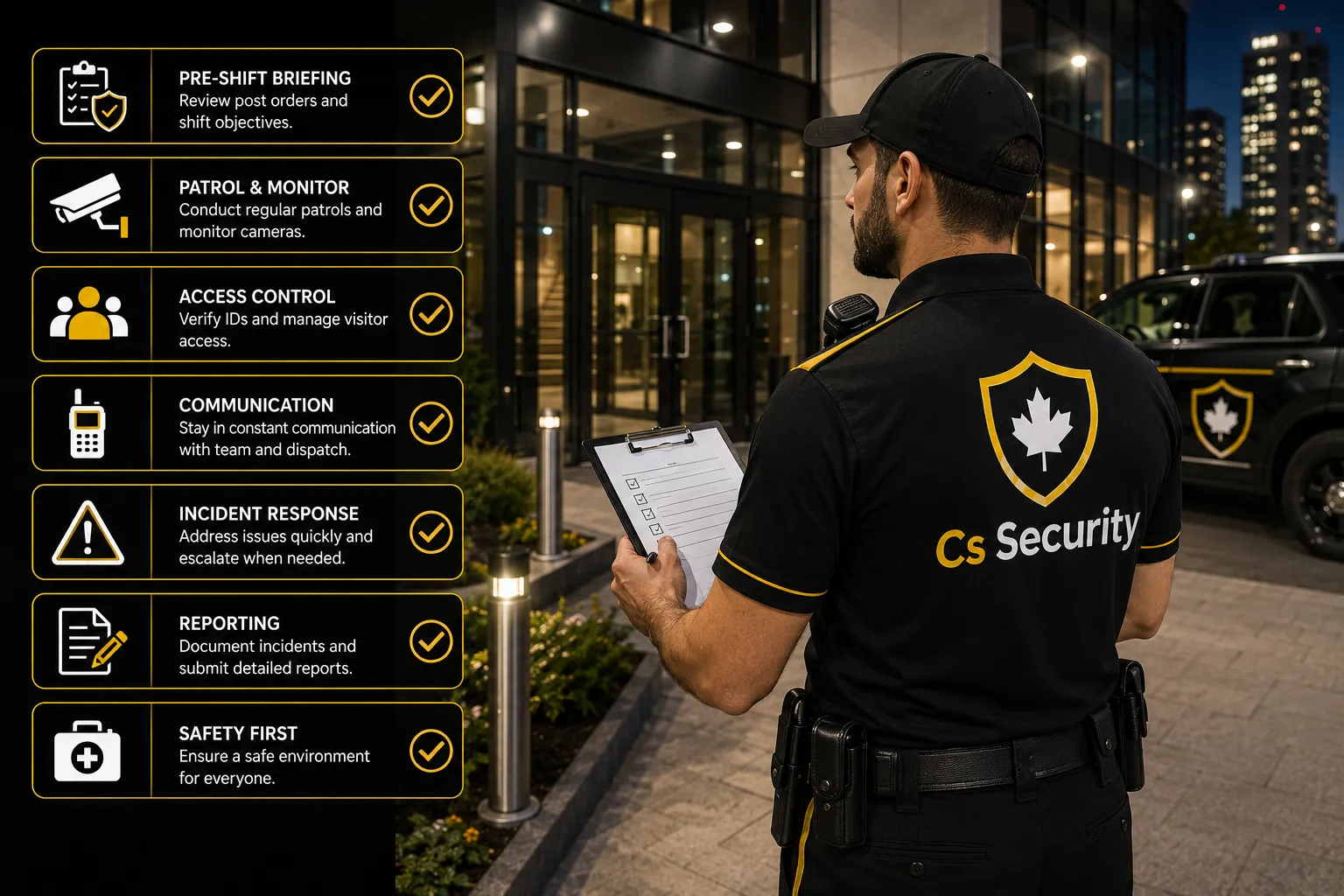
A security guard's shift involves more than standing near a door. Access control, patrol, monitoring, incident reporting, and shift handover are all part of a licensed guard's core duties, whether the site is a T5J office tower or a Whyte Avenue storefront. Canadian Shield Security trains every guard against the same duties checklist regardless of property type.
This checklist covers exactly what to expect on every shift, how to verify a guard is meeting it, and what to do if the duties are not being met.
|
A licensed security guard's shift duties typically include access control, scheduled patrols, CCTV or alarm monitoring, incident documentation, and a shift handover report. Every duty must be performed by a guard holding a valid licence under the Security Services and Investigators Act (Alberta). Business owners should receive shift logs confirming these duties were completed. |
What Should a Security Guard Actually Do During a Shift?
A guard's job is not passive presence. Every shift should involve active duties tied to the property's specific risks, documented in a way the business owner can verify after the fact.
The exact mix of duties depends on the site's post order, but five categories apply to nearly every static or on-site guard assignment in Edmonton: access control, patrol, monitoring, reporting, and handover. A guard missing any one of these categories is not fully covering the shift.
A duties checklist like this one gives a business owner without security expertise a plain-language way to evaluate coverage, whether reviewing a current guard's performance or comparing quotes from different Edmonton security companies before signing a contract.

Business owners without a security background often assume a guard's presence alone deters problems. Presence helps, but a guard actively working through these duties catches issues a passive guard misses entirely, from a propped-open fire door to a suspicious vehicle circling the lot.
The duties on this checklist apply whether you have hired one guard for evening coverage or a full rotating team for 24/7 protection. Scale changes the schedule, not the underlying expectations for what each individual shift should include.
The Core Duties Every Licensed Edmonton Guard Performs
These five duty categories form the backbone of nearly every guard assignment, static or mobile, across Edmonton properties.
|
Duty Category |
What It Involves |
|
Access Control |
Verifying ID, checking visitor lists, managing entry and exit points |
|
Patrol |
Walking or driving scheduled routes, checking doors, gates, and blind spots |
|
Monitoring |
Watching CCTV feeds, responding to alarm triggers, checking equipment status |
|
Incident Reporting |
Documenting anything unusual with time, location, and detail, not just serious events |
|
Shift Handover |
Briefing the incoming guard on open issues, recent activity, and pending tasks |
Post orders define exactly how each duty applies to a specific site. A guard's duties checklist stays consistent across Edmonton, but the post order tells them which doors to check, which cameras to watch, and who to call when something happens at that particular property.
Customer service is a sixth duty many business owners overlook. A guard interacting with staff, customers, or tenants professionally is part of the job, not separate from it, since a hostile or dismissive guard creates its own liability and reputation risk regardless of how well they handle the security-specific duties.
Complete Security Guard Shift Duties Checklist
Use this checklist to know what a properly run shift looks like from start to finish, whether you are reviewing your own guard's performance or evaluating a new provider.
1. Start of shift: Guard arrives on time, in uniform, and reviews the post order and any handover notes from the previous shift.
2. Start of shift: Guard checks all assigned equipment, including radio, flashlight, and any access control devices, confirming everything functions correctly.
3. During shift: Guard conducts scheduled patrols at the intervals specified in the post order, checking doors, gates, and any flagged risk areas.
4. During shift: Guard monitors CCTV feeds or alarm systems continuously where assigned, responding to triggers within the timeframe set by the post order.
5. During shift: Guard verifies identification and authorization for anyone entering restricted areas, logging visitor entries where required.
6. During shift: Guard documents any unusual activity immediately, including time, location, and description, rather than waiting until end of shift to recall details.
7. End of shift: Guard completes a written shift report summarizing patrols completed, incidents logged, and any outstanding issues for the next shift.
8. End of shift: Guard briefs the incoming guard directly whenever possible, rather than relying solely on the written report to communicate open issues.
A guard who cannot produce documentation for these steps when asked is not completing the checklist, regardless of how the shift appeared from the outside. Ask for a sample shift report before signing a contract with any Edmonton security provider, since the format and detail level of that report tells you more about actual duty compliance than any sales conversation will.
|
Under the Security Services and Investigators Act (Alberta), every duty on this checklist must be performed by a guard holding a valid SSIA licence. Confirm licensing status before assigning any guard to your property. |
Common Signs Your Guard Isn't Following Post Order Duties
A handful of warning signs show up repeatedly when a guard is not actually working through the duties checklist, even if nothing has gone visibly wrong yet.
|
Warning Sign |
What It Usually Means |
|
Shift reports are vague or identical each time |
Patrols may not be happening as logged |
|
No incident reports for weeks despite known activity |
Guard may not be documenting minor issues |
|
Guard is difficult to reach during shift |
Coverage gaps or guard is away from post |
|
Handover notes are missing or inconsistent |
Communication breakdown between shifts |
|
Equipment checks are never mentioned in reports |
Equipment status is going unverified |
None of these signs alone proves a problem, but two or more together are worth a direct conversation with your security provider before they compound into a real incident. Trust your own observations too, since a business owner who is on-site regularly often notices patterns in guard behaviour before any report would ever surface them.
When Guard Duties Aren't Being Met: What to Do
Start with the shift reports themselves. If documentation is thin or missing, request a meeting with the security company's supervisor before assuming the worst, since reporting gaps sometimes reflect a training issue rather than a guard skipping duties entirely.
Put any concerns in writing and set a specific timeline for improvement, such as two weeks of complete shift reports before you decide whether to continue the contract. Vague verbal complaints rarely produce lasting change, but a documented expectation with a deadline gives the security company something concrete to act on.
For active criminal incidents, always contact Edmonton Police Service first. SSIA-licensed security guards are trained to observe and report; they do not replace police authority or emergency services, and no duties checklist changes that boundary regardless of how thorough the guard's coverage is.
Canadian Shield Security assigns a supervisor to review shift reports and address gaps directly with Edmonton clients, so a missed duty becomes a corrected pattern rather than a recurring problem discovered only after an incident.
How to Keep Your Security Guard Program Accountable Long-Term
A duties checklist only works if someone actually checks it. Set a recurring monthly review of shift reports rather than only looking at them after something goes wrong, so gaps surface while they are still minor.
Update your post order whenever your business changes, such as new hours, a new access point, or a tenant change, since a duties checklist followed against an outdated post order still leaves real gaps uncovered.
Edmonton winters add another layer worth checking seasonally. Confirm your guard's patrol duties account for reduced visibility, icy walkways, and the earlier darkness that changes when foot traffic and risk actually peak at your property.

Ask your security provider how guards are trained against this checklist, not just whether they are licensed. Licensing under the Security Services and Investigators Act (Alberta) confirms a guard has met the province's minimum requirements, but consistent duty performance comes from the individual company's supervision and training standards on top of that baseline.
Build the review into your calendar the same way you would any other vendor performance check. A security guard program that only gets attention after an incident is, by definition, being managed reactively rather than proactively, which defeats much of the value a duties checklist is meant to provide.
Conclusion
A licensed guard's value comes from consistently working through access control, patrol, monitoring, reporting, and handover, not just standing visibly at your property. This checklist gives Edmonton business owners a concrete way to verify that is actually happening.
If you have never compared your guard's shift reports against a checklist like this one, that review is worth doing before your next contract renewal rather than after an incident forces the question.
|
Canadian Shield Security serves Edmonton 24/7. Free consultation -- no hidden fees. Call 1 (800) 326-7879. |
Frequently Asked Questions
Do all the duties on this checklist require a licensed guard?
Yes. Every duty on this checklist, from access control to incident reporting, must be performed by a guard holding a valid licence under the Security Services and Investigators Act (Alberta). Canadian Shield Security confirms licensing for every guard before they are assigned to an Edmonton site, regardless of shift length or duty scope.
How much does on-site security guard service cost in Edmonton?
Most Edmonton businesses pay roughly $18 to $28 per hour for a licensed on-site guard, depending on shift hours, site risk, and whether coverage runs during business hours or around the clock. Canadian Shield Security provides a free site assessment and a custom quote with no hidden fees before any contract begins.
Does Canadian Shield Security provide guards with this duties checklist outside Edmonton?
Yes. Canadian Shield Security assigns licensed guards following the same duties checklist across the Edmonton region, including Sherwood Park, St. Albert, Leduc, Beaumont, Nisku, Acheson, Stony Plain and Spruce Grove. Every guard follows a site-specific post order built on top of these core shift duties.
What is the difference between a guard's post order and a duties checklist?
A post order is site-specific, covering the exact access points, patrol routes, and emergency contacts for one property. A duties checklist is the general shift structure every licensed guard follows regardless of site, such as starting patrol logs, checking equipment, and completing handover notes at shift end.
How do I know if my security guard is actually doing their job?
Ask for shift logs, incident reports, and patrol timestamps, and compare them against this checklist. A guard following proper duties will have documented entries for every checklist item, not vague summaries. Canadian Shield Security provides digital shift reporting so business owners can verify coverage without guessing.
