
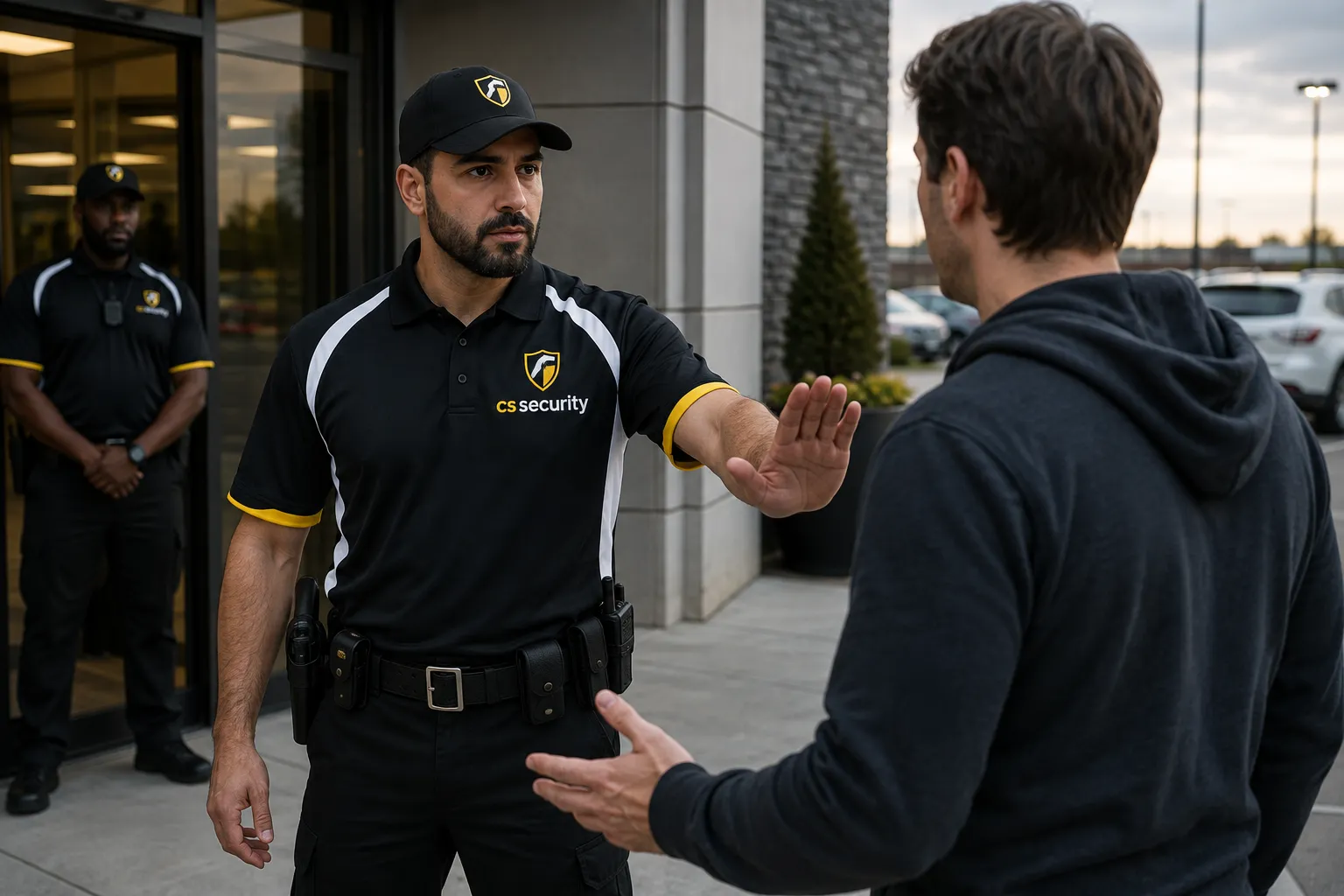
A loss prevention officer working a retail plaza in Edmonton's Downtown core near T5J watched a shoplifter conceal two jackets on store camera, then intercepted him calmly at the exit doors. The guard held the man for eleven minutes near the service counter until Edmonton Police Service arrived to process the arrest.
That eleven-minute window is where most Edmonton business owners get nervous. Security guards are not police officers, yet Alberta law does give them limited legal power to detain someone under specific conditions. Understanding that power, and its limits, protects both your business and your guard from a wrongful detention claim.
Canadian Shield Security answers the question property managers, retailers, and event organizers ask most often: what exactly is a security guard allowed to do when a crime happens on their property? The Security Services and Investigators Act (Alberta) sets the licensing baseline for who may work as a guard, and federal criminal law sets the actual boundary of that guard's authority to detain.
|
A licensed security guard in Alberta can detain someone under Criminal Code section 494, the citizen's arrest provision, if they witness a criminal offence such as theft or trespassing. The guard must have reasonable grounds, use only proportionate force, and hand the person to Edmonton Police Service without delay. Guards hold no extra police powers. |
What Is a Security Guard's Legal Power to Detain in Edmonton?
A security guard's power to detain comes from citizen's arrest law, not from any police authority granted by the province. Section 494 of the Criminal Code lets any person, including a licensed guard, arrest someone they find committing an indictable offence, or someone fleeing after a crime while being freshly pursued.
Alberta's Trespass to Premises Act adds a second, property-specific layer to this authority. Chapter T-7 of that Act allows the owner, or an authorized representative such as a security guard, to arrest a trespasser without a warrant under section 5. For an Edmonton property manager, this combination means a licensed guard can act the moment a crime happens on site, without waiting for police to arrive first, provided the legal conditions are actually met.

This authority is deliberately narrow. It was never designed to turn private security into a parallel police force, and Alberta courts continue to apply it that way whenever a detention is challenged.
Business owners sometimes assume a signed contract with a security company automatically grants broader powers. It does not. No private contract can expand what Parliament and the Alberta legislature have already defined as the outer limit of a guard's authority to detain.
|
A guard's detention power only applies on or near the property they are hired to protect. It does not extend to public sidewalks, neighbouring lots, or off-duty encounters away from the site. |
Where the Power Comes From: Criminal Code Section 494 and Trespass to Premises Act
Two separate laws work together to define what an Edmonton guard can legally do. Security guards are treated the same as any private citizen for arrest purposes under Canadian law. They hold no special police status under the Security Services and Investigators Act (Alberta); that Act governs licensing, training standards, and background checks, not arrest powers.
The table below summarizes where each legal authority applies and who it covers. Property managers should confirm their security provider trains guards on all three rows, not just the first.
Detention Authority Sources in Alberta
|
Legal Source |
What It Covers |
Applies To |
|
Criminal Code s.494 |
Citizen's arrest for an indictable offence witnessed in progress, or fresh pursuit after one |
Any person, including guards, anywhere in Canada |
|
Trespass to Premises Act (AB), s.5 |
Arrest without warrant for trespass on posted or enclosed premises |
Property owner or authorized representative, Alberta only |
|
Criminal Code ss.25-26 |
Legal limits on the force used during any lawful arrest |
Anyone making an arrest, including licensed guards |
What a Security Guard Is Allowed to Do During a Detention
A guard may physically stop someone from leaving the immediate area, state clearly that the person is under arrest and why, and hold them in a reasonable manner until police arrive. A guard may not conduct a warrantless search of a person's body or bag without their consent.
SSIA licensing requires every guard to understand these boundaries before deployment, and Canadian Shield Security builds this into onboarding for every new hire. Guards deployed under our on-site guard program are trained to narrate the arrest clearly to the suspect and any witnesses, minimize physical contact wherever possible, and call police immediately rather than delay the handover.
This narration step matters more than most business owners expect. A guard who says nothing while physically restraining someone gives a court far less to work with than a guard whose statement, a nearby witness, or CCTV footage confirms exactly what was said and why the arrest happened.
Post orders at a retail plaza differ from post orders at a construction site or an office tower, but the underlying legal boundary stays identical. Only the practical detail of how a guard applies it changes with the property type.
How Much Force Can a Security Guard Use in Alberta?
Only as much force as is reasonably necessary, under Criminal Code sections 25 and 26. Alberta courts weigh whether the threat actually justified the guard's response, not just whether an offence occurred. A guard who tackles a shoplifter walking calmly toward an exit faces very different liability than a guard who restrains someone actively assaulting a bystander.
Use of Force (UoF) training required for Canadian Shield Security guards covers proportional response, verbal de-escalation first, and the point at which physical contact becomes legally defensible rather than excessive. Guards are trained to default to the lowest level of force that safely resolves the situation.
Edmonton winters add a practical wrinkle to this calculation. Heavy coats and gloves can mask an assailant's hands and body language, which changes how a guard reasonably assesses threat level during a Downtown Edmonton or Whyte Avenue detention in January compared with a summer afternoon.
A guard who exceeds reasonable force does not just risk a lawsuit against the company. Individual guards can face assault charges personally, which is exactly why Canadian Shield Security repeats Use of Force refresher training on a set schedule rather than only at initial hiring.
What Happens After a Security Guard Detains Someone
The guard must hand the person over to Edmonton Police Service or the RCMP without unreasonable delay. Holding someone for hours, or well past the point police could reasonably respond, can turn a lawful citizen's arrest into unlawful confinement.
Canadian Shield Security's post orders require guards to call police immediately after a detention begins, document the incident through a digital incident report, and preserve any relevant video evidence from the property's CCTV system before it can be overwritten by the next recording cycle.
|
Ask your security provider how long their average police handover takes on a typical Edmonton site. A guard trained on GPS dispatch and clear post orders should not need more time than police realistically require to arrive. |
When a Security Guard Cannot Legally Detain You
A guard cannot detain someone on suspicion alone, for a minor bylaw issue, or after the fact once the person has already left the property. Section 494 generally requires the guard to have witnessed the offence directly or be in fresh pursuit immediately afterward.
Waiting until the next day, or acting purely on a tip from someone else with no direct observation, falls outside this authority in most circumstances and can expose the guard's employer to a wrongful detention claim rather than a valid citizen's arrest.
A guard also cannot detain someone to punish them, to make an example for other visitors, or simply to hold them until a manager decides what to do. The purpose must be limited to handing the person to police within a reasonable time.
|
For active criminal incidents, always contact Edmonton Police Service first. SSIA-licensed security guards are trained to observe and report; they do not replace police authority or emergency services, and should never be relied on as a substitute for calling 911 during a serious threat. |
How Canadian Shield Security Trains Guards to Detain Lawfully
Every Canadian Shield Security guard completes Use of Force training and reviews section 494 and Trespass to Premises Act procedure before working an Edmonton site. Guards serving Downtown T5J office towers, Mill Woods T6K retail plazas, and Nisku T9E industrial sites all follow the same post orders for lawful detention, de-escalation, and immediate police notification, adjusted only for the specific risks of that property type.
A free consultation and site assessment lets Edmonton property managers confirm exactly what detention protocol applies to their location before signing a contract, with transparent pricing and no hidden fees added later. Property managers can also request confirmation of each assigned guard's SSIA licence number before deployment begins.

For sites with a history of theft or trespass, Canadian Shield Security can also pair a static guard with mobile patrol coverage, so a detention during business hours is backed by the same trained response overnight when the property is otherwise unattended.
Conclusion
A security guard's power to detain someone in Alberta is real, but it is narrow. It comes from citizen's arrest law under the Criminal Code and the province's Trespass to Premises Act, not from any independent police authority, and it comes with strict limits on force, search, and timing.
Getting this wrong exposes an Edmonton business to real legal liability, from a false imprisonment claim to a damaged reputation. Canadian Shield Security trains every guard on these limits before deployment, so Edmonton property managers get lawful protection instead of a lawsuit waiting to happen. Call 1 (800) 326-7879 for a free consultation on licensed guard coverage for your property.
|
Canadian Shield Security serves Edmonton 24/7. Free consultation, no hidden fees. Call 1 (800) 326-7879. |
Frequently Asked Questions
Are security guards in Edmonton required to be licensed?
Yes. Every security guard operating in Alberta, including those with detention authority, must hold a valid licence under the Security Services and Investigators Act (Alberta). Canadian Shield Security confirms SSIA licensing and background checks before deployment. An unlicensed guard who detains someone exposes the hiring business to legal liability under Alberta law.
How much does hiring a licensed security guard with detention training cost in Edmonton?
Licensed on-site guard rates in Edmonton typically run $18 to $28 per hour, depending on site risk, use of force training level, and shift length. Guards trained specifically in citizen's arrest procedure and de-escalation often sit at the higher end. Canadian Shield Security provides a free consultation and site assessment before issuing a custom quote.
Does Canadian Shield Security cover Sherwood Park and nearby suburbs?
Yes. Canadian Shield Security deploys SSIA-licensed guards trained in lawful detention procedure across Sherwood Park, St. Albert, Leduc, Beaumont, and greater Edmonton including Downtown T5J and Mill Woods T6K. Coverage runs 24/7, 365 days a year. Call 1 (800) 326-7879 to confirm guard availability for your specific property or site.
Can a security guard search my bags in Alberta?
No, not without consent. A security guard's authority under Criminal Code section 494 covers detaining a person, not conducting a warrantless search. Guards may ask a suspect to voluntarily empty pockets or open a bag, but physically searching without consent or reasonable statutory authority can expose the guard and employer to civil liability.
What happens if a security guard wrongfully detains someone in Alberta?
Wrongful detention can expose the guard and the hiring business to a civil claim for false imprisonment, plus potential assault charges if force was used. Alberta courts weigh whether the guard had reasonable grounds and used proportionate force. This is why Canadian Shield Security trains every guard on section 494 limits before deployment.
