
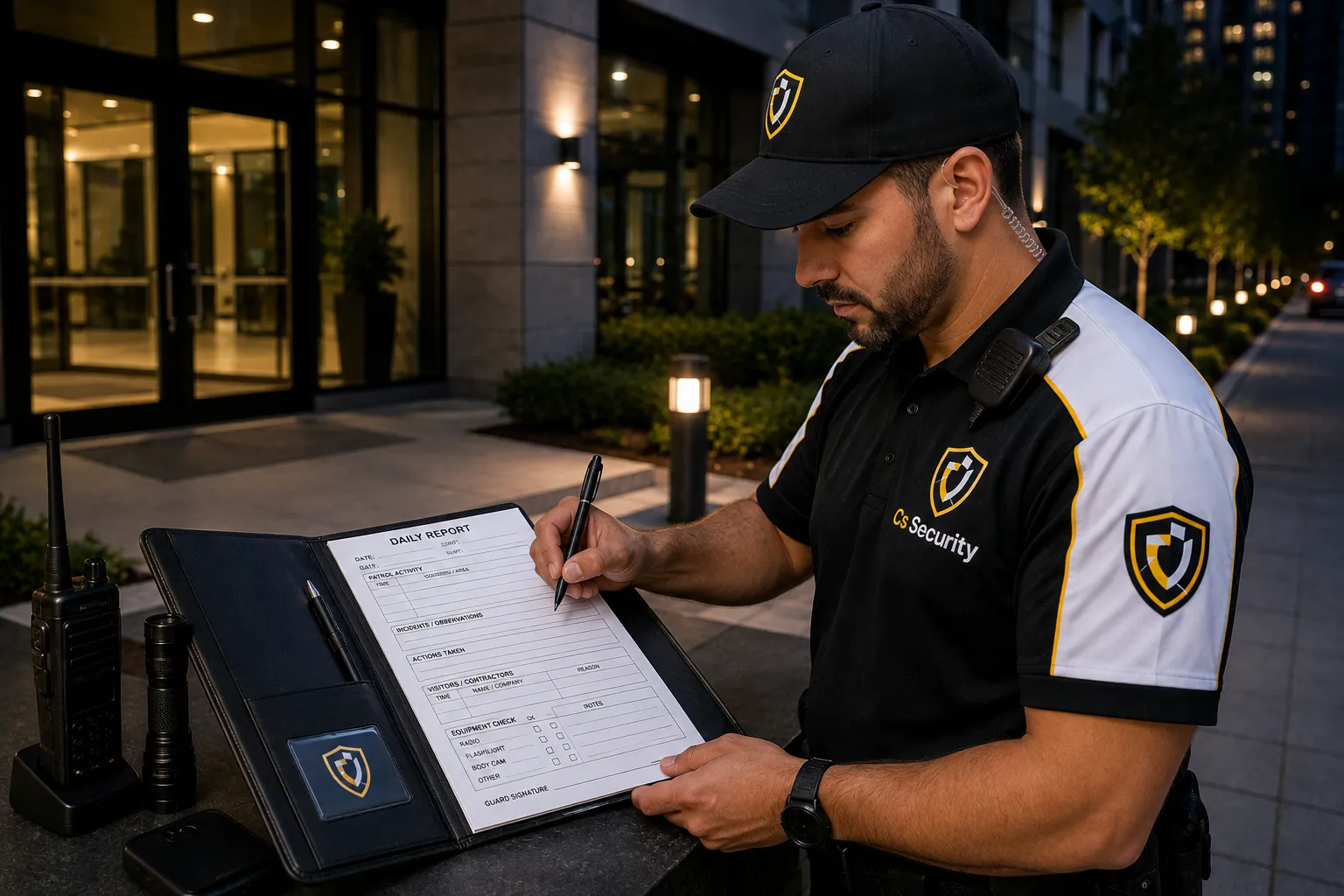
A property manager overseeing a mixed-use office tower near Jasper Avenue in Downtown Edmonton found a slow pipe leak on the fourth floor at 2:14 a.m. because the on-site guard's security guard daily report logged the routine walkthrough time and flagged wet carpet before it reached the electrical room below.
That single logged line, tied to a timestamp and a licensed guard's name, prevented a six-figure repair bill and gave the building's insurer the documentation it needed. A security guard daily report is the written or digital record an SSIA-licensed guard completes during and after every shift.
This guide covers exactly what an Edmonton security guard daily report should include, how it differs from an incident report, and what to expect from a licensed security provider like Canadian Shield Security.
|
A complete security guard daily report should include the guard's name and SSIA licence number, shift start and end times, patrol or walkthrough timestamps, any irregularities observed, access or equipment issues, and a supervisor sign-off. Edmonton reports should also note weather conditions, since ice and cold routinely affect access points and patrol routes. |
What Is a Security Guard Daily Report and Why Does It Matter for Edmonton Businesses?
A security guard daily report is the shift-by-shift written record that documents everything a guard observed, checked, and responded to during a posting. For Edmonton property managers, condo boards, and site owners, this report is the primary paper trail connecting a guard's presence to what actually happened on site.
Without a consistent daily report, there is no record to support an insurance claim, resolve a tenant dispute, or confirm that patrols happened on schedule. Property managers in T5J towers and Mill Woods condo complexes alike rely on these reports as their first line of documentation.

Edmonton winters add another layer. A guard who cannot log why a scheduled 3:00 a.m. patrol of a Nisku Industrial Park yard was delayed by an icy access road leaves a property manager guessing. A properly timestamped daily report removes that guesswork and gives management a defensible record.
|
TIP: Ask your security provider whether daily reports are reviewed by a supervisor before they reach you. A report that skips supervisor sign-off is easier to dispute later, especially in an insurance claim or tenant complaint. |
What Information Must Every Daily Report Include?
A complete daily report needs six core elements: guard identification and SSIA licence number, exact shift start and end times, timestamped patrol or walkthrough entries, any irregularities or maintenance issues observed, access control notes, and a supervisor or client sign-off line.
Canadian Shield Security guards bold the primary keyword information first, then log supporting detail using GPS-verified timestamps so property managers can confirm a patrol actually reached every checkpoint rather than trusting a written estimate.
Canadian Shield Security's supervisors review every digital daily report each morning before it reaches the client, checking that patrol timestamps line up with the post order for that site and that any flagged issue has a clear next step attached.
Bold the guard's name, licence number, and any flagged irregularity on the report itself. This is not decorative formatting. It lets a property manager scanning ten reports in a row find the one entry that actually needs a follow-up call, rather than rereading every line.
Daily Report Elements Edmonton Properties Should Require
Property managers can use the following table as a quick reference when reviewing a security company's reporting standards, whether comparing Canadian Shield Security to another provider or setting reporting expectations for an in-house guard team.
|
Report Element |
Why It Matters |
Edmonton Example |
|
Guard name and SSIA licence number |
Confirms a licensed, background-checked guard filed the report |
Licence verified against SSIA registry before shift assignment |
|
Shift start and end times |
Establishes coverage window for billing and liability |
6:00 PM to 6:00 AM winter shift, Downtown T5J tower |
|
Timestamped patrol entries |
Proves checkpoints were physically reached |
GPS-verified walkthrough of Mill Woods condo stairwells |
|
Irregularities or maintenance issues |
Creates a record for insurance and maintenance follow-up |
Wet carpet, propped fire door, burnt-out exterior light |
|
Weather and access conditions |
Documents winter hazards affecting patrol routes |
Ice buildup at Nisku Industrial Park loading dock |
|
Supervisor or client sign-off |
Confirms the report was reviewed, not just filed |
Site supervisor reviews and signs digital report each morning |
Daily Report vs Incident Report: What Is the Difference?
A daily report covers routine shift activity: patrol times, property conditions, and general observations, filed whether or not anything unusual happened. An incident report documents one specific event, such as a break-in, trespasser, or medical emergency, with detailed timestamps and witness information.
Under the Security Services and Investigators Act (Alberta), licensed guards are trained to distinguish between the two so nothing serious gets buried inside routine notes. A trespassing incident, for example, always triggers a separate incident report in addition to that shift's daily report.
This distinction also affects use of force reporting. If a guard has to physically intervene, even briefly, Alberta's Use of Force (UoF) standards require a separate, detailed incident report regardless of how minor the daily report entry might otherwise read.
|
COMPLIANCE NOTE: Under the Security Services and Investigators Act (Alberta), a guard who fails to accurately report a use-of-force event can face licence suspension. Daily reports and incident reports are not interchangeable for this purpose. |
How Licensed Guards Log and Submit Daily Reports
Canadian Shield Security guards submit daily reports through a digital platform tied to GPS dispatch, so every checkpoint timestamp is verified rather than self-reported. Post orders for each site specify exactly what the guard checks and how often, keeping reports consistent across shifts and guards.
Digital reports also solve a storage problem. Canadian Shield Security's mobile patrol security and on-site guard reporting both run through the same platform. Under Alberta's Personal Information Protection Act (PIPA), any personal information collected in a report, including tenant names or vehicle plates, must be stored securely with defined retention limits and access controls.
GPS dispatch also supports the CPTED framework, crime prevention through environmental design, by showing property managers exactly which blind spots or poorly lit corridors a patrol route passes through most often, informing where lighting or camera upgrades matter most.
Post orders differ by property type. A commercial office tower's post order might require a lobby check every 30 minutes, while a Nisku truck yard's post order focuses on gate checks and vehicle logs. Daily reports should always reflect the specific post order for that site, not a generic template.
|
TIP: Request a sample week of digital daily reports from any provider before signing a contract. This shows you exactly how consistent, detailed, and timestamped their reporting actually is under normal conditions. |
What Happens If Daily Reports Are Missing or Incomplete?
An incomplete daily report is a liability gap. If a slip-and-fall claim comes in and the guard's report has no timestamped walkthrough for that hour, the property owner has no documentation that reasonable care was taken. Insurers and lawyers both treat missing reports as missing evidence.
For active criminal incidents, always contact Edmonton Police Service first. SSIA-licensed security guards are trained to observe and report; they do not replace police authority or emergency services, and a daily report is never a substitute for calling 911 during an active threat.
This is especially relevant for condo boards. An 80-unit board that cannot produce six months of consistent daily reports during a liability review has effectively no evidence that reasonable security measures were in place, regardless of what guards actually did on site.
Construction sites carry their own version of this risk. Under Alberta's Occupational Health and Safety Act, a site without a documented security presence during off-hours can struggle to demonstrate due diligence after an equipment theft or trespassing incident, making daily reports part of the broader compliance picture.
How to Choose a Security Company With Reliable Reporting in Edmonton
Ask any prospective security company three questions: is reporting digital and timestamped, is every guard's SSIA licence verified before deployment, and can reports be reviewed by property managers in real time rather than delivered days later.
Canadian Shield Security's 32-plus licensed guards file digital daily reports on every posting across Edmonton, from Downtown towers to Nisku Industrial Park sites, giving property managers same-day visibility into every shift.

Before signing a contract, ask to see a sample daily report. A vague, handwritten log with no timestamps is a warning sign. A digital report with GPS-verified patrol points, named checkpoints, and a supervisor sign-off line is the standard Edmonton properties should expect.
Response time matters too. Ask how quickly a flagged irregularity in a daily report reaches a live person, not just a database. Canadian Shield Security guards escalate urgent findings by phone the same shift, with the digital report following as the permanent record.
Conclusion
A security guard daily report is only useful if it is complete, timestamped, and consistent, shift after shift. The six core elements above, guard identification, shift times, patrol timestamps, irregularities, access notes, and sign-off, form the minimum standard every Edmonton property should require.
Canadian Shield Security builds every guard's daily report around these standards, backed by SSIA licensing and GPS-verified patrol data. Contact Canadian Shield Security today for a free site assessment and see what a properly documented shift actually looks like.
|
GET STARTED: Canadian Shield Security serves Edmonton 24/7. Free consultation, no hidden fees. Call 1 (800) 326-7879. |
Frequently Asked Questions
Are security guards in Edmonton required to be licensed?
Yes. Under the Security Services and Investigators Act (Alberta), every security guard working in Edmonton must hold a valid SSIA licence before deployment. Canadian Shield Security verifies licensing and runs background checks on all officers before they are assigned to a site, so every daily report is filed by a properly credentialed guard.
How much does professional security guard reporting cost in Edmonton?
Pricing depends on site size, shift length, and reporting frequency, typically ranging from $18 to $28 per hour for on-site guard services that include digital daily reporting. Canadian Shield Security offers a free site assessment and custom quote, with no hidden fees added after the consultation is complete.
Does Canadian Shield Security cover Sherwood Park and surrounding areas?
Yes. Canadian Shield Security provides on-site guard and mobile patrol coverage, including daily reporting, throughout Edmonton and surrounding areas such as Sherwood Park, St. Albert, Leduc, and Nisku. Coverage runs 24 hours a day, 365 days a year, including nights, weekends, and public holidays.
What is the difference between a daily report and an incident report?
A daily report logs routine shift activity, patrol times, and property conditions, while an incident report documents a specific event, such as a break-in or trespasser, with timestamps and witness details. Canadian Shield Security guards file both, so property managers get full visibility into every shift.
How long should a security company keep guard daily reports?
Digital daily reports should be retained for a minimum of one year, though many Edmonton property managers keep records for two years to support insurance claims or legal disputes. Canadian Shield Security stores timestamped digital reports securely and provides property managers with access on request.
