
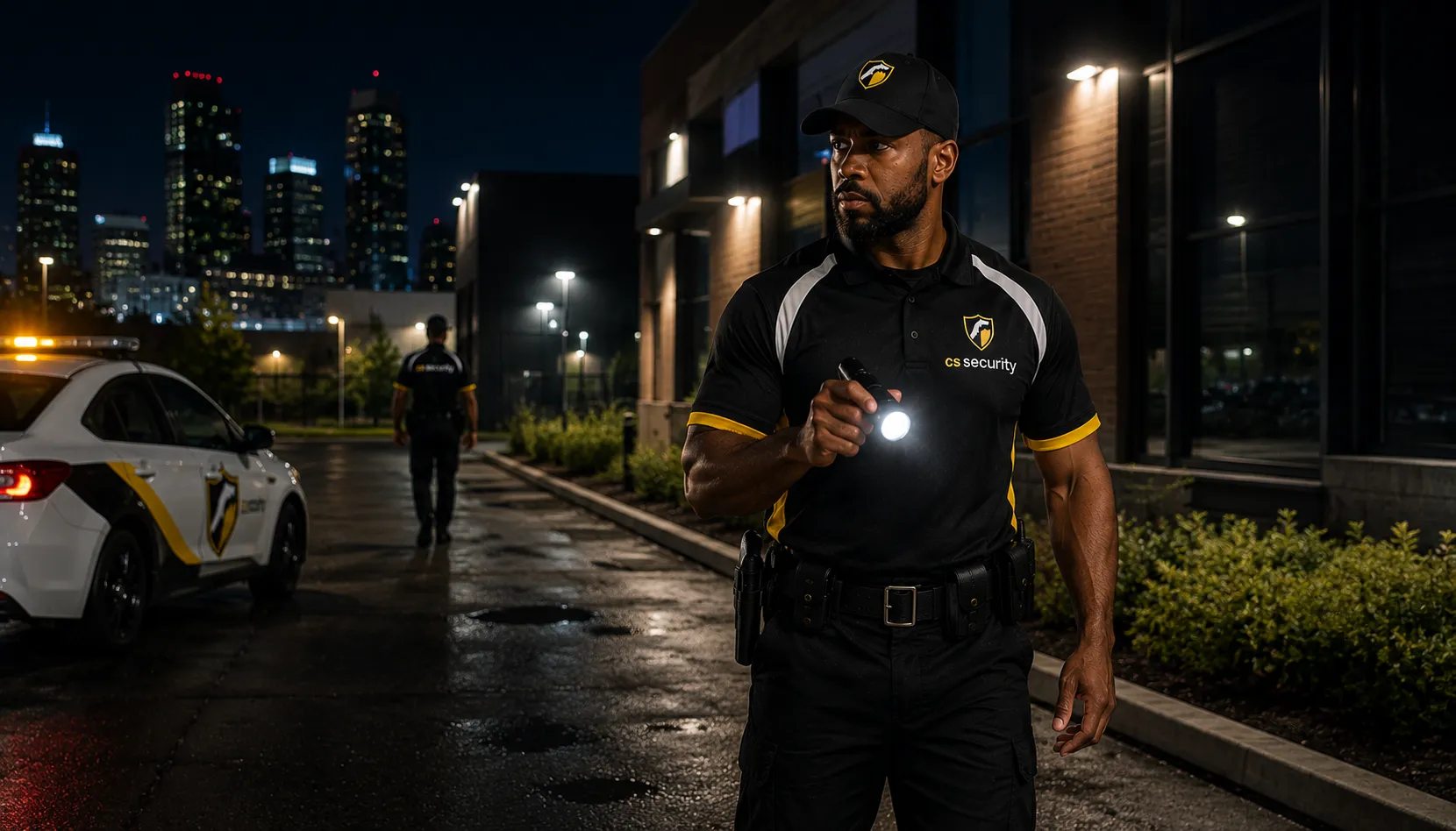
A retail plaza manager near Whyte Avenue (T6E) once assumed a nightly patrol simply meant a guard drove past the parking lot once and left. After a string of overnight break-ins, she learned her actual contract included scheduled walk-around checks, door and window verification, and a written log for every single visit, not just a drive-by.
That gap between assumption and reality is common. Night patrol security in Edmonton, provided under a standard SSIA licence, covers far more than a passing vehicle, and knowing exactly what is included changes how a property manager evaluates a quote.
This guide breaks down what night patrol actually covers, how Edmonton's winters change the job, and how to tell whether patrol coverage or an overnight guard fits your property better and your budget.
|
Night patrol security in Edmonton typically includes scheduled and randomized property checks, a walk-around inspection of doors, windows, and lighting, written incident logs for every visit, and coordination with police or fire services when something is found. Guards hold a standard SSIA licence and follow set patrol routes adjusted for Edmonton's winter conditions. |
What Does Night Patrol Security in Edmonton Actually Include?
Night patrol security in Edmonton covers a defined set of tasks performed on a scheduled and randomized basis, not a single pass through a parking lot. A standard visit includes a walk-around of the building exterior, verification that doors and windows are secured, a check of exterior lighting, and a look at parking areas and loading zones for anything out of place.
Every visit gets logged, whether or not anything unusual was found, since a documented history of empty findings is itself useful for an insurer or a police report later. Guards performing this work hold a standard licence under the Security Services and Investigators Act (Alberta), the same base credential required for any Alberta security guard.
For an Edmonton property manager, the value is less about any single visit and more about the pattern: consistent, documented, and visible coverage across the hours when most incidents actually happen. A property with a genuine gap in overnight visibility often sees a measurable drop in opportunistic issues within the first few weeks of consistent patrol coverage.
|
Patrol Element |
Included in a Standard Visit? |
|
Building exterior walk-around |
Yes |
|
Door and window verification |
Yes |
|
Exterior lighting check |
Yes |
|
Parking and loading zone check |
Yes |
|
Written incident log per visit |
Yes, every visit regardless of findings |
|
Police/fire coordination if needed |
Yes, when warranted |
|
Interior building search |
No -- outside guard authority and scope |
How Night Patrol Routes Are Planned Across Edmonton
Patrol routes across Edmonton are built around a property's specific risk pattern, not a generic loop repeated at every site. A route near Downtown Edmonton (T5J) office towers typically prioritizes underground parkades and loading docks, while a route covering retail near Whyte Avenue (T6E) focuses more on storefront entrances and back alleys where break-ins are more common.
Properties in T6H office corridors often need coverage timed around specific after-hours access points rather than a fixed loop, since commercial tenants keep varying schedules. Routes are also randomized within a coverage window, meaning a guard does not arrive at the exact same minute every night, which matters because a predictable schedule is easier for someone to work around than a randomized one.

Property managers can request specific timing or emphasis, such as extra attention to a loading dock after a delivery schedule change, and a well-run patrol provider adjusts the route accordingly. Multi-property clients, such as a company managing several buildings across Edmonton, often benefit from a single coordinated route rather than separate contracts for each site.
How Edmonton Winters Change Night Patrol Operations
Edmonton winters change night patrol operations in ways that matter well beyond simply dressing warmer. Temperatures that regularly reach negative 30 to negative 40 degrees Celsius affect vehicle cold starts, camera and flashlight battery performance, and even how quickly a guard can safely complete a walk-around without frostbite risk on exposed skin.
Frozen locks and door mechanisms become a real operational issue in deep cold, and patrol guards are trained to recognize when a door that will not close properly is a maintenance issue rather than a security breach. Patrol vehicles used across Edmonton winters need reliable cold-start capability, since a vehicle that fails to start mid-shift leaves a gap in coverage at exactly the time visibility and deterrence matter most.
Snow accumulation also changes what a walk-around actually reveals, since fresh footprints or tire tracks near an entry point can be a genuine security signal that a guard trained for Edmonton winters knows to document. Property managers should ask directly how a provider's winter patrol differs from its summer routine, since a provider without a real answer likely has not thought it through.
|
WINTER OPERATIONS Edmonton winters regularly reach negative 30 to negative 40 degrees Celsius, affecting vehicle cold starts, equipment performance, and how patrol guards distinguish frozen-lock issues from genuine security breaches. |
What Happens When a Guard Finds Something During a Patrol
When a night patrol guard finds something during a check, whether a propped-open door, a broken window, or a person who should not be on the property, the response follows a set sequence rather than improvisation. The guard first assesses the situation from a safe distance and documents what they observe, including time, location, and specific details.
For anything suggesting an active crime in progress, the guard contacts Edmonton Police Service directly rather than investigating alone, since a patrol guard's legal authority never exceeds that of a private citizen. For a maintenance issue, such as a door that failed to latch, the guard secures what they can, documents the issue, and notifies the property manager immediately rather than waiting for the next scheduled report.
Every incident, regardless of severity, generates a written report the client can review, which is often the detail that separates a patrol contract worth the cost from one that is not. Clients who request same-night notification for any finding, rather than a summary the next business day, get a materially faster picture of what is happening on their property.
Night Patrol vs an On-Site Overnight Guard: Which Fits Your Property
Choosing between night patrol and a dedicated overnight on-site guard comes down to how much continuous presence a property actually needs. Night patrol suits properties where the main risk is opportunistic, such as a retail plaza, small office building, or residential complex where a visible, randomized presence deters most issues without needing someone stationed there for eight straight hours.
An overnight on-site guard makes more sense for properties with constant activity, high-value inventory, or a legal or insurance requirement for continuous staffed coverage, such as certain healthcare or industrial sites. Cost reflects this difference directly, since patrol coverage bills for scheduled visits across a coverage window rather than a full shift, making it the more budget-efficient option for lower-risk properties.

Many Edmonton property managers start with patrol coverage and upgrade to on-site staffing only after a specific incident pattern demonstrates the need for constant presence rather than periodic checks, which avoids paying for continuous coverage a property may not actually require.
What Night Patrol Guards Are Not Trained to Do
Night patrol guards are trained to observe, deter, and report; they are not trained or authorized to function as an investigative or law enforcement presence. A patrol guard will not conduct a room-by-room building search for an intruder, will not detain someone beyond the narrow bounds of a lawful citizen's arrest, and will not attempt to physically stop a crime in progress beyond protecting themselves or others from immediate harm.
For any situation involving an active threat, weapon, or violent confrontation, the correct guard response is to retreat to safety and call Edmonton Police Service, not to intervene further. This boundary exists for the guard's safety as much as the client's, and a provider that promises more than this is setting expectations no licensed guard can legally meet.
Edmonton property managers should treat this limitation as a planning input, not a disappointment, since it shapes what patrol coverage can and cannot replace, and clarifies why patrol works alongside alarm systems and police response rather than instead of them.
|
Night patrol guards are trained to observe, deter, and report. For active criminal or violent incidents on an Edmonton property, always contact Edmonton Police Service first. |
How Canadian Shield Security Runs Night Patrol Across Edmonton
Canadian Shield Security runs randomized, documented night patrol routes across Edmonton, including Downtown, Whyte Avenue, and T6H commercial corridors, with routes adjusted for each property's specific layout and risk pattern. Winter operations account for Edmonton's cold directly, with patrol vehicles maintained for reliable cold-start performance and guards trained to distinguish frozen-lock maintenance issues from genuine security breaches.
Every patrol visit generates a written log, and any incident triggers immediate client notification rather than waiting for a scheduled summary report. Coverage extends beyond Edmonton proper into Sherwood Park, St.
Albert, and Leduc, coordinated from the same operations hub so multi-location clients get consistent reporting regardless of which community a given property sits in. Property managers evaluating patrol coverage can request a free consultation and site assessment to determine whether patrol, an on-site overnight guard, or a combination of both fits their property's actual risk pattern, rather than guessing based on a generic quote or a competitor's flat rate sheet.
Conclusion
Night patrol security in Edmonton is not a single drive-by; it is a documented sequence of checks, verifications, and incident responses built around a property's actual layout and Edmonton's genuinely difficult winter conditions. Understanding what a patrol contract actually includes is the difference between a security line item and real coverage that holds up when something actually happens.
Edmonton property managers who ask for specifics, route planning, winter procedures, and incident documentation, get a clearer picture of what they are paying for than those who compare providers on price alone. Canadian Shield Security lays out exactly what each patrol visit covers before any contract is signed, so expectations match reality from the first shift onward.
|
Canadian Shield Security serves Edmonton 24/7. Free consultation, no hidden fees. Call 1 (800) 326-7879. |
Frequently Asked Questions
Are night patrol guards in Edmonton licensed?
Yes. Every night patrol guard holds a standard licence under the Security Services and Investigators Act (Alberta), the same base credential required for any Alberta security guard. This licence confirms the guard completed approved training, passed background checks, and meets the province's English language standard before working a single shift.
How much does night patrol security cost in Edmonton?
Night patrol pricing depends on visit frequency, route length, and property risk level, and typically costs less than a dedicated overnight on-site guard since it bills for scheduled checks rather than a full continuous shift. Exact pricing requires a site assessment, since a single-building route costs differently than a multi-property patrol schedule.
Does Canadian Shield Security patrol Whyte Ave and Downtown Edmonton?
Yes. Canadian Shield Security runs regular patrol routes through Whyte Avenue, Downtown Edmonton, and T6H commercial corridors, along with Sherwood Park, St. Albert, and Leduc. Routes are randomized within a coverage window and adjusted for each property's specific layout, access points, and documented risk pattern.
How often does a mobile patrol guard check a property overnight?
Visit frequency is set per contract, commonly ranging from one to several checks per night depending on the property's risk level and client preference. Visits are randomized within the agreed window rather than arriving at a fixed time each visit, since a predictable schedule is easier to work around than a randomized one.
Does night patrol work during Edmonton winters?
Yes, though winter changes how it operates. Patrol vehicles are maintained for reliable cold-start performance in temperatures reaching negative 30 to negative 40 degrees Celsius, and guards are trained to distinguish frozen-lock maintenance issues from genuine security breaches during the coldest months of the year.
