
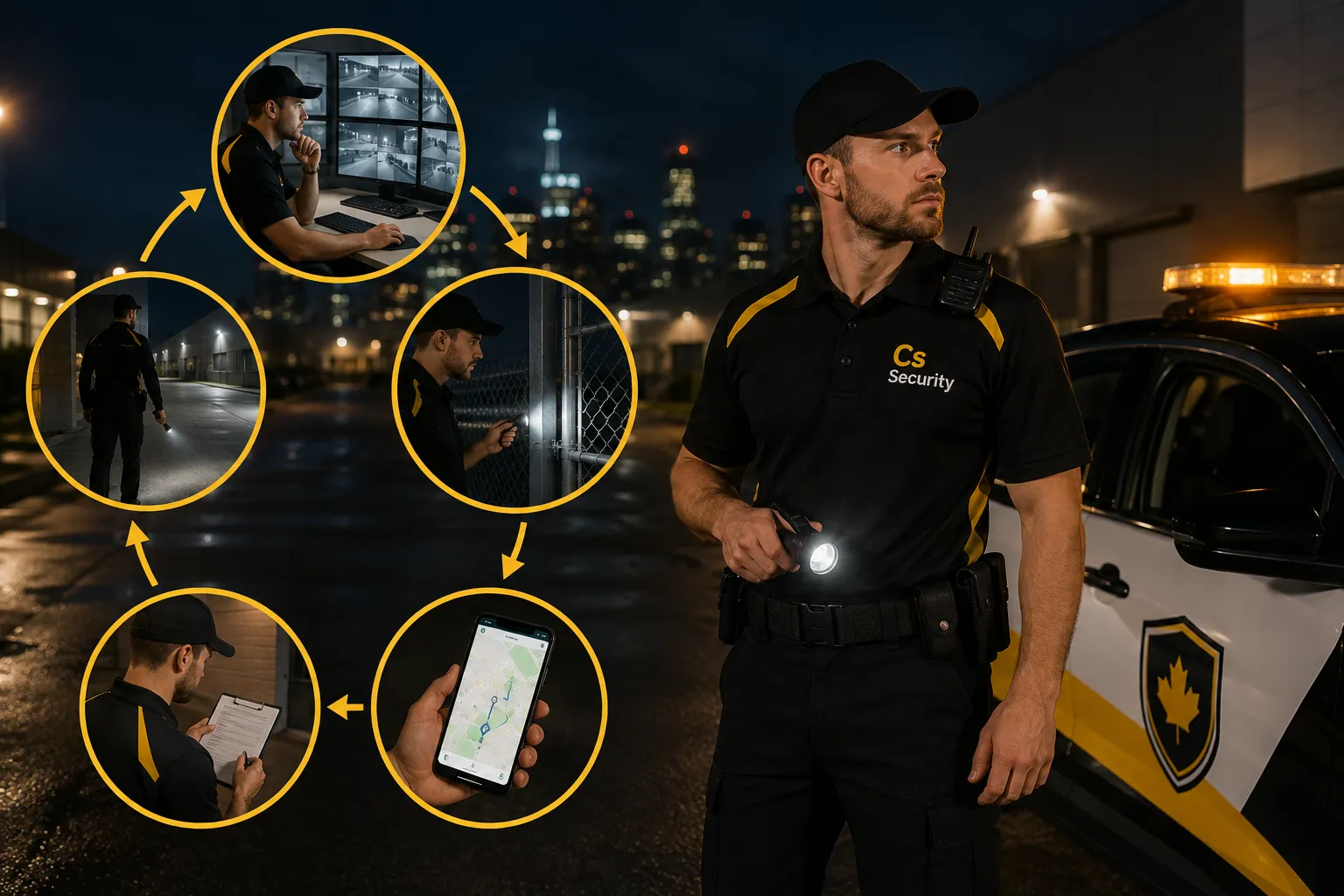
A construction site manager just outside Edmonton, in the Nisku Industrial Park, lost two trailers of copper wiring over a single weekend because the previous patrol company walked the same fixed loop every night, at the same time, past the same blind corner. Canadian Shield Security rebuilt the route, varied the timing, and added a checkpoint at the blind corner. No further thefts were reported in the following six months.
A security patrol procedure Alberta guards follow is not a casual walk-through. It is a documented sequence of pre-patrol prep, route execution, checkpoint verification and post-patrol reporting, built around the site's post orders and repeated the same way every shift.
This guide breaks down the exact steps a licensed guard follows to conduct a security patrol properly, what belongs in a patrol report, and the mistakes that turn a patrol into a predictable, exploitable routine.
|
A security patrol procedure Alberta guards follow has five stages: pre-patrol briefing and equipment check, route execution with varied timing, checkpoint verification at each stop, incident response if something is found, and a written report logged before the shift ends. SSIA-licensed guards follow site-specific post orders at every stage, not a generic checklist. |
Pre-Patrol Preparation: Briefing and Equipment Check
Conducting a security patrol properly starts before the guard leaves the office or guard shack: a pre-patrol briefing covering the site's post orders, known hazards, and any incidents from the previous shift.
Guards check their equipment next: flashlight, radio or GPS handset, incident report forms or tablet, and keys or access cards for the specific areas on that night's route. Missing equipment gets replaced before the patrol starts, not mid-route.

For armed or specialized posts, this stage also includes confirming any required certifications are current, since Alberta post orders often specify exactly what gear and credentials a guard must carry for that site.
Guards also confirm radio or handset battery levels and test communication with dispatch before stepping off, since a dead radio mid-route turns a routine checkpoint into an unmonitored gap in coverage.
Why Post Orders Are the Foundation of Every Security Patrol Procedure
A post order is the written instruction set for a specific site: which doors to check, what times to patrol, who to call in an emergency, and what is and is not within the guard's authority.
Every Canadian Shield Security patrol procedure starts from the site's post orders rather than a generic template, because a downtown office tower, a Mill Woods condo and a Nisku equipment yard each carry different risks and require different checkpoints.
Post orders should be reviewed and updated after any incident, ownership change, or finding from a recent security risk assessment. An outdated post order sends a guard through a route built for a property that no longer exists in its current layout.
Canadian Shield Security drafts post orders collaboratively with the client during onboarding, then revisits them every 12 months or after any major incident, so the document guards actually follow stays current rather than sitting untouched in a binder.
Planning and Walking the Patrol Route
A patrol route should never run the same path at the same time twice in a row. Predictable timing is the single easiest thing for someone casing a property to exploit, whether it is a downtown parkade or a Nisku equipment yard.
Effective routes prioritize high-risk points first: entry and exit doors, loading docks, parking structures, and any area flagged in the property's most recent security risk assessment. Blind spots and previously reported incident locations get extra passes.
Edmonton winters add a route consideration most checklists ignore. Guards adjust timing and footing on icy walkways, check that exterior locks have not frozen shut, and confirm heated entry points and vehicle block heaters are functioning on industrial sites near Nisku and Acheson.
On multi-building commercial properties, routes are staggered so no two guards cross paths at predictable intervals, and radio check-ins are scheduled at set points along the route so dispatch always knows a guard's approximate location.
Verifying Checkpoints Properly
Each checkpoint on the route gets a physical verification, not just a walk-past. Guards test that doors are actually locked, confirm lighting is working, and check that cameras have a clear, unobstructed view of the area they are meant to cover.
GPS-enabled checkpoint scanning, using a handset or phone app, timestamps each stop and creates an auditable record. This matters for both accountability and liability, since a property manager can confirm exactly when and where a guard was standing if a question comes up later.
Any anomaly found at a checkpoint, from a propped-open fire door to a broken lock, gets logged immediately rather than held until the end of the shift, since delayed reporting is one of the most common gaps auditors find in patrol records.
Consistent checkpoint verification also protects the guard. A documented, timestamped record showing a door was checked and secure at a specific time is the guard's best defence if a liability question comes up weeks later.
Responding to Incidents During a Patrol
If a guard finds something during a checkpoint, the response follows a fixed order: assess safety first, then contain the issue if it is safe to do so, then communicate with dispatch and, where relevant, Edmonton Police Service.
Under the Security Services and Investigators Act (Alberta), guards are trained to observe, document and report. They are not authorized to use force beyond what the law permits for self-defence or citizen's arrest, and post orders should make this boundary explicit for every site.
For anything involving an active crime, fire, or injury, the guard's job is to secure the immediate area, call the appropriate emergency service, and stay on the line with dispatch until help arrives or a supervisor takes over.
Guards are also trained to recognize when a situation is outside their authority entirely, such as a medical emergency requiring first aid beyond basic training, and to request additional support immediately rather than attempting to manage it alone.
Documenting and Reporting After Every Patrol
A patrol is not complete until it is documented. Every round should produce a written log noting checkpoint times, anything unlocked or unusual, and photos of any issue found along the route.
A complete patrol report covers the fields below, whether logged on paper or through GPS dispatch software.
|
Report Field |
What to Record |
|
Checkpoint time |
Exact time the guard arrived at each stop |
|
Checkpoint status |
Locked and secure, or issue found and logged |
|
Observations |
Anything unusual, damaged, or suspicious |
|
Photos |
Visual evidence of any flagged issue |
|
Guard ID |
Name or badge number, confirming accountability |
Reports get reviewed the same shift wherever possible, not batched for the following week. A property manager checking an incident three days later needs the same detail a guard would remember only hours after the fact.
Canadian Shield Security guards submit digital incident reports with timestamps and photos directly through GPS-tracked dispatch software, so clients can review each patrol the night it happens rather than waiting for a paper log.
Digital reports are timestamped and stored centrally, which matters when an insurance provider or property owner requests six months of patrol history after a claim, something a stack of paper logs rarely survives intact.
Common Patrol Mistakes That Undermine Security
The most common patrol mistakes are predictability, incomplete checkpoint verification, and delayed reporting, all of which turn a security measure into a formality that offers little real protection.
A guard who walks the same loop at the same time every night is not patrolling, they are advertising a schedule. Varying both the route order and the timing window is one of the simplest, lowest-cost improvements a site can make.
Skipping physical verification at checkpoints, such as pulling on a door instead of just glancing at it, is the second most common gap. A locked-looking door that has not actually been tested is a guess, not a confirmation.

The third gap is treating reporting as optional. A patrol with no written record is functionally unverifiable, and insurance providers increasingly ask for patrol logs as proof of due diligence after a claim is filed.
New guards are paired with a supervisor for their first several shifts on any Edmonton property specifically to catch these three mistakes early, before they become habits that carry through months of otherwise unsupervised patrols.
Conclusion
A security patrol only works if it follows a consistent, documented procedure: briefing, varied route execution, real checkpoint verification, a clear incident response order, and same-shift reporting. Skipping any one of these steps turns a patrol into a routine a determined intruder can learn and exploit.
Canadian Shield Security guards are trained on post orders specific to each Edmonton property, licensed under the Security Services and Investigators Act, and dispatched with GPS-tracked reporting for full accountability. Book a free consultation to review your site's current patrol procedure.
Property managers who request a copy of their current patrol procedure and post orders often find gaps they did not know existed, from routes that have not been updated in years to checkpoints that no longer match the building's layout.
|
Canadian Shield Security serves Edmonton 24/7. Free consultation, no hidden fees. Call 1 (800) 326-7879. |
Frequently Asked Questions
Are Edmonton security guards required to be licensed to conduct patrols?
Yes. Every Canadian Shield Security guard conducting a patrol holds a valid licence under the Security Services and Investigators Act (Alberta). Guards also complete post order training specific to each site before their first shift. Ask to see licence credentials at any time, and confirm the licence number against Alberta Security Programs records if you have doubts about a company.
How much does mobile or foot patrol security cost in Edmonton?
Mobile patrol service in Edmonton typically costs $35 to $60 per visit, or $600 to $2,000 per month for scheduled nightly rounds, depending on route length and check frequency. On-site foot patrol guards run $28 to $45 per hour. Canadian Shield Security offers a free consultation to scope patrol frequency and provide a custom quote.
Does Canadian Shield Security run patrols in Sherwood Park and Nisku?
Yes. Canadian Shield Security runs patrol routes across Edmonton, including Downtown (T5J), Mill Woods (T6K) and Whyte Avenue (T6E), plus Sherwood Park, St. Albert, Leduc and the Nisku Industrial Park corridor. Routes are adjusted for each area, with extra checkpoints added near loading docks, parking structures and industrial equipment yards.
How often should a security guard patrol a property?
Patrol frequency depends on the property's risk level. Low-risk commercial buildings often need two to four checks per night, while active construction sites or industrial yards may need hourly passes. A security risk assessment helps determine the right frequency before a patrol contract is set, rather than guessing at a fixed schedule.
What should be documented during a security patrol?
Every patrol should generate a written log noting checkpoint times, any doors or gates found unlocked, lighting or camera issues, and anything unusual observed. Canadian Shield Security guards submit digital incident reports with photos through GPS-tracked dispatch software, so property managers can review each round the same night it happens.
