
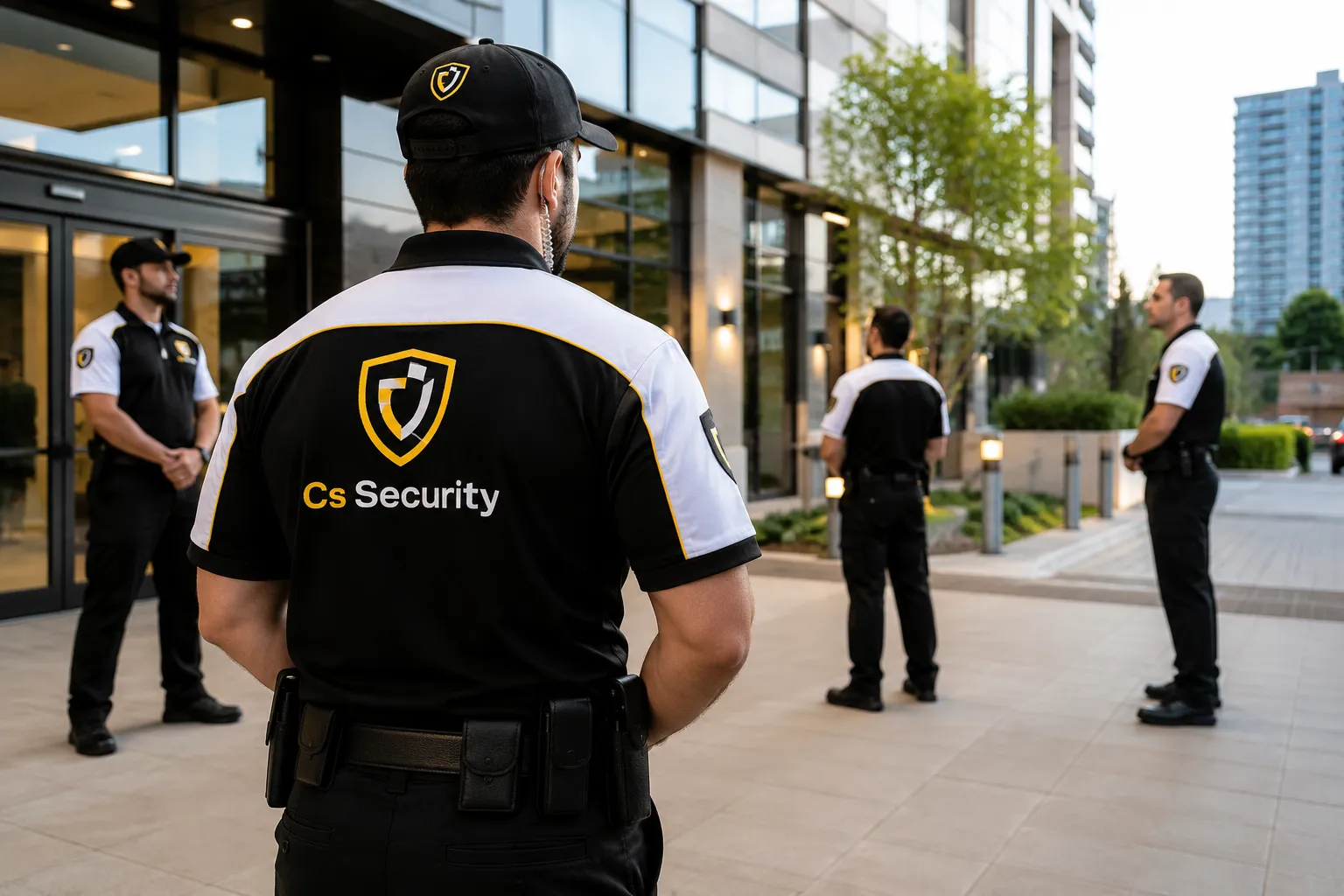
A property manager overseeing a 60,000-square-foot office building in South Edmonton's T6H corridor spent three years paying for a single overnight guard the building never needed, while the lobby sat unstaffed during the 8 a.m. rush when most tenant complaints and unauthorized entries actually happened. A site assessment reversed the staffing plan and cut the security budget by 18 percent while closing the real gap.
There is no single formula that tells you how many security guards a building needs. Square footage matters, but so does layout, tenant mix, hours of operation, and how many entrances your building actually has. Canadian Shield Security works through all of it during a free consultation and site assessment for every Edmonton property.
This guide covers the factors that actually drive guard count, a step-by-step way to calculate your own staffing level, and when it makes sense to bring in a licensed security company to get the number right.
|
Most commercial buildings need one guard per 50,000 to 100,000 square feet as a starting point, but layout matters more than size. A building with one main entrance needs fewer guards than a smaller building with four access points. Round-the-clock coverage at a single post typically requires three to four guards to cover all shifts plus relief. |
What Determines How Many Security Guards Your Edmonton Building Needs?
Building size is the factor everyone starts with, and it matters, but it is rarely the deciding one. A 50,000-square-foot warehouse with a single gate needs less static coverage than a 20,000-square-foot office with four entrances, a loading dock, and an underground parkade.
The number of access points that genuinely need a decision made at them is a better starting question than square footage alone. Every entrance, every loading dock, every parkade gate is a point where someone has to decide who gets in. That count, not the building's total area, is closer to your real staffing requirement.

Operating hours multiply everything. A building open 8 a.m. to 6 p.m. on weekdays needs one staffing plan. The same building with a 24-hour data centre tenant or a fitness facility with early-morning and late-evening access needs a completely different one, often doubling or tripling the guard hours required per week.
Value concentration matters as much as physical size. Not every part of a building carries equal risk. A server room, a cash office, or a pharmacy storage area concentrates value in a small footprint, and that concentration deserves dedicated attention even inside a building that otherwise looks low-risk on paper.
Key Factors That Increase or Reduce Your Guard Count
Six factors move the number up or down from whatever a generic square-footage formula suggests. Weigh all six together rather than relying on any single one.
|
Factor |
Increases Guard Count |
Reduces Guard Count |
|
Number of entrances |
Multiple unmonitored access points |
Single controlled entrance |
|
Operating hours |
24/7 or extended after-hours access |
Standard weekday business hours only |
|
Tenant mix |
Retail, healthcare, or high-turnover tenants |
Single stable long-term tenant |
|
Incident history |
Past break-ins, theft, or trespassing reports |
No documented incidents on file |
|
Existing technology |
Limited or aging CCTV and access control |
Modern CCTV, card access, monitored alarms |
|
Layout complexity |
Blind spots, hidden stairwells, large parkade |
Open sightlines, simple floor plan |
Existing technology deserves a closer look, because it is the factor most Edmonton property managers underweight. A building with modern CCTV and card access control can often run with fewer guards, because the guard's job shifts from constant physical presence toward monitored response. A building relying on outdated cameras or no access control at all needs more physical coverage to fill the gap technology should be closing.
CPTED thinking applies directly here. A building designed with clear sightlines, well-lit entrances, and minimal hidden corners naturally needs less guard coverage than one with blind stairwells and poorly lit parkade levels, because the environment itself is doing part of the security work before a guard ever gets involved.
How to Calculate Security Guard Staffing for Your Edmonton Building: Step by Step
Start with a site assessment rather than a formula pulled from a national blog post. Canadian Shield Security walks every Edmonton property through a free consultation before recommending a guard count, because the six factors above interact differently on every site. A property manager who runs through these seven steps before calling a security company arrives at the consultation with better data and gets a faster, more accurate quote.
1. Count every entrance, loading dock, and parkade gate that allows building access, not just the main lobby door.
2. Map your building's actual operating hours, including tenant-specific access outside standard business hours.
3. Pull any incident reports from the past 24 months, including minor trespassing or after-hours access issues.
4. Audit existing CCTV and access control coverage to identify where technology already reduces physical staffing needs.
5. Apply the 50,000 to 100,000 square foot starting ratio, then adjust up or down using the six factors together.
6. Decide whether you need static post coverage, mobile patrol, or a blend of both across your operating hours.
7. Have an SSIA-licensed security company confirm the plan against current Alberta staffing standards before you commit to a contract.
Multi-tenant buildings with more than one access point should calculate staffing per post rather than per building. A 90,000-square-foot office tower with a staffed lobby and a separate loading dock needs guard hours for both posts, not one combined number split awkwardly between them.
|
COMPLIANCE ALERT Under the Security Services and Investigators Act (Alberta), every guard included in your staffing plan must hold a valid SSIA licence. Confirm licensing for the whole team before signing any staffing contract. |
Guard Staffing by Edmonton Building Type: Quick Reference
These starting points come from the factors above applied to common Edmonton property types. Every one of them should still go through a full site assessment before you finalize a contract.
|
Building Type |
Typical Size |
Starting Guard Recommendation |
|
Small single-tenant office |
Under 25,000 sq ft |
1 guard during business hours, mobile patrol evenings |
|
Mid-size office tower (T5J Downtown) |
25,000-150,000 sq ft |
1-2 guards per shift, lobby plus floor patrol |
|
Retail plaza or strip mall |
20,000-80,000 sq ft |
1 guard evenings and weekends, patrol backup |
|
Condo tower (Mill Woods, T6K) |
80-250 units |
1 concierge guard plus overnight patrol |
|
Industrial yard (Nisku Industrial Park) |
100,000+ sq ft |
1-2 guards, perimeter patrol and gate control |
When to Get a Professional Security Assessment for Your Edmonton Property
A rough calculation from this guide gets you close. It does not replace a walk-through by someone who has assessed dozens of similar Edmonton buildings and knows where the estimate usually breaks down.
For active criminal incidents, always contact Edmonton Police Service first. SSIA-licensed security guards are trained to observe and report; they do not replace police authority or emergency services, and a staffing plan should never be built around the assumption that guards will intervene physically.
A licensed security company also brings comparison data a first-time reviewer cannot access alone. Canadian Shield Security's consultations draw on staffing patterns across dozens of similar Edmonton properties, from South Edmonton T6H office buildings to Downtown T5J towers, so the recommendation reflects what actually works locally rather than a generic industry average.
Canadian Shield Security's licensed team completes a free site assessment for every Edmonton property before recommending a guard count, covering office towers, retail plazas, condo boards, and industrial sites across the region.
How to Adjust Guard Staffing as Your Building's Needs Change
A staffing plan built once and never revisited drifts out of date the moment your tenant mix changes. A new retail tenant, a vacancy that turns into after-hours storage, or a break-in two buildings over on the same T5J block are all reasons to re-run the calculation.
Review your staffing level at least once a year, and immediately after any incident, major tenant turnover, or a shift into Edmonton's winter season, when reduced daylight hours and -40C conditions change how guards patrol and how quickly response times matter.

Track guard hours against actual incident and access data over time. If a post consistently sees no activity during certain hours, that is a signal to shift coverage rather than simply add more of it.
Seasonal swings deserve their own line item in the plan rather than an afterthought. Edmonton winters bring shorter daylight hours, icy walkways that increase liability exposure, and slower emergency response times during severe weather, all of which can justify shifting guard hours earlier in the evening even without any change to the building itself.
Budget season is also the right time to revisit staffing, not just incident season. A property manager who reviews guard hours alongside the annual operating budget can right-size coverage before renewal, rather than discovering months into a contract that half the staffed hours cover a risk that no longer exists.
Conclusion
The right number of security guards for your Edmonton building comes from a real count of entrances, hours, and risk, not a single square-footage formula copied from another market. Getting it right protects your tenants and your budget at the same time.
If your building's last staffing review happened more than a year ago, or happened before you ever occupied the role, that is worth revisiting before the next incident makes the case for you.
|
Canadian Shield Security serves Edmonton 24/7. Free consultation -- no hidden fees. Call 1 (800) 326-7879. |
Frequently Asked Questions
Are the guards in an Edmonton staffing plan required to be licensed?
Yes. Every guard assigned to your building under the Security Services and Investigators Act (Alberta) must hold a valid provincial licence issued by Alberta Justice, regardless of whether you staff one guard or a full rotating team. Canadian Shield Security confirms licensing for every guard placed on an Edmonton site before a staffing plan goes live.
How much does it cost to hire the right number of security guards for an Edmonton building?
Cost depends on guard count, shift hours, and coverage type, but most Edmonton commercial buildings pay roughly $18 to $28 per hour per guard. A single daytime guard runs far less than round-the-clock coverage with relief staff. Canadian Shield Security provides a free site assessment and a custom quote with no hidden fees.
Does Canadian Shield Security provide staffing assessments outside Edmonton, like Sherwood Park or St. Albert?
Yes. Canadian Shield Security completes staffing assessments across the Edmonton region, including Sherwood Park, St. Albert, Leduc, Beaumont, Nisku, Acheson, Stony Plain and Spruce Grove. Each assessment accounts for building size, layout, tenant mix and local risk factors before recommending a guard count.
Is one guard enough for a small office building?
Often, yes. A single-tenant office under roughly 25,000 square feet with one main entrance and predictable daytime hours can usually run on one licensed guard during business hours, sometimes paired with mobile patrol for evenings. Multiple entrances, after-hours tenants, or a history of incidents push that number up quickly.
How many guards do I need for 24/7 coverage?
Round-the-clock coverage at a single post typically needs three to four guards to cover day, evening and overnight shifts plus relief for days off, sick time and vacation. Buildings with more than one post, such as a lobby and a loading dock, multiply that number by however many posts run continuously.
