
A property manager overseeing three truck yards along the Nisku Industrial Park corridor reviewed a month of GPS patrol logs and found overnight rounds were being completed nine minutes faster than the contracted route allowed. Two additional checkpoint stops were added to the route the following week.
That kind of visibility is the entire point of GPS vehicle tracking. Mobile patrol has always relied on trust between the property manager and the security company, but trust alone does not prove a guard actually drove the full route. GPS tracking turns that trust into a record.
Canadian Shield Security answers the question Edmonton property managers ask most often once they start comparing mobile patrol providers: how does GPS tracking actually work, and what does it let you see? Our mobile patrol security program builds GPS verification into every contracted route.
|
GPS vehicle tracking for security patrols uses a smartphone or vehicle-mounted device to record a guard's location and timestamp throughout a shift. Supervisors see the live route on a dispatch dashboard, confirm every checkpoint was reached on schedule, and generate an auditable patrol record. It does not replace the guard, it proves what the guard actually covered. |
What Is GPS Vehicle Tracking for Security Patrols and Why Does It Matter in Edmonton?
GPS vehicle tracking records the exact location and time of a patrol vehicle throughout a shift, creating a digital trail that shows where the guard drove and when. For an Edmonton property manager, this turns a patrol contract from a promise into something that can actually be checked.
Before GPS became standard, mobile patrol relied on handwritten logs filled out after the fact, often from memory. A missed checkpoint or a shortened route was almost impossible to prove either way. GPS closes that gap by recording the route as it happens, not as it gets remembered later.

This matters most for properties with a real incident history. A Downtown T5J office tower that has had break-in attempts, or a Nisku T9E truck yard with equipment theft pressure, needs proof that patrols happened on schedule, not just an assurance that they did.
Edmonton winters add another reason this matters. A patrol vehicle that skips the far end of a snow-covered lot because the access road has not been plowed leaves that gap unrecorded on a written log. A GPS-verified route shows exactly which sections of a property were actually covered on any given night, plowed or not.
|
GPS tracking works alongside your existing security plan. It does not replace on-site guards, alarm response, or CCTV, it adds a verifiable record to the mobile patrol layer specifically. |
How GPS Patrol Tracking Actually Works
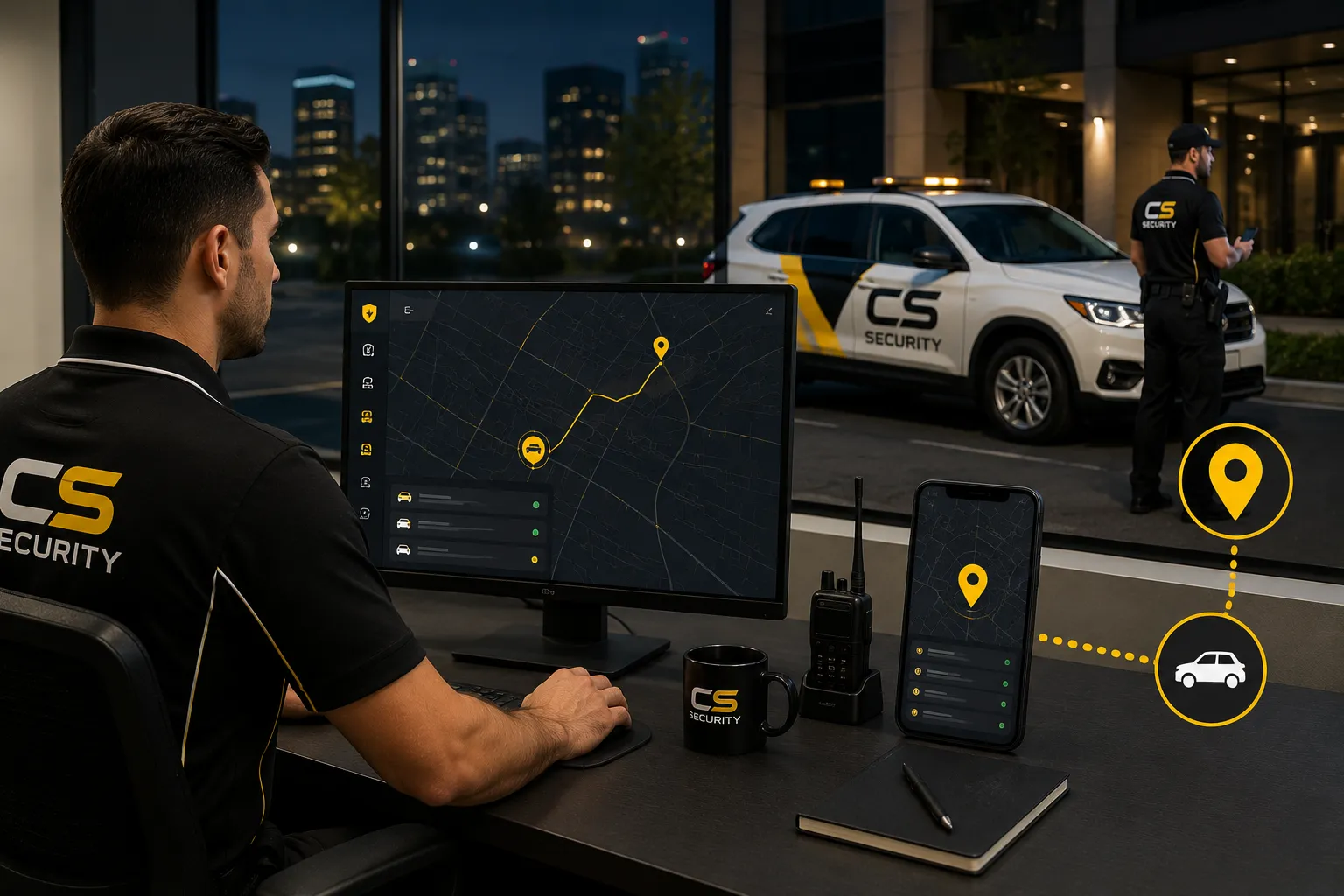
A GPS-enabled patrol vehicle or the guard's assigned smartphone transmits location data at set intervals to a central dispatch system. Canadian Shield Security's dispatch dashboard plots that data on a live map, so a supervisor can see exactly where a patrol vehicle is at any moment during a shift.
Each stop on the route is logged with a timestamp the moment the vehicle arrives within range of a checkpoint. Supervisors can see how long the guard remained at each stop, whether the route was completed in the expected order, and whether any checkpoint was skipped entirely.
Indoor areas, underground parkades, and some Downtown Edmonton tower interiors can weaken GPS signal. Post orders account for this by pairing GPS route verification with a secondary checkpoint method, such as a scan code, for the specific spots where satellite signal does not reach reliably.
Canadian Shield Security's dispatch team reviews route data the same shift it is generated, not at the end of the week. A guard who is running behind schedule on a Whyte Avenue T6E route gets a dispatch check-in before a missed checkpoint ever becomes a client complaint.
GPS Patrol Verification Methods Compared
|
Method |
Best Used For |
Limitation |
|
GPS vehicle tracking |
Outdoor routes, yards, parking areas, perimeter roads |
Signal weakens indoors and in parkades |
|
Checkpoint scan (QR or NFC) |
Indoor stops, stairwells, mechanical rooms, control rooms |
Confirms presence only, not GPS-level route detail |
|
Manual written log |
Backup method only |
No independent timestamp, easiest record to dispute |
What Data a GPS System Captures During a Patrol
A typical GPS patrol record includes the vehicle's route line, arrival and departure time at each checkpoint, total distance covered, and any gaps where the vehicle was stationary longer than expected. Canadian Shield Security pairs this with a digital incident report whenever something out of the ordinary is found on site.
None of this data describes what the guard actually saw or did at a stop, only where the vehicle was and for how long. That distinction matters for the privacy discussion below, and it is also why post orders still require a written note for anything a camera or GPS device cannot capture on its own.
Canadian Shield Security retains GPS patrol records long enough to support a client's insurance or incident review window, then archives or deletes them on a set schedule. This keeps the record useful for accountability without holding onto location data longer than the patrol contract actually requires.
What Edmonton Property Managers Can See and Verify
Clients on a Canadian Shield Security mobile patrol contract can request a route summary showing every checkpoint reached, the time of each stop, and total patrol duration for a given shift or reporting period. This is the record most often requested for insurance renewals or board meetings.
For a Mill Woods T6K retail plaza or a Sherwood Park commercial strip, this kind of record answers the two questions property managers ask most: did the patrol actually happen, and did it happen on the schedule we are paying for.
Some clients ask for a monthly summary rather than a per-shift breakdown. Canadian Shield Security can format the same underlying GPS data either way, since the raw route record does not change, only how often it gets packaged into a report for the property manager.
|
Ask your security provider whether GPS patrol reports are included at no extra charge or billed separately. Canadian Shield Security includes route verification in every mobile patrol contract. |
How PIPA Alberta Governs Guard and Vehicle Tracking Data
GPS location data collected from a company vehicle counts as personal information under Alberta's Personal Information Protection Act (PIPA) once it can be tied to an identifiable guard. The Alberta Office of the Information and Privacy Commissioner confirmed this directly in a 2019 ruling involving GPS devices installed in contractor vehicles.
Employers do not need individual consent for every GPS ping if the collection is reasonably required to manage the patrol contract, but the purpose has to stay narrow. Collecting location data outside the guard's assigned shift, or for a reason unrelated to the patrol contract, is exactly the kind of overreach the Commissioner has flagged as a separate compliance problem.
Canadian Shield Security limits GPS collection to active patrol shifts only. Tracking does not run before a guard starts a route or after it ends, which keeps the data collected squarely inside the purpose the client contract actually calls for.
|
For active criminal incidents, always contact Edmonton Police Service first. GPS patrol data supports accountability and reporting, it is not an emergency response tool on its own. |
What GPS Tracking Cannot Do
GPS shows where a vehicle went, not what a guard actually observed while they were there. A guard can be parked at the correct checkpoint for the full required time and still miss something a camera or a physical walkthrough would have caught, which is why post orders still require a written or photographed note for anything unusual.
GPS also cannot replace a guard's judgment during an active incident. Reviewing a route after the fact tells a property manager whether the contracted patrol happened, it does not tell them how a guard would respond to a trespasser or a break-in in progress, and it was never designed to.
Treat GPS tracking as a way to verify that patrol coverage happened, not as a substitute for the training and judgment the guard brings to the property. The two work together, and neither one replaces the other.
How Canadian Shield Security Uses GPS Tracking Across Edmonton Patrol Routes
Every mobile patrol route Canadian Shield Security runs, from Downtown T5J towers to Nisku T9E industrial yards, is GPS-verified and logged through the same dispatch dashboard. Supervisors review missed checkpoints and route deviations the same day they happen, not weeks later during a client complaint.

A free consultation and site assessment lets Edmonton property managers see a sample GPS patrol report before signing a contract, with transparent pricing and no hidden fees for the reporting itself. Ask about pairing GPS-tracked mobile patrol with on-site guard coverage for properties with a higher incident history.
Property managers switching from a competitor's paper-log patrol service most often ask for a side-by-side comparison during the free site assessment, so they can see the exact difference between a written log and a GPS-verified route before committing to a new contract.
Conclusion
GPS vehicle tracking turns a mobile patrol contract from a promise into a verifiable record. It shows exactly where a patrol vehicle went, when it arrived at each checkpoint, and how long it stayed, without replacing the guard's judgment or the parts of a patrol that only a human can actually assess.
For Edmonton property managers who have been burned by a patrol contract they could not verify, that record is the difference between hoping the route happened and knowing it did. Call 1 (800) 326-7879 for a free consultation on GPS-verified mobile patrol coverage for your property.
|
Canadian Shield Security serves Edmonton 24/7. Free consultation, no hidden fees. Call 1 (800) 326-7879. |
Frequently Asked Questions
Do GPS-tracked security guards still need to be SSIA licensed in Alberta?
Yes. GPS tracking verifies a patrol route, but it never replaces the guard's licence. Every guard driving a marked patrol vehicle in Alberta must still hold a valid licence under the Security Services and Investigators Act (Alberta). Canadian Shield Security confirms SSIA licensing and background checks for every guard before assigning them to a GPS-tracked route.
Does GPS tracking increase the cost of mobile patrol services in Edmonton?
No, GPS tracking is built into the mobile patrol rate quoted during your free consultation, not billed as an add-on. Mobile patrol pricing in Edmonton typically runs on a per-visit or hourly model depending on route length and check frequency. Canadian Shield Security includes GPS verification and reporting in every mobile patrol contract at no extra cost.
Does Canadian Shield Security use GPS tracking for patrols in Nisku and Sherwood Park?
Yes. Canadian Shield Security runs GPS-tracked mobile patrol routes across Nisku Industrial Park, Sherwood Park, St. Albert, Leduc, and greater Edmonton, including Downtown T5J towers and Mill Woods T6K properties. Coverage runs 24/7, 365 days a year. Call 1 (800) 326-7879 to confirm a GPS-verified patrol route for your specific property.
Is GPS patrol tracking data covered under Alberta privacy law?
Yes. GPS location data collected from a patrol vehicle counts as personal employee information under Alberta's Personal Information Protection Act. Employers can collect it without individual consent when it is reasonably required to manage the patrol contract, but off-hours or unrelated collection creates a separate compliance obligation the Alberta Privacy Commissioner has flagged before.
How accurate is GPS tracking for verifying a security guard's patrol route?
GPS accuracy for a moving patrol vehicle typically lands within three to five metres outdoors, tight enough to confirm a checkpoint was reached and timestamped correctly. Accuracy drops indoors, in parkades, and near tall Downtown Edmonton towers, which is why most patrol systems pair GPS with a secondary checkpoint method for those specific areas.
