
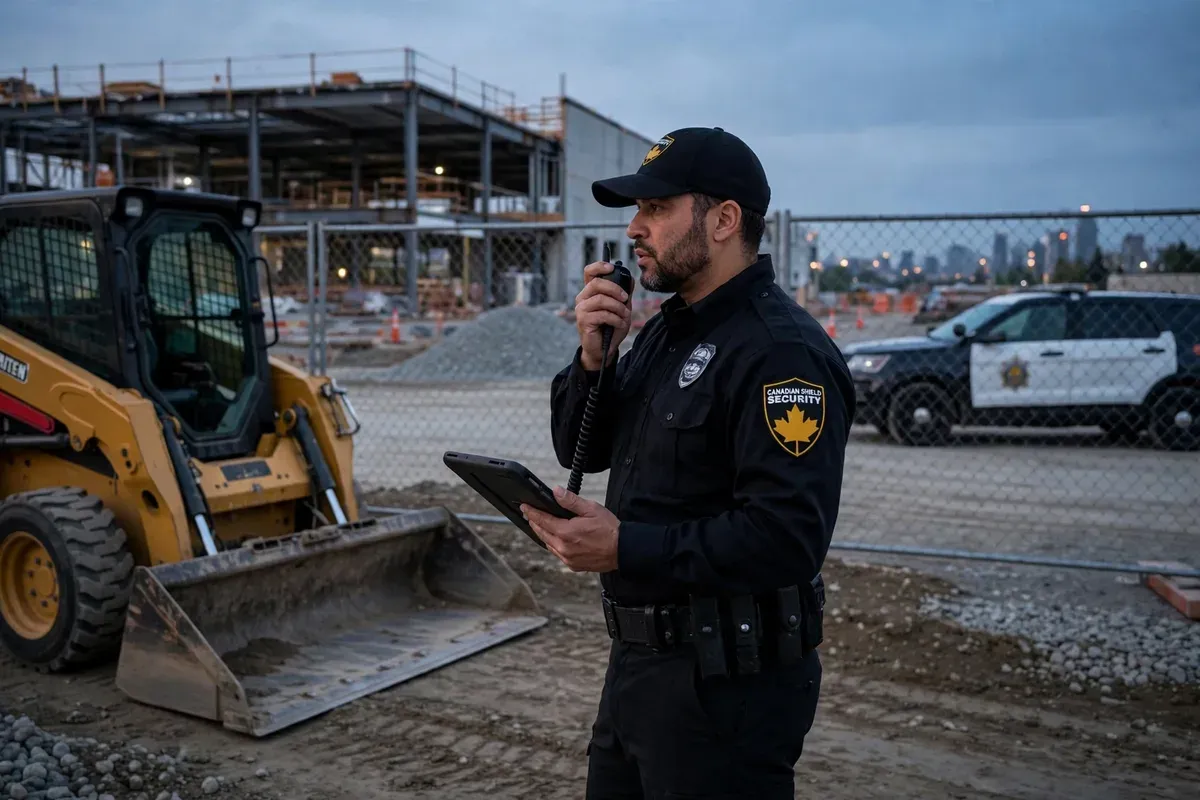
It is 6:15 on a Monday morning on a half-built warehouse lot off 99 Street in south Edmonton, T6E, and the site supervisor is counting machines that are no longer there. The skid steer is gone, the generator has vanished from the sea can, and two pallets of copper wire are missing from the laydown yard. The schedule slips a week. Our Canadian Shield Security team works Edmonton construction sites every week, and the sites that keep their equipment are the ones with a plan, not luck.
This guide is for a site manager, general contractor or developer who wants practical equipment theft prevention for an Edmonton build. It covers why machines and tools go missing, the four layers of prevention Canadian insurers recommend, how GPS tracking really works, what guards and patrols add, and what prevention costs. Our construction site security service covers active builds across Edmonton, Leduc and Nisku.
Equipment theft prevention on Edmonton construction sites means locked storage, key control, GPS tracking with geofence alerts, and SSIA-licensed guards or mobile patrols after hours. Record serial numbers and photos for every machine, park equipment in lit, fenced areas, and keep a written night routine. Start with a free site assessment to match the plan to your build phase.
Why Construction Equipment Is an Easy Target in Edmonton
Construction equipment is built to move, and that is what makes it easy to steal. A skid steer starts with a common key, a generator lifts into a pickup bed, and copper wire sells fast. Sites change every week, with subcontractors coming and going, so a stranger in a hard hat rarely draws a second look. Northbridge Insurance puts the cost of construction theft in Canada at an estimated $46 million in 2024, and industry reporting says less than 25 percent of stolen equipment is ever recovered.
The Four Layers of Equipment Theft Prevention
Canadian insurers describe theft prevention in four layers, and the smart move is to use all four together. Each layer on its own slows a thief down; stacked together, they make your site a poor target next to the one down the road.
| Layer | What It Covers | Examples | Best For |
|---|---|---|---|
| Layer 1: Basic habits | Low-cost daily habits | Lock doors, remove keys, lit parking | Every site, every night |
| Layer 2: Physical locks | Machine-level locks and alarms | Track locks, wheel boots, VIN etching | Tools and mid-value machines |
| Layer 3: Immobilisers | Stopping the machine starting | Engine immobilisers, kill switches | Owned fleet machines |
| Layer 4: Tracking and watch | Finding and watching equipment | GPS, geofencing, cameras, patrols | High-value and rented fleet |
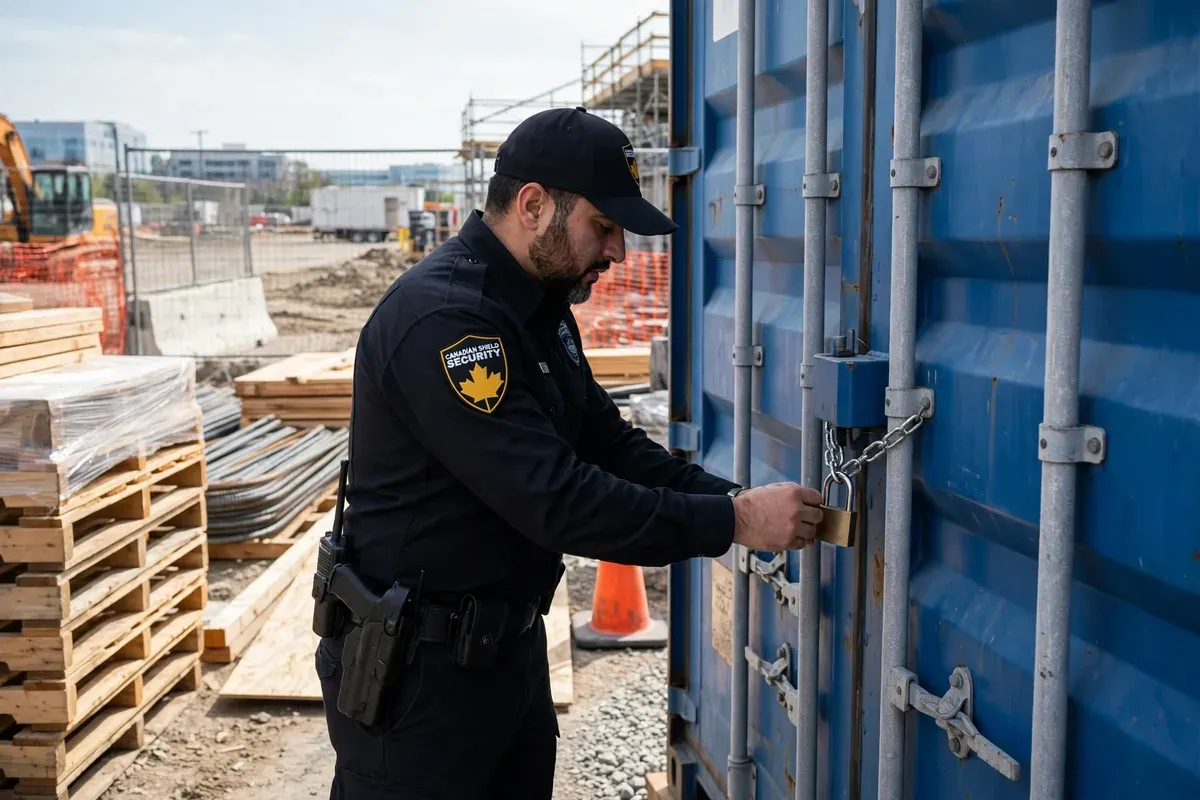
Layers one and two cost the least and stop the most casual theft. Lock every cab and engine compartment, take the keys off site, and park machines together in a lit, fenced corner where a truck cannot reach them without being seen. Fit track, cylinder and fuel-cap locks, and etch the VIN or ID number onto windows and parts so a machine is hard to sell on. If your site has been hit before, see our construction site security guide.
Layers three and four protect the machines worth stealing. An engine immobiliser or kill switch stops a thief from starting the machine at all, and a GPS tracker with a geofence alert tells you the minute a machine leaves the yard. GPS is not a cure on its own: thieves know where trackers sit and can pull them out fast, so hide a second tracker.
GPS Tracking and Geofencing: What Works and What Does Not
GPS tracking earns its keep in the first hour after a theft, when police still have a live location to work with. A tracker on a skid steer or generator, paired with a geofence around the site, sends an alert the moment the machine moves after hours. Thieves who steal machines for a living know the factory fit points, so fit a second, battery-powered tracker somewhere they will not look.
Geofencing works best when someone is watching the alerts. An alert that lands on a phone nobody checks at 2 a.m. is no better than no alert at all. That is where a patrol or a monitored camera system earns its fee: the alert reaches a guard who can be on site in minutes, not a manager who reads it over breakfast. Our CCTV monitoring service turns an alert into a response.
Lock It Down: Storage, Keys and the Night Routine
Most equipment theft is a paperwork failure as much as a security failure. Before a machine arrives on site, record its serial number, make and model, year built, purchase date and value, and take photos from every side. File that record where the night supervisor can reach it, because a police report without serial numbers goes nowhere, and an insurer will ask for the same list.
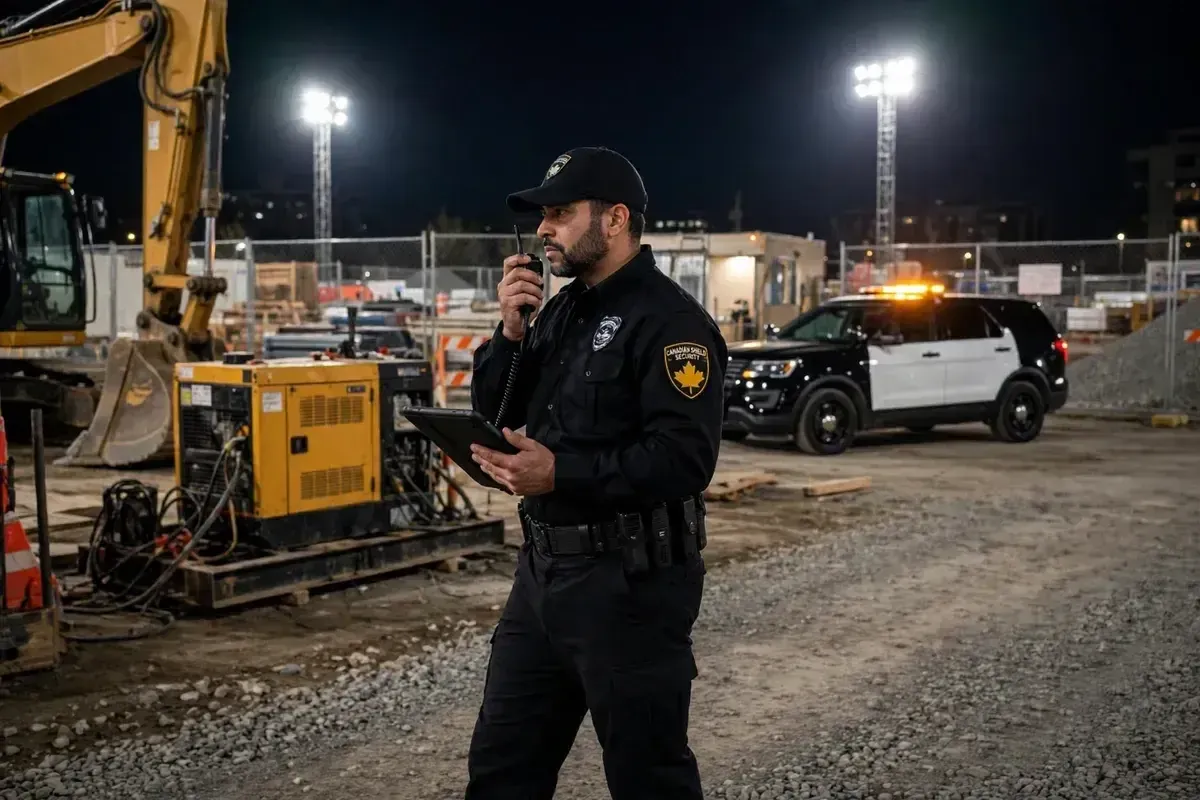
The night routine is the last line. Keys go into a locked box, not a site office drawer; the fuel caps and engine compartments get locked; machines park together, nose in, in the lit corner; the sea can gets a proper lock, not a padlock from the hardware store. The guard or the last person off site walks the yard, checks the gate, and writes it down.
Guards and Patrols: The Layer Thieves Cannot Switch Off
A lock can be cut and a tracker can be pulled, but a guard on site changes the maths for a thief. A static guard on a high-value phase, or a mobile patrol through the night, means the yard is watched at random times a thief cannot plan around. Every visit leaves a written report with photos, so the site manager sees the fence line, the gate and the machines checked, night after night.
What Equipment Theft Prevention Costs in Edmonton
Cost comes down to four things: the size of the site, the number of gates and access points, the value of the machines left on site overnight, and the hours you need covered. A mobile patrol costs less than a guard on site around the clock, and most active builds use both, a guard through the high-value phases and patrols through the quiet ones.
SSIA Licensing: The Check Before You Hire
Every security guard in Alberta must hold a valid licence under the Security Services and Investigators Act (Alberta). Guards must be over 18, eligible to work in Canada, and fluent in English, with an approved training course and 80 percent or higher on the provincial exam. The licence costs $100, lasts two years, and a guard must carry the original card while working. The company must also hold a valid SSIA business licence -- ours is B001449. Check the official licensing requirements on alberta.ca before you sign.
After a Theft: What to Do the Same Day
If a machine is missing, call Edmonton Police Service first if anyone may still be on site, then keep the crew out and touch nothing until police say it is clear. Hand police the serial numbers, photos and purchase records you filed, plus the last GPS location if the machine had a tracker. Then call your insurer and your security provider so patrols step up that night. Our construction site break-in guide covers the same-night steps.
Your Equipment Theft Prevention Checklist
You need no security background to protect a site. Work through these steps before the next machine arrives, and repeat the check at every phase change.
- Record serial numbers, photos and purchase details for every machine and tool.
- Lock cabs, engine compartments and fuel caps, and take the keys off site.
- Park machines together in a lit, fenced corner, and lock the sea can properly.
- Fit GPS trackers, hide a second one, and set a geofence alert for after hours.
- Book patrols or a guard for the high-value phases, and agree the reporting routine.
- Check the SSIA business licence, and review the plan at every phase change.
Equipment theft is a cost of building in Edmonton, but it is not a fixed one. The sites that keep their machines are the ones that lock up, track, watch and write it all down, every night, without exception. Start with the inventory list and the night routine, and put a licensed guard on the hours that count.
Are security guards on Edmonton construction sites required to be licensed?
Yes. Every guard on an Edmonton construction site must hold a licence under the Security Services and Investigators Act (Alberta). Guards complete an approved training course, pass a provincial exam at 80 percent or higher, and pass a criminal record check. The licence costs $100 and lasts two years.
How much does equipment theft prevention cost for an Edmonton construction site?
It depends on the size of the site, the number of access points, the value of machines left on site overnight, and the hours you need covered. Locks and trackers are one-off buys, while guards and patrols are priced by the shift. Ask for a free site assessment and a written quote before you sign.
Does Canadian Shield Security cover construction sites in Leduc and Nisku?
Yes. We cover active builds in Edmonton, Leduc, Nisku, Acheson and Stony Plain, including the T9E industrial corridor near Edmonton International Airport. Patrol routes run day and night, and your site is confirmed during a free assessment before guards deploy. Call 1 (800) 326-7879 to book a walk-through for your build.
Does GPS tracking really help recover stolen construction equipment?
Yes, when it is fitted well and someone watches the alerts. A tracker with a geofence sends an alert the moment a machine leaves the site after hours, giving police a live location in the first hour. But thieves know the factory fit points, so hide a second battery-powered unit and pair tracking with a guard.
What should I do first if equipment is stolen from my Edmonton construction site?
Call Edmonton Police Service first if the intruder may still be on site, then keep everyone out and do not touch anything. Hand police the serial numbers, photos and purchase records you filed, plus the last GPS location if the machine had a tracker. Then call your insurer and your security provider so patrols step up that night.
Canadian Shield Security Editorial Team, Edmonton, Alberta
Canadian Shield Security protects Edmonton construction sites 24/7, from the first dig to the final walkthrough. Free consultation -- call 1 (800) 326-7879 or request a free consultation.
