
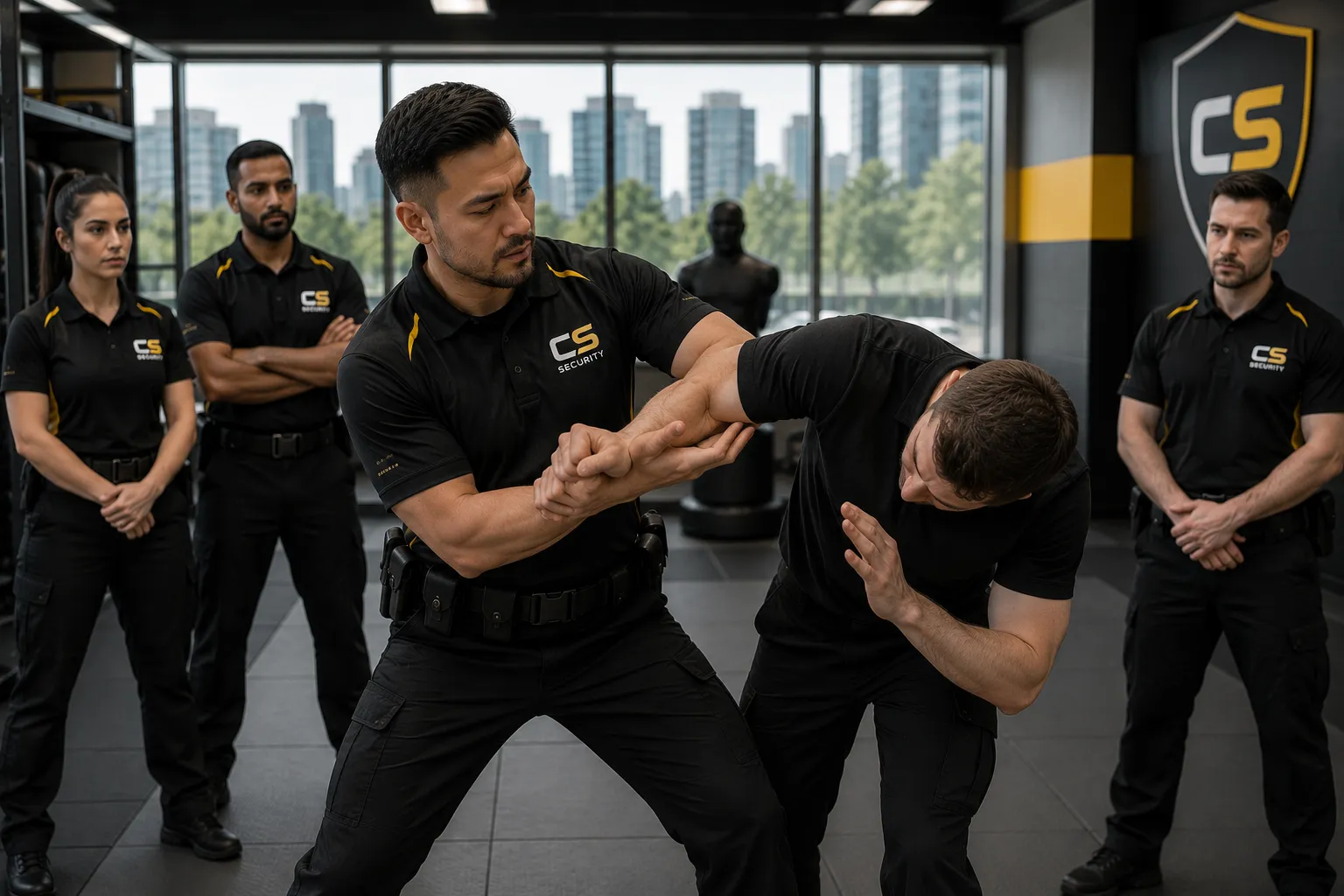
A clinic administrator overseeing a walk-in medical practice near Downtown Edmonton (T5J) once assumed her contracted guard could physically remove an agitated patient the moment tempers rose. When an incident actually happened, the guard used verbal de-escalation and called for backup instead, a response that turned out to be exactly what Alberta law required, not a failure of nerve.
That response reflects a security guard's use of force training, a mandatory component of every SSIA licence under the Security Services and Investigators Act (Alberta). Guards providing on-site guard coverage in Edmonton are trained to use the minimum force necessary, never the maximum available.
This guide explains what use of force training actually covers, the legal limits guards operate under, and how Canadian Shield Security applies this training across healthcare, retail, and commercial sites in Edmonton.
|
Use of force training teaches Alberta security guards the legal limits on physical intervention, prioritizing verbal de-escalation and only using force that is reasonable and proportionate to a threat. It is built into the Alberta Basic Security Training Course, with a separate 40-hour certification required before a guard can carry a baton or handcuffs on duty. |
What Is Use of Force Training for Security Guards in Alberta?
Use of force training is the portion of a security guard's licensing that teaches when, and how much, physical intervention is legally permitted in Alberta. It is built into the Alberta Basic Security Training Course, commonly known as ABST, which every guard completes to earn a licence under the Security Services and Investigators Act (Alberta), or SSIA.
The training covers a use of force continuum, ranging from presence and verbal commands at the low end to physical restraint at the high end, and teaches guards to select the lowest level of response that will resolve a situation safely. Guards learn to treat their own presence and calm verbal commands as the first and often only tools needed, since a visible, trained officer resolves the majority of situations before anything more is required.
It also covers documentation, since any use of force must be recorded in an incident report regardless of how minor it seemed at the time. For an Edmonton business, this training is not an optional add-on.
It is the legal foundation every licensed guard already carries before their first shift, and it applies equally whether that guard is stationed at an office tower or a retail entrance.
|
Force Level |
Guard Action |
Extra Certification Required? |
|
Presence |
Visible, uniformed deterrence |
No |
|
Verbal |
Commands, verbal de-escalation |
No |
|
Soft control |
Guiding or escorting a cooperative person |
No |
|
Mechanical restraint |
Handcuffing a person under lawful citizen's arrest |
Yes -- 40-hour certification |
|
Intermediate weapon |
Baton use in a defensive scenario |
Yes -- 40-hour certification + employer approval |
The Legal Limits on Force Under Canadian Law
Security guards in Alberta operate under the same use of force authority as any private citizen, not the expanded powers granted to police. Section 25 of the Criminal Code permits reasonable force when a person is authorized by law to do something, such as a lawful citizen's arrest under section 494, while Section 26 holds that same person criminally responsible if the force used is excessive.
Section 34 allows reasonable force in self-defence, and Section 35 allows reasonable force to protect property, but both require that the response match the actual threat, not the guard's worst-case assumption about it. A guard who strikes a verbally uncooperative but non-violent person, for example, has used a level of force the law does not support for that situation, regardless of how justified it may have felt in the moment.
This legal framework is the same reason Edmonton security companies train guards to document every incident and default to the least forceful option available, since the documentation itself becomes the record that determines whether a response was reasonable after the fact.
|
A security guard's legal authority to use force comes from the same Criminal Code sections that apply to any private citizen, not from special police-level powers. |
Why De-Escalation Comes Before Any Physical Response
De-escalation is not a soft alternative to use of force training; it is the first and most heavily weighted part of it. Guards are trained to recognize rising tension early, use calm and assertive verbal communication, and give an agitated person time and space before any physical option is even considered.
Research cited in professional training materials suggests guards who allow that time achieve meaningfully better outcomes than those who rush toward a resolution, since agitated individuals often calm down on their own once they feel heard rather than confronted. This matters because the mere presence of a uniformed, trained guard often resolves a situation on its own, without a single word needing to become a command.

Healthcare environments make this especially important, since patients or visitors in distress may be dealing with pain, fear, or a medical crisis rather than genuine aggression, and a guard trained only in physical control would misread that distinction badly. Canadian Shield Security's healthcare facility security guards are trained specifically in de-escalation for exactly this reason, since a hospital hallway calls for a different first response than a construction site gate, and treating the two the same is where avoidable incidents tend to start.
What Extra Training a Guard Needs to Carry a Baton or Handcuffs
Carrying a baton or handcuffs requires certification well beyond the base ABST course, and Alberta treats this as a separate, additional qualification tied to the guard's licence. The full course typically runs around 40 hours and covers physical control techniques, handcuffing procedures, and a deeper study of use of force principles and stress management under pressure.
Recertification is required periodically, typically through a shorter refresher course, since these are physical skills that fade without practice, and lapsed certification means the guard is no longer authorized to carry either tool. Critically, completing the course is not enough on its own.
The guard's current employer must also approve baton or handcuff use for a specific role, meaning a licensed and certified guard still cannot carry either tool without that additional employer sign-off documented on file. This two-layer requirement, provincial certification plus employer approval, exists specifically to prevent guards from carrying control tools into roles where they were never actually needed or authorized.
What Happens If a Guard Uses Excessive Force
A security guard who uses excessive force in Alberta faces consequences that extend well past an awkward conversation with a supervisor. Under Section 26 of the Criminal Code, using more force than a situation reasonably required can lead to criminal charges, including assault, regardless of the guard's intent going in.
The guard's SSIA licence can also be suspended or revoked following a serious incident, and the hiring business can face separate civil liability if the guard was acting within the scope of their contracted duties at the time. Insurers may deny coverage tied to an incident involving excessive force, treating it differently than an incident where a guard's response stayed within trained limits, which turns a single bad decision into a compounding financial and legal problem for everyone involved.
This is why Edmonton property managers should ask a security provider directly how incidents are documented and reviewed, not just whether guards are licensed, since documentation practices are often what separates a defensible response from an indefensible one after the fact.
When to Rely on Police Instead of a Security Guard
Security guards are trained to observe, deter, and report; they are never trained or authorized to replace police in an active criminal or violent situation. For an assault in progress, a weapon on scene, or any situation where someone's safety is at immediate risk, the correct response from a guard is to create distance, call Edmonton Police Service, and document what they observed, not to physically intervene beyond what self-defence or protecting others genuinely requires in the moment.
This boundary exists because a guard's legal authority never exceeds that of a private citizen, no matter how much use of force training they have completed or how many years of experience they carry. Edmonton property managers who expect a guard to function like an armed response unit are working from the wrong model, and that mismatch in expectations is often where liability problems start, well before any physical incident actually occurs on site.
|
Security guards are trained to observe, deter, and report. For active criminal or violent incidents on an Edmonton property, always contact Edmonton Police Service first. |
How Canadian Shield Security Applies Use of Force Training on Edmonton Sites
Canadian Shield Security builds use of force training and de-escalation into every guard placement across Edmonton, from healthcare facility security through standard on-site guard contracts. Guards deployed to hospitals, clinics, and care facilities near Downtown Edmonton and T6H receive additional emphasis on de-escalation given the sensitivity of those environments, where confrontational tactics can worsen a medical or psychological crisis rather than resolve it.

Any guard authorized to carry a baton or handcuffs on a Canadian Shield Security contract holds the additional 40-hour certification on file, with employer approval documented before deployment, not assumed after the fact. Property managers can request confirmation of a guard's specific training level, not just their base SSIA licence, as part of any service agreement, which keeps expectations aligned with what a guard is actually trained and authorized to do.
This same documentation approach carries across every Edmonton-area contract, from Sherwood Park to St. Albert, so a client's expectations never outpace what a guard's certification actually covers.
Conclusion
Use of force training is not about equipping guards to handle worst-case scenarios physically. It is about teaching them the legal limits that already apply to everyone in Alberta, and giving them the judgment to de-escalate before those limits ever become relevant on an Edmonton property.
Property managers who understand this distinction ask better questions when vetting a security provider, focusing on training depth and documentation rather than assuming more force equals more protection. Canadian Shield Security trains every guard to this standard before deployment, not after an incident forces the conversation.
|
CANADIAN SHIELD SECURITY Canadian Shield Security serves Edmonton 24/7. Free consultation, no hidden fees. Call 1 (800) 326-7879. |
Frequently Asked Questions
Is use of force training required for every security guard in Alberta?
Yes. Foundational use of force training is built into the Alberta Basic Security Training Course that every guard completes to earn an SSIA licence. Additional 40-hour certification is required only for guards who will carry a baton or handcuffs, which is a separate qualification tied to specific job roles, not a standard requirement for every licensed guard.
How much does baton or use of force certification cost in Alberta?
New baton and handcuff certification typically runs several hundred dollars for the full course, with a shorter and less expensive recertification required periodically to keep the credential active. Costs vary by training provider, and businesses should confirm this is factored into a contracted guard's rate rather than billed as a separate line item.
Does Canadian Shield Security provide de-escalation trained guards in Sherwood Park and St. Albert?
Yes. Canadian Shield Security deploys guards trained in de-escalation and use of force principles across Edmonton, Sherwood Park, St. Albert, Leduc, Beaumont, and Nisku, with 24/7 coverage including nights, weekends, and holidays for commercial, residential, and healthcare-adjacent properties throughout the region.
Can a security guard in Alberta use pepper spray or a taser?
No. Pepper spray and stun devices are classified as prohibited weapons under Canada's Criminal Code and are not standard tools for private security guards in Alberta. Guards rely on presence, verbal de-escalation, and, where specifically certified and employer-approved, a baton or handcuffs instead.
What happens if a security guard uses excessive force in Alberta?
A guard who uses excessive force can face criminal charges under the Criminal Code, and their SSIA licence can be suspended or revoked following review. The hiring business can also face civil liability, and insurers may treat an excessive force incident differently than one where a guard's response stayed within trained, documented limits.
