
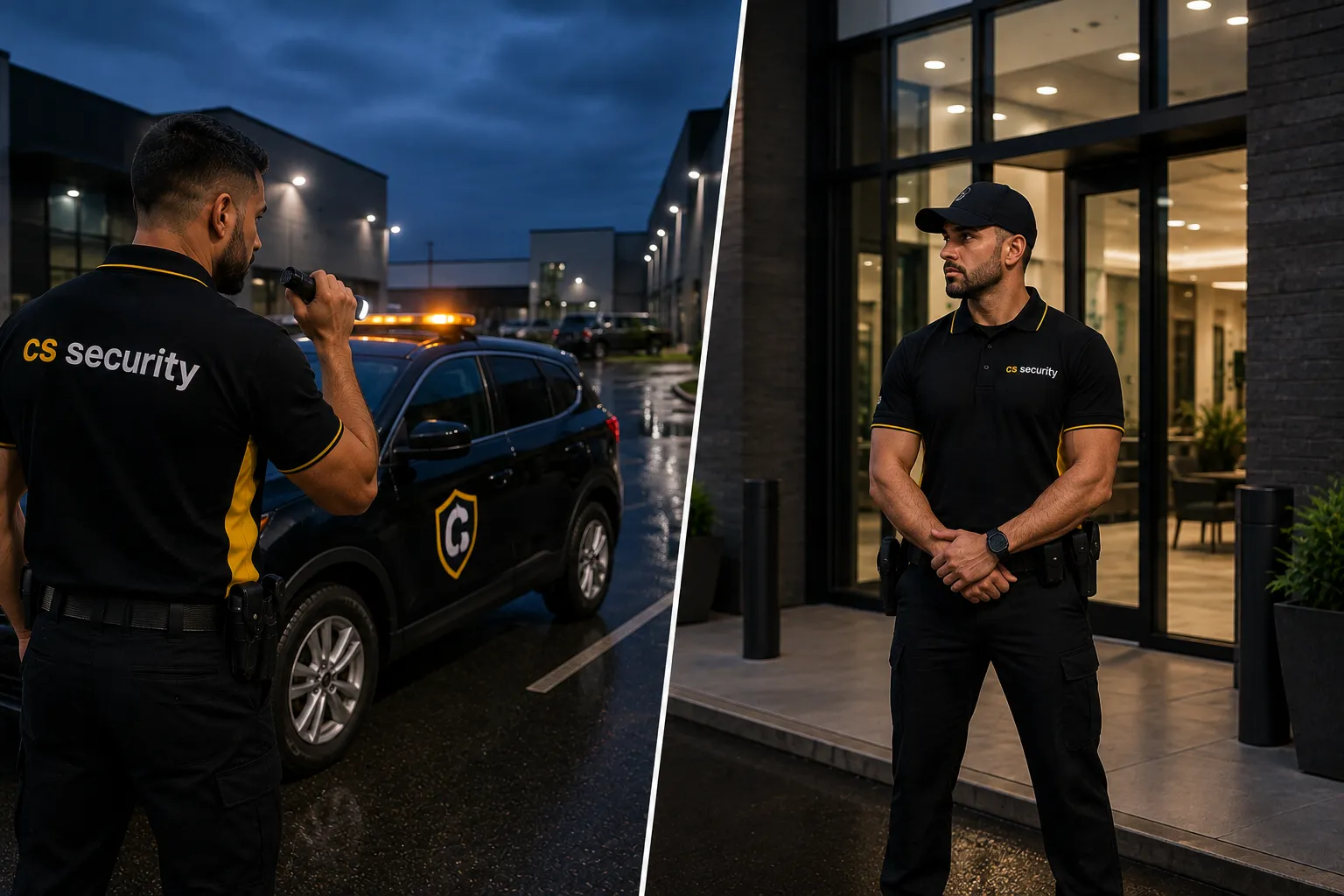
A retail plaza owner in South Edmonton spent two years paying for a 24/7 on-site guard before a free assessment showed that a randomized mobile patrol route covering three overnight checks per night, paired with a guard during business hours only, cut the monthly security bill by nearly 40 percent without losing coverage where it mattered.
A mobile patrol vs on-site guard Edmonton decision like this comes up constantly for property managers and business owners who rely on our mobile patrol security and on-site guard services to protect very different types of sites. Choosing wrong means either overpaying for coverage you do not need or leaving real gaps exposed.
This guide compares cost, response time, and legal requirements for both options, so you can match the right service, or the right combination, to your specific Edmonton property.
|
QUICK ANSWER Mobile patrol suits lower-risk or larger properties needing randomized checks and cost efficiency, while an on-site guard suits high-traffic sites needing constant presence and instant response. Both require SSIA-licensed officers in Alberta. Many Edmonton businesses combine both: an on-site guard by day and mobile patrol overnight for full, budget-friendly coverage. |
What's the Difference Between Mobile Patrol and On-Site Guard?
Mobile patrol involves a marked vehicle and officer covering multiple properties on a scheduled or randomized route, performing exterior checks, alarm response, and lock-up verification at each stop. An on-site guard is a dedicated officer stationed continuously at one property for the full shift.
The core trade-off is presence versus coverage. An on-site guard is always there, able to respond the instant something happens. A mobile patrol officer is not present between visits, but one officer can protect far more ground across several Edmonton properties in a single shift.
Neither option is inherently better. A downtown office tower with constant visitor traffic has very different needs than a fenced storage yard that only sees activity after dark, and the right choice depends entirely on how your property actually gets used throughout the day and night.
Retail plazas, warehouses, car dealerships, and construction sites tend to lean toward mobile patrol for its cost efficiency across larger footprints, while healthcare facilities, condo towers with front-desk expectations, and high-traffic offices tend to lean toward an on-site guard for the direct human presence residents and visitors expect.
|
Factor |
Mobile Patrol |
On-Site Guard |
|
Presence |
Periodic, scheduled or randomized |
Continuous for the full shift |
|
Best for |
Larger footprints, lower-risk sites |
High-traffic or high-risk single sites |
|
Cost model |
Billed per visit or route |
Billed per hour, full shift |
|
Documentation |
GPS-verified checkpoint log |
Continuous shift incident log |
Are Both Mobile Patrol and On-Site Guards SSIA-Licensed in Alberta?
Yes. Under the Security Services and Investigators Act (Alberta), every guard, whether assigned to a fixed post or a patrol route, must complete Alberta Basic Security Training and hold a valid SSIA licence before working on any Edmonton property.
Post orders, the written instructions defining exactly what a guard does at a specific site, apply to both roles but look different in practice. An on-site guard's post orders cover a single location in detail. A mobile patrol officer's post orders cover a route, listing each stop, checkpoint, and expected task per visit.
Both sets of post orders should be reviewed and updated as your property's needs change. A post order written for a construction site's active build phase, for example, looks very different once the building is enclosed and the risk profile shifts toward standard commercial coverage.

GPS patrol tracking is one of the biggest practical differences between the two services. Mobile patrol visits are logged automatically, with GPS-verified timestamps confirming exactly when an officer arrived and departed each property, giving property managers a documented record for every checkpoint on the route.
Client reporting reflects this difference too. An on-site guard's incident log documents continuous shift activity, hourly observations, and any incidents as they happen. A mobile patrol report instead shows a series of time-stamped checkpoints, confirming the property was checked, when, and by whom, which many Edmonton property managers find easier to review at a glance across multiple sites.
Mobile Patrol vs On-Site Guard: Cost Comparison in Edmonton
On-site guards typically cost $28 to $45 per hour in Edmonton, depending on certification level and whether coverage runs 24/7 or scheduled hours. Mobile patrol is usually billed per visit or route rather than a flat hourly rate, which often works out to $35 to $55 in patrol-hour equivalent, but across far fewer total hours than a standing guard.
For a mid-size commercial property, three to six randomized patrol visits per night can cost a fraction of what 24/7 on-site coverage requires, while still deterring the after-hours activity most Edmonton businesses are actually worried about.
Contract length also affects pricing for both services. Longer-term agreements typically bring the per-hour or per-visit rate down for either option, while short-term or event-based coverage carries a premium to reflect the shorter commitment and faster mobilization required.
Properties with constant foot traffic, high-value inventory, or a need for visitor management during business hours usually find on-site guard costs justified by the direct interaction and instant response a stationed officer provides. A free consultation and site assessment can model both options against your actual risk profile before you commit to either.
|
Coverage Type |
Typical Cost Range |
Best For |
|
On-site guard, standard hours |
$28-$35/hour |
Business-hours visitor management |
|
On-site guard, 24/7 post |
$35-$45/hour |
High-traffic or high-risk single site |
|
Mobile patrol, 3-6 visits/night |
$35-$55 patrol-hour equivalent |
Larger footprints, lower-risk sites |
Response Time: How Fast Does Each Option Reach You?
An on-site guard responds immediately because they are already positioned at the property when an incident occurs, whether that is a medical emergency, a disturbance, or an unauthorized entry attempt.
Mobile patrol response depends on route timing and proximity. A scheduled check might arrive within its normal window, while an alarm call-out on a standing GPS-dispatched route can bring an officer to your Edmonton property within 15 to 45 minutes, depending on where the vehicle currently sits on its route.

For most non-emergency situations, that response window is more than adequate. For sites where seconds genuinely matter, such as a healthcare facility or an active retail floor, an on-site guard's instant presence is difficult to replace with patrol alone.
Alarm response is where the two services often overlap. A monitored alarm can trigger an immediate mobile patrol dispatch even outside the officer's scheduled route, closing much of the response gap for properties that only need fast action during genuine emergencies rather than constant physical presence.
How to Choose: Matching the Service to Your Property
Start by identifying your actual risk pattern. If incidents cluster around business hours with high foot traffic, an on-site guard usually fits better. If your main exposure is after-hours trespassing, parking lot activity, or unlocked doors, mobile patrol is often sufficient.
Map your property against three questions: how much continuous human presence do you need, what is your realistic incident frequency, and what does client reporting need to show for insurance or ownership purposes.
Consider your budget ceiling next. Properties with a fixed monthly security budget often get more total protection from a mix of shorter on-site guard shifts and supplemental patrol coverage than from stretching a single service to cover every scenario.
Review your insurance requirements as well. Some commercial policies specify a minimum level of documented security presence, and either service can satisfy that requirement, but the documentation style differs enough that it is worth confirming with your insurer which format they expect to see.
Edmonton Winter and Routing: Nisku vs Downtown Differences
Edmonton winters change both services in different ways. On-site guards need cold-weather gear and shelter access for outdoor posts, while mobile patrol vehicles must be equipped for reliable cold starts at -40C, since a patrol route is only as effective as the vehicle's ability to complete it on schedule.
Routing also differs by area. A Downtown Edmonton (T5J) patrol route typically covers tightly packed properties within a short driving distance, allowing more frequent visits per shift. A route through Nisku Industrial Park covers fewer, more spread-out properties, so patrol frequency and per-visit cost are usually structured differently to reflect the added drive time.
Properties near Nisku or Leduc considering mobile patrol for after-hours coverage should confirm how drive time between stops affects both response time and overall visit frequency, since a route built for Downtown density does not translate directly to an industrial corridor.
Seasonal demand shifts matter too. Retail properties near West Edmonton Mall may want increased patrol frequency or added on-site coverage during the holiday season, while construction sites near Acheson often need heavier overnight presence during active build phases and can scale back once a site is enclosed and secured.
Can You Combine Both? The Hybrid Approach
Yes, and for many Edmonton businesses this is the most cost-effective answer. A common pattern is an on-site guard during business hours for visitor management and access control, switching to mobile patrol overnight for perimeter checks and alarm response once the property is closed.
Construction sites often use a similar layered model through construction site security: an on-site guard overnight during high-theft phases of a build, with patrol checks covering lower-activity periods once major materials and equipment are secured.
Canadian Shield Security can structure a hybrid plan during a free site assessment, blending on-site hours and patrol frequency around your property's actual traffic pattern rather than defaulting to one service for the entire contract.
Condo and multi-tenant properties, supported through condo security Edmonton, frequently land on a similar hybrid model: a concierge or gate guard during the day for resident and visitor interaction, paired with overnight patrol checks of parking areas, amenity spaces, and building perimeters where a stationed officer adds less value after hours.
Final Thoughts
Choosing between mobile patrol and an on-site guard comes down to how much continuous presence your property genuinely needs versus how much ground it needs covered. Many Edmonton businesses do not have to choose at all, since a blended plan often delivers stronger protection at a lower total cost than either service alone.
Canadian Shield Security's SSIA-licensed officers serve Edmonton businesses 24/7 with GPS-verified patrol reporting, on-site guard coverage, and a free consultation to build the right mix for your property and budget.
|
GET A FREE CONSULTATION Canadian Shield Security serves Edmonton 24/7. Free consultation, no hidden fees. Call 1 (800) 326-7879 or WhatsApp 1 (780) 203-4535. |
Frequently Asked Questions
Do mobile patrol officers need the same licence as on-site guards in Alberta?
Yes. Under the Security Services and Investigators Act (Alberta), both mobile patrol officers and on-site guards must complete Alberta Basic Security Training and hold a valid SSIA licence. Canadian Shield Security confirms licence numbers for every officer before deployment, whether they are assigned to a fixed post or a patrol route.
Is mobile patrol cheaper than an on-site guard in Edmonton?
On-site guards typically cost $28 to $45 per hour, while mobile patrol runs $35 to $55 per visit-hour depending on frequency and route length. Mobile patrol is often cheaper overall for larger or lower-risk properties, since one officer covers multiple sites instead of standing at just one. A free assessment gives you an exact quote.
Does Canadian Shield Security offer both services near Nisku and Downtown Edmonton?
Yes. Canadian Shield Security provides both mobile patrol and on-site guard coverage across Downtown T5J, South Edmonton T6H, Nisku, Sherwood Park, St. Albert, and Leduc. Properties in any of these areas can combine both services, using a fixed guard by day and randomized patrol routes overnight for full coverage.
Can I use both mobile patrol and an on-site guard at the same property?
Yes, many Edmonton businesses use both. A retail plaza might staff an on-site guard during business hours for visitor management, then switch to mobile patrol overnight for perimeter checks and alarm response. This layered approach often costs less than 24/7 on-site coverage while still closing key security gaps.
How fast does each option respond to an incident?
An on-site guard responds immediately since they are already stationed at your property. Mobile patrol response depends on route timing and distance, typically arriving within 15 to 45 minutes for a scheduled check, or faster for alarm call-outs on a standing GPS-dispatched route near your location.
