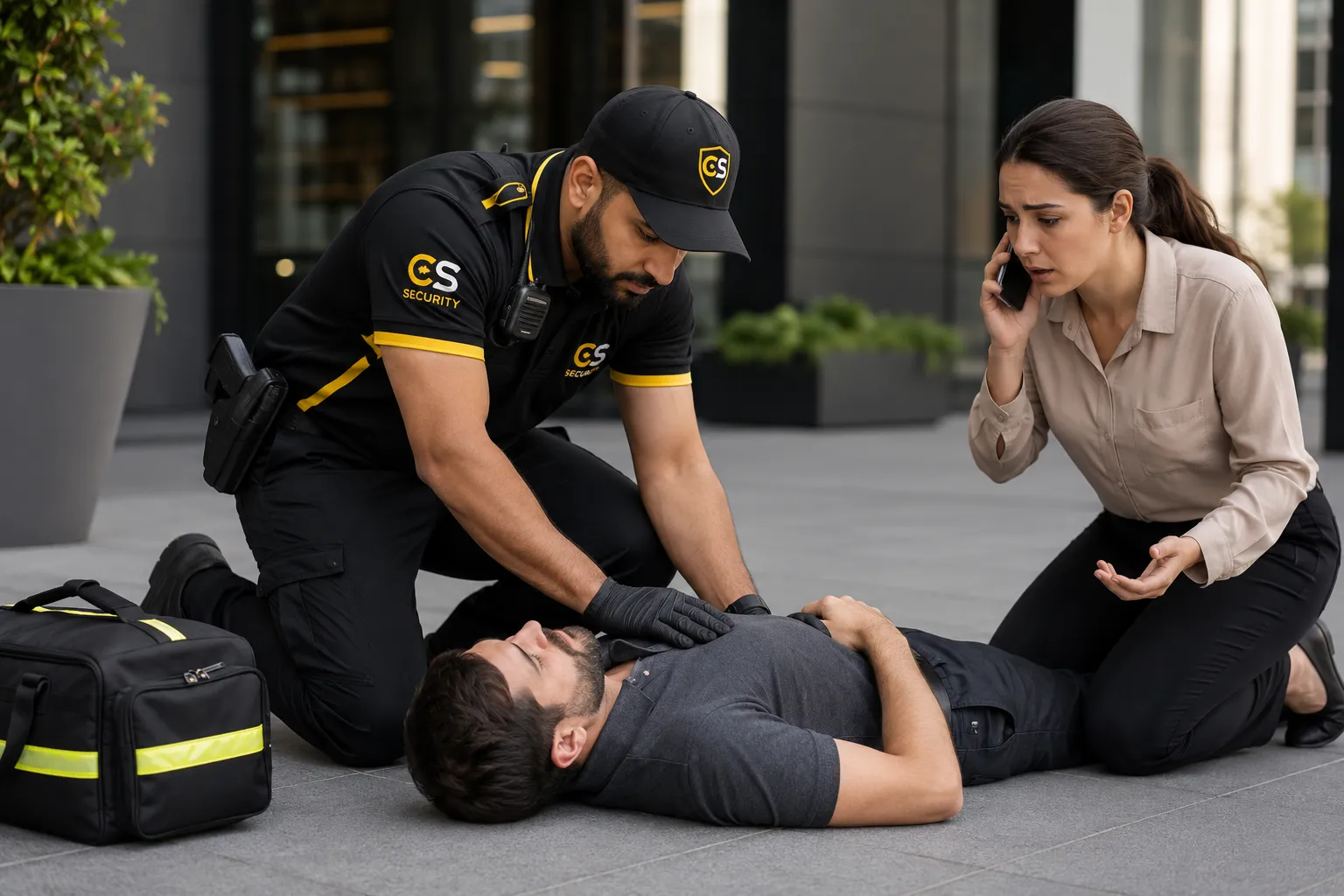
A visitor to a downtown Edmonton office tower near the Royal Alexandra Hospital area collapsed in the lobby during a busy Monday morning, and the on-site guard reached him within thirty seconds, checked for breathing, and began chest compressions while a colleague called 911 and retrieved the building's AED.
A medical emergency security guard Alberta response like this one is exactly what property managers and healthcare facility administrators across the city rely on our on-site guard service to provide. Paramedics arrived within minutes, but those first thirty seconds, handled correctly, are often what determines the outcome.
This guide walks through what a licensed Edmonton security guard actually does during an on-site medical emergency, what training the law requires, and how to prepare your property for a faster, more coordinated response.
|
QUICK ANSWER When a medical emergency happens on site, a security guard assesses the scene, calls 911 with the exact location, provides first aid within their training, and clears the path for paramedics. SSIA-licensed guards in Edmonton are typically Standard First Aid and CPR certified and document every step for the incident report. |
What Counts as a Medical Emergency a Security Guard Must Respond To?
A medical emergency a security guard must respond to includes sudden collapse, chest pain, severe allergic reaction, seizure, uncontrolled bleeding, choking, and loss of consciousness. Guards are trained to recognize these situations quickly and begin the correct response sequence without waiting for direction.
Slips, falls, and minor injuries also fall under a guard's response duties, though the urgency and steps differ from a life-threatening event. A guard's training helps them distinguish between a situation that needs first aid on-site and one that needs an immediate 911 call before anything else.
|
Emergency Type |
First Guard Action |
Escalation |
|
Cardiac arrest / collapse |
Check responsiveness, begin CPR, retrieve AED |
Call 911 immediately, before first aid if alone |
|
Severe allergic reaction |
Assist with epinephrine auto-injector if trained and available |
Call 911 immediately |
|
Seizure |
Clear surrounding area, time the seizure, protect the head |
Call 911 if first seizure or lasts over 5 minutes |
|
Uncontrolled bleeding |
Apply direct pressure, elevate if possible |
Call 911 for severe or arterial bleeding |
|
Minor slip or fall |
Assess injury, apply basic first aid |
Call 911 only if injury is severe |
Why On-Site Guards Are Often First to Respond
Security guards are frequently first on scene because they are already positioned throughout a property, monitoring entrances, common areas, and high-traffic zones where incidents are most likely to occur. In a large office tower or retail site, a guard can often reach a person faster than an ambulance can arrive from across the city.
Alberta Health Services response times vary by location and call volume, and downtown Edmonton properties can see EMS arrival in a different window than sites near Nisku or the outer suburbs. A trained guard bridges that gap, delivering first aid and CPR in the minutes that matter most before paramedics take over.
Healthcare facilities face a related but distinct challenge. Security guards at clinics and hospitals near the Royal Alexandra Hospital corridor often support clinical staff during a code response, managing crowd control and access rather than delivering direct medical care through healthcare facility security, since licensed medical professionals are already present.

Construction and industrial sites around Nisku and Leduc present a different risk profile entirely. Under Alberta's OHS Code, these are typically classified as high-hazard work through construction site security arrangements, which changes both the first aid certification level required and how quickly a guard or designated first aider must be able to respond on a remote or distant site.
Large event security deployments at venues like Rogers Place or the EXPO Centre create a third scenario, where guards work alongside dedicated event medical teams. In a crowd of thousands, a guard's main job is often locating the person quickly and guiding paramedics through a packed venue rather than providing extended first aid alone.
Is a Security Guard Legally Required to Have First Aid Training in Edmonton?
Yes, in practice. The Security Services and Investigators Act (Alberta) requires every guard to complete the Alberta Basic Security Training course and hold a valid SSIA licence, though first aid certification itself is set by individual employer contracts rather than the SSIA directly.
Most Edmonton commercial and healthcare contracts require guards to hold Standard First Aid and CPR certification meeting the CSA Z1210-17 training standard. Canadian Shield Security confirms this certification, alongside the SSIA licence, before any officer is deployed to a client site.
Under Alberta's OHS Code Part 11, the property owner or prime contractor, not the guard individually, carries the legal duty to provide first aiders, supplies, and equipment based on the site's hazard classification and worker count. A security contract with trained guards is one way many Edmonton properties fulfill part of that obligation.
Schedule 2 of the OHS Code sorts worksites into low, medium, and high hazard categories, then further by distance from emergency medical services: close, distant, or isolated. An office tower in Downtown Edmonton is a close, low-hazard site, while a remote industrial camp near Fort Saskatchewan may be classified as distant or isolated, requiring a higher first aider ratio and certification level.
|
KEY INSIGHT Alberta's Emergency Medical Aid Act, the province's Good Samaritan law, protects anyone who renders emergency first aid in good faith from liability, unless the assistance involves gross negligence. This protection extends to trained guards acting within the scope of their certification during a genuine emergency. |
What a Security Guard Does During a Medical Emergency: Step by Step
1. Assess and stay safe. Assess the scene for hazards before approaching, then check the person for responsiveness and breathing. A guard's own safety comes first, since an injured responder cannot help anyone else on site.
2. Call 911. Call 911 immediately, giving the exact building name, floor, and entrance closest to the emergency. Edmonton properties with a documented address and access instructions on file help dispatchers route paramedics faster once the call connects.
3. Provide first aid. Provide first aid within the guard's training level, whether that is CPR, use of an AED, wound care, or monitoring an airway, while continuing to reassess the person's condition until help arrives on scene.
4. Clear the path. Clear the path for paramedics by holding elevators, unlocking restricted doors, and directing bystanders away from the immediate area. A guard positioned at the main entrance to flag down the ambulance saves critical minutes in a large or unfamiliar building.
5. Document the incident. Document the incident, including the time symptoms were noticed, actions taken, and paramedic arrival time, in a digital incident report. This record supports the property's insurance file and gives Alberta Health Services useful context during handover.
6. Follow up carefully. Follow up with building management and, where appropriate, the person's emergency contact, while respecting privacy throughout. Canadian Shield Security guards are trained to communicate calmly with family members and colleagues without disclosing medical details beyond what is necessary.
Store the written incident report securely and limit access to those with a legitimate need to know, consistent with Alberta's privacy expectations for personal health information. A clear internal policy on who can view an incident report prevents an already difficult situation from becoming a second, separate problem.
When a Security Guard Hands Off to Paramedics
A security guard's training covers immediate stabilization, not diagnosis or ongoing treatment, so every medical emergency response hands off to Alberta Health Services paramedics as soon as they arrive on scene. Guards are trained to observe, assist, and report; they do not replace licensed medical professionals.
|
HONEST LIMITATION At healthcare facilities specifically, guards defer entirely to clinical staff once a nurse or physician is present, shifting into a supporting role that manages access, crowd control, and communication rather than hands-on care. |
For situations beyond first aid, such as a suspected overdose, active violence, or a person in psychiatric crisis, guards are trained to prioritize scene safety and call for both paramedics and police support rather than intervening directly.
What Does On-Site Medical Emergency Coverage Cost in Edmonton?
On-site guard coverage that includes medical emergency response typically costs $28 to $45 per hour in Edmonton, depending on certification level, whether the post runs 24/7 or scheduled hours, and the hazard classification of the site under Alberta's OHS Code.
Healthcare facilities and higher-hazard commercial sites generally require guards with more advanced certification, which affects hourly pricing. A free consultation and site assessment lets Canadian Shield Security recommend the right coverage level and certification mix for your specific Edmonton property.
Bundling medical emergency readiness into an existing on-site guard contract is typically more cost-effective than adding a separate standby medical response service, particularly for office towers, retail centres, and mid-size healthcare facilities across Edmonton.
Larger properties with 24/7 coverage often see the per-hour rate decrease as contract length and guard headcount increase, while single-shift or event-based coverage carries a higher hourly rate to reflect the shorter engagement. A written quote that breaks down certification level, hours, and site hazard rating avoids surprises later.
|
Coverage Type |
Typical Cost Range |
Best For |
|
Standard First Aid certified guard, scheduled |
$28-$35/hour |
Low-hazard offices and retail |
|
Standard First Aid + CPR/AED, 24/7 post |
$35-$45/hour |
Healthcare facilities, high-traffic sites |
|
Advanced certification, high-hazard/distant site |
Custom quote |
Industrial and construction sites near Nisku/Leduc |
How to Prepare Your Site for a Faster Medical Response
Confirm your building's AED location is known to all guards and staff, tested regularly, and clearly signed near main entrances and elevator lobbies. A guard who cannot find the AED in an emergency loses valuable time that training alone cannot recover.
Keep an emergency communication system in place so any employee can summon a guard quickly, whether through a radio, a panic button, or a direct phone line. Alberta's OHS Code specifically requires a reliable way for workers to reach a first aider without delay.

Schedule refresher training for on-site guards every two to three years, aligned with CSA Z1210-17 certification renewal cycles, so response skills stay current rather than fading between real incidents. Canadian Shield Security tracks certification expiry dates for every officer on assignment.
Run a short tabletop review with your guard team and building management at least once a year, walking through exactly who calls 911, who meets paramedics at the entrance, and who documents the incident. Properties that rehearse this sequence tend to execute it more smoothly when a real medical emergency happens.
Final Thoughts
A medical emergency on site is rarely predictable, but the response does not have to be. A licensed, first aid certified security guard bridges the critical gap between the moment symptoms appear and the moment Alberta Health Services takes over care.
Canadian Shield Security's SSIA-licensed guards serve Edmonton commercial and healthcare properties 24/7, with Standard First Aid and CPR certification, digital incident reporting, and a free site assessment to build the right coverage plan for your property in Downtown Edmonton or anywhere across the city.
|
GET A FREE CONSULTATION Canadian Shield Security serves Edmonton 24/7. Free consultation, no hidden fees. Call 1 (800) 326-7879 or WhatsApp 1 (780) 203-4535. |
Frequently Asked Questions
Are Edmonton security guards required to have first aid training?
Yes. Under the Security Services and Investigators Act (Alberta), every guard must complete the 40-hour Alberta Basic Security Training course and hold a valid SSIA licence. Most Edmonton employers also require Standard First Aid and CPR certification meeting CSA Z1210-17, so guards can respond to a medical emergency before paramedics arrive.
How much does on-site medical emergency coverage cost in Edmonton?
On-site guard coverage for medical emergency response in Edmonton typically runs $28 to $45 per hour, depending on certification level, site hazard classification, and whether the post is standing 24/7 or scheduled. A free site assessment gives you an exact quote based on your building's OHS Code hazard rating and worker count.
Does Canadian Shield Security cover healthcare facilities near the Royal Alexandra Hospital?
Yes. Canadian Shield Security provides SSIA-licensed on-site guards and healthcare facility security across Downtown T5J, South Edmonton T6H, Mill Woods T6K, and the Royal Alexandra Hospital area, plus Sherwood Park, St. Albert, and Leduc. Coverage runs 24/7, 365 days a year for offices, retail sites, and medical facilities alike.
Can a security guard be held liable for performing first aid in Alberta?
No. Alberta's Emergency Medical Aid Act protects anyone who renders emergency first aid in good faith from liability, unless the assistance involves gross negligence. This protection applies to trained security guards responding within their training, though guards should always document the incident and defer to arriving paramedics.
What exactly does a security guard do when a medical emergency happens?
Guards assess the scene for hazards, call 911 with the exact location and nature of the emergency, provide first aid within their training level, and clear the path for paramedics. They also control bystanders, document the incident, and stay with the person until Alberta Health Services arrives on site.
