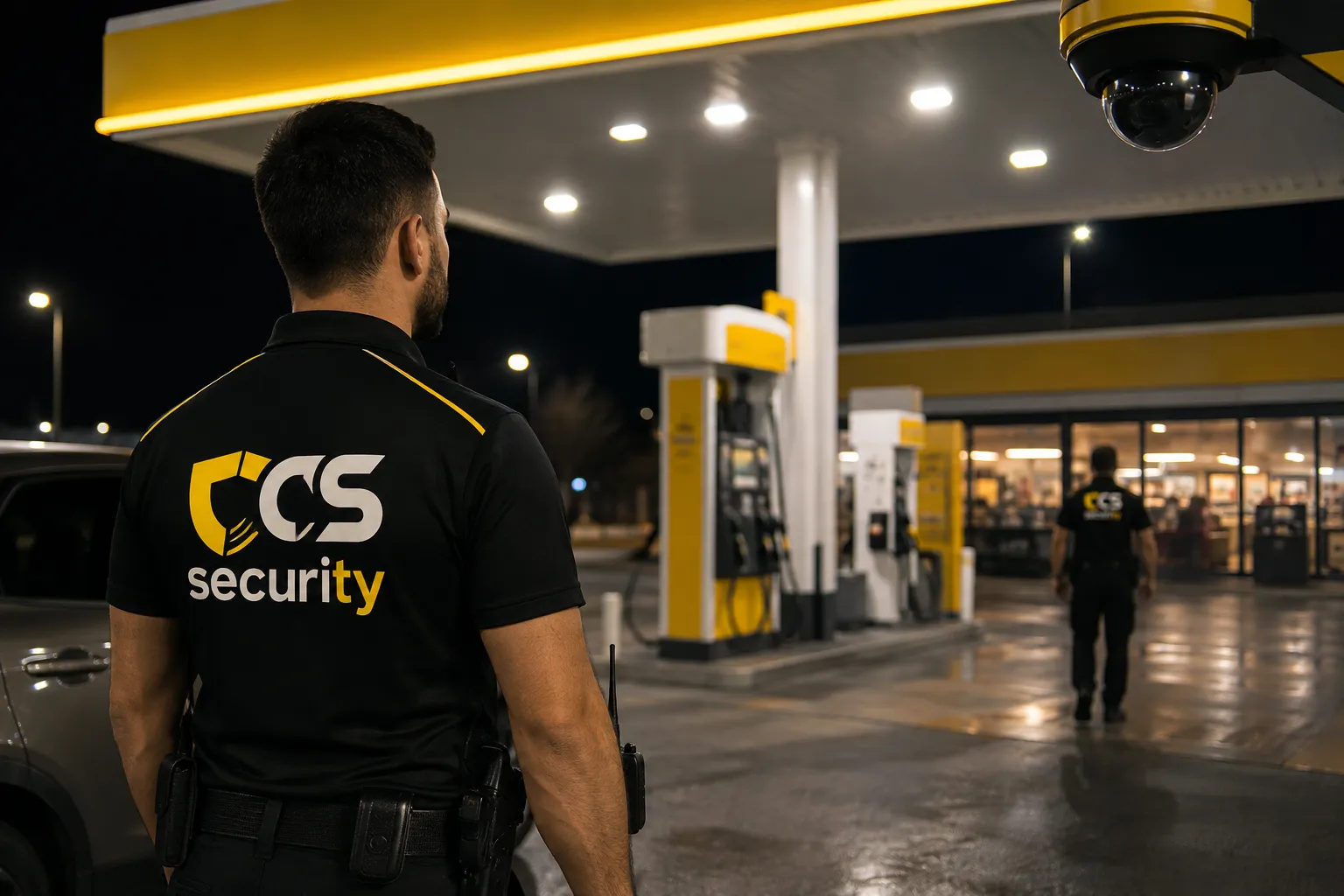
A convenience store owner near Whyte Avenue (T6E) watched a wave of late-night robberies hit stores just blocks away. Rather than wait for it to reach his own counter, he added mandatory fuel prepayment, upgraded his cameras, and brought in on-site guard coverage for the overnight shift. Eighteen months later, his store remains untouched while several nearby locations were hit more than once.
Gas stations and convenience stores carry a genuinely higher robbery risk than almost any other retail category, largely because of cash on hand, late-night solo staffing, and easy street access for a fast getaway. The good news is that the prevention steps that actually work are well documented and, in several important cases, already legally required in Alberta.
This guide covers exactly what Alberta law requires for gas station worker safety, which prevention steps genuinely reduce risk in practice, and what to do if a robbery happens despite every reasonable precaution taken.
|
FEATURED SNIPPET -- DIRECT ANSWER Gas station robbery prevention starts with mandatory fuel prepayment, visible cameras, clear signage, and good lighting, all required or recommended under Alberta's OHS Code. Workers alone overnight must wear a personal emergency transmitter by law. Adding scheduled patrol or on-site guard coverage during high-risk hours closes the gap that policy and cameras alone cannot close. |
Gas Stations and Convenience Stores Face a Higher Robbery Risk Than Most Retail
Gas stations and convenience stores share three specific risk factors that most other retail businesses do not combine together: cash transactions late at night, frequently a single staff member working alone on shift, and a location built around quick street access for a fast getaway.
Edmonton has seen this exact pattern play out directly. A string of violent convenience store robberies in west Edmonton neighbourhoods, including armed incidents at Circle K locations, prompted police appeals for public help identifying suspects and highlighted exactly how quickly these incidents can escalate into something serious.
The broader trend offers some encouragement. Alberta RCMP reported property crime hitting a 10-year low in 2025, down 13 percent from 2024 and 32 percent from 2016, crediting a Crime Reduction Strategy that targets the small number of repeat offenders responsible for a disproportionate share of harm.

That province-wide progress does not remove the risk at any individual location. The stores that stay safest are the ones that combine every available legal requirement with additional prevention measures, rather than relying on broader crime trends alone.
Locations in areas with higher foot traffic and easy highway access, including several sites near T6R, report a different risk pattern than quieter residential-area stations, which is exactly why a generic prevention plan applied to every location misses the specifics that actually matter.
What Alberta Law Requires for Gas Station Worker Safety
Under Part 27 of Alberta's Occupational Health and Safety Code, employers must ensure fuel sold at retail fuelling outlets is paid for before it is dispensed, a requirement specifically designed to remove drive-off theft and reduce cash-related confrontation. You can review the full Alberta OHS working alone and violence prevention guidance directly.
Under Part 28 (Working Alone), a worker at a gas station or convenience store working alone between 11 p.m. and 6 a.m. must wear a personal emergency transmitter monitored by the employer or their designate, a requirement strengthened by amendments effective March 2025 that changed the language from providing the device to actually wearing it.
Employers must also develop a written workplace violence prevention plan specific to retail fuel and convenience stores, covering cash-handling procedures, physical barriers or a second worker where genuinely appropriate, and staff training on how to respond safely during any incident.
|
AMBER -- LEGAL COMPLIANCE None of these requirements are optional upgrades. They are legal minimums, which means a store that has not implemented them is not just more vulnerable, it is out of compliance with Alberta's OHS Code. |
Owners sometimes assume these rules apply only to large chains, but Part 27 and Part 28 apply to any retail fuel or convenience store operation in Alberta regardless of size, ownership structure, or whether the business operates as an independent or a franchise location.
Robbery Prevention Steps That Actually Work
Beyond the legal minimums already covered, several additional measures consistently reduce robbery risk at gas stations and convenience stores, based on CPTED, Crime Prevention Through Environmental Design, principles applied specifically to retail fuel locations.
1. Keep cash on hand minimal with a time-delay or drop safe, and post visible signage stating that staff cannot access it.
2. Position cameras to capture clear facial images at the counter, entrance, and pump islands, not just wide overview shots.
3. Maintain strong exterior lighting across the entire lot, not just near the building entrance, to remove dark approach and escape routes.
4. Keep sightlines clear from the counter to the street, removing large window signage or displays that block outside visibility.
5. Train staff on de-escalation language and compliance-first response, rather than assuming instinct will guide the right reaction under stress.
6. Add scheduled patrol checks or on-site guard coverage during the highest-risk overnight hours identified in your own incident history.
Most of these measures cost relatively little compared to the loss, injury risk, and staff turnover that follow a violent robbery, which is why they are considered standard practice rather than optional extras across the industry.
A single overnight shift covered by a trained, licensed guard often costs less than the inventory loss from one robbery, before even accounting for the harder-to-measure costs of staff turnover, lost productivity, and reputational damage that follow a violent incident at a specific location.
|
GREEN -- KEY INSIGHT Prepayment alone removes an entire category of confrontation. A driver who has already paid before fuel dispenses has no reason to argue about payment at the counter, which eliminates one of the most common flashpoints for an incident to begin. |
Insurance providers increasingly ask about these specific measures when underwriting a retail fuel location. Documented compliance with the OHS Code requirements, combined with visible prevention measures, can meaningfully affect both premiums and claims outcomes.
None of these measures work well in isolation. A store with excellent cameras but poor lighting, or strict cash policy but no visible signage, still leaves an obvious gap that an experienced offender will notice and exploit.
Gas Station Security Coverage and Cost in Edmonton
Coverage cost depends on whether you need overnight on-site presence, scheduled patrol checks, or a combination matched to your specific risk hours. The table below reflects typical Edmonton figures.
None of these figures include the equipment costs of installing new cameras, upgrading a drop safe, or adding exterior lighting, which are typically quoted separately from ongoing guard or patrol service fees.
Gas Station Security: Coverage and Cost in Edmonton
|
Coverage Type |
Typical Use Case |
Typical Cost |
|
On-Site Guard (overnight) |
High-risk late-night shifts, single-staff locations |
$32-$48 per hour |
|
Scheduled Mobile Patrol |
Multiple checks per night, lower cash-risk hours |
$28-$45 per hour |
|
CCTV Monitoring (installed) |
24/7 recorded coverage, all locations |
Custom quote based on camera count |
Many Edmonton gas station owners combine mobile patrol for lower-risk hours with full on-site coverage only during the overnight window, which keeps costs proportionate to actual, measured risk rather than paying for maximum coverage around the clock every single day.
What to Do During an Actual Robbery
|
AMBER -- TRUST / SAFETY PRIORITY If a robbery happens despite every reasonable precaution, staff safety takes absolute priority over cash, merchandise, or property every single time. Comply with instructions calmly, avoid any sudden movements, and let the robber leave the scene without any pursuit whatsoever. |
Once the immediate danger has passed, call 911 and preserve the scene exactly as it is for Edmonton Police Service, including camera footage, cash drawer condition, and any note or item the robber may have left or dropped.
A licensed guard, if on site, can secure the location, support staff, and coordinate directly with responding police, but the guard's role during the robbery itself is the same as staff: personal safety and compliance first, confrontation never.
Debrief staff afterward, ideally with support resources available, not just a police statement. A robbery is traumatic even when no one is physically hurt, and treating it as purely an operational incident overlooks the people who lived through it.
Owners sometimes worry that offering time off or counseling support signals weakness in the business. The opposite is true: staff who feel genuinely supported after an incident are far more likely to stay, which matters enormously in an industry that already struggles with overnight staffing turnover.
Building Long-Term Security for Your Gas Station
Long-term security means treating prevention as an ongoing program, not simply a one-time purchase made after a scare. Review your workplace violence prevention plan annually, and again after any incident, whether it happened at your own store or a nearby one.
A free site assessment identifies exactly which combination of on-site guard hours, patrol frequency, and camera placement fits your specific location and risk pattern, rather than applying a generic template across every property.

Staying current on which Edmonton neighbourhoods are seeing active robbery patterns, including areas near T6R and West Edmonton with documented history, helps prioritize where additional coverage matters most right now.
Bring your security provider into the conversation whenever store hours, staffing levels, or the physical layout changes, rather than only reviewing coverage once a year on a fixed schedule. A new self-checkout counter or an extended overnight window both shift the actual risk profile the original plan was built around.
Conclusion
Gas station robbery risk is genuinely real, but it is also one of the most preventable retail risks when Alberta's legal requirements are properly paired with proven prevention measures and the right security coverage for your specific location.
Canadian Shield Security helps Edmonton gas stations and convenience stores build compliant, effective security coverage with a free consultation. Call 1 (800) 326-7879 to review your current protection.
|
Canadian Shield Security serves Edmonton 24/7. Free consultation -- no hidden fees. Call 1 (800) 326-7879. |
Frequently Asked Questions
Do gas station security guards need to be SSIA licensed?
Yes. Every guard Canadian Shield Security deploys to a gas station or convenience store holds a valid licence under the Security Services and Investigators Act (Alberta). Guards complete background checks and training in de-escalation, robbery response, and incident documentation before working any retail fuel location, day or night shift alike.
How much does gas station security cost in Edmonton?
Gas station security in Edmonton typically costs $32-$48 per hour for on-site guard coverage during high-risk overnight shifts, or $28-$45 per hour for scheduled mobile patrol checks. Canadian Shield Security offers a free site assessment to recommend the right coverage level for your specific location, with no hidden fees added later.
Does Canadian Shield Security cover gas stations near Whyte Avenue or T6R?
Yes. Canadian Shield Security protects gas stations and convenience stores across Edmonton, including locations near Whyte Avenue, T6R, and surrounding communities like Sherwood Park and St. Albert. Our GPS dispatch system routes the closest available SSIA-licensed officer, keeping response consistent regardless of your store's exact location.
Does Alberta law require a personal emergency transmitter for gas station workers?
Yes. Under Alberta's Occupational Health and Safety Code, a worker at a gas station or convenience store working alone between 11 p.m. and 6 a.m. must wear a personal emergency transmitter monitored by the employer or their designate. This is a legal requirement, not an optional safety upgrade, following amendments effective March 2025.
Does mandatory fuel prepayment actually reduce robbery risk?
Yes, significantly. Alberta's OHS Code requires mandatory prepayment for fuel at retail fuelling outlets before it is dispensed, which removes the drive-off theft risk entirely and reduces the cash-related confrontations that often escalate into robbery. Combined with visible cameras and clear signage, prepayment is one of the most effective deterrents available.
