
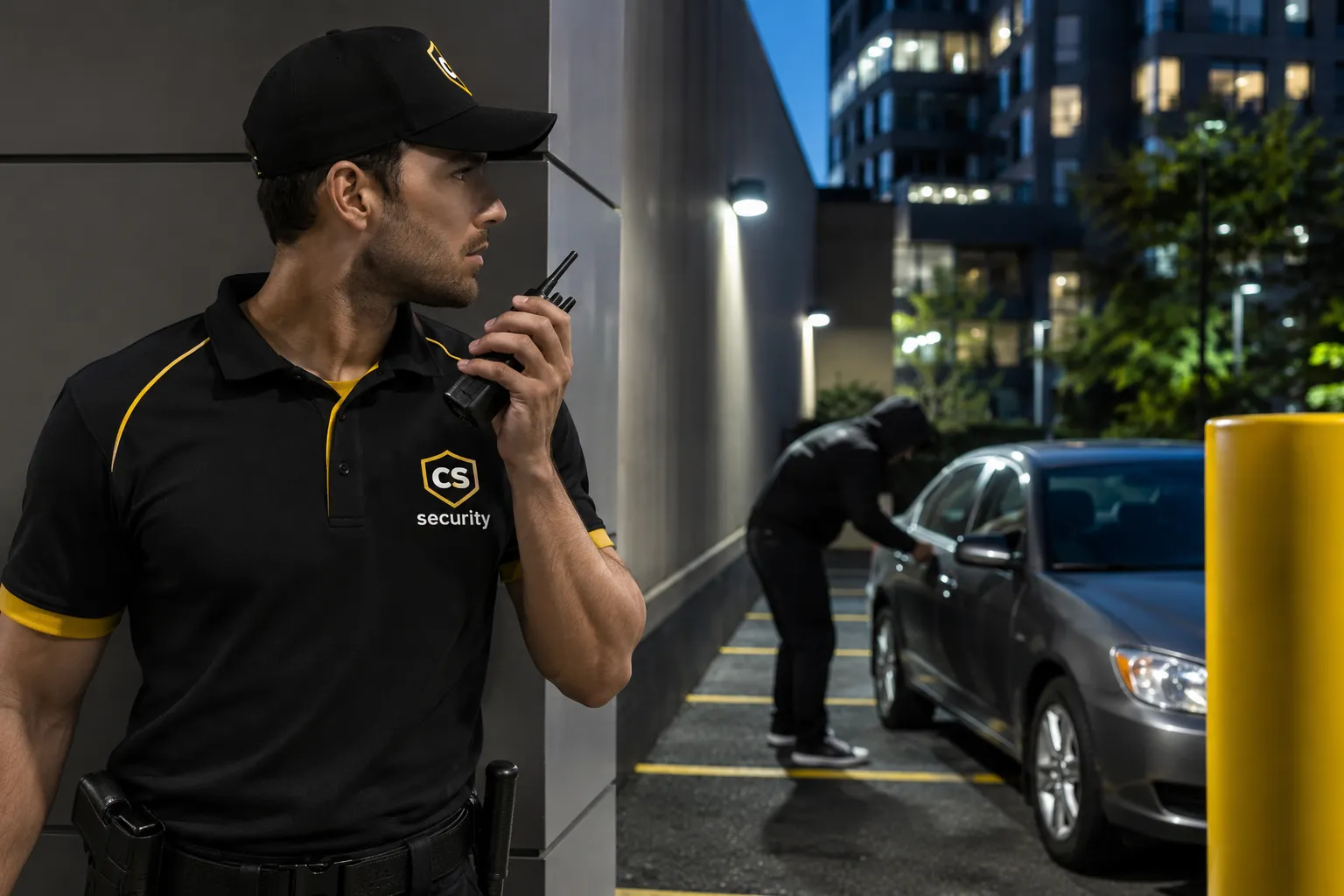
A property manager near Whyte Avenue (T6E) watched someone force open a neighbouring unit's back door late one night. Instead of confronting the intruder, she moved inside, locked the door behind her, and called Canadian Shield Security's on-site guard line, who dispatched an officer to secure the scene while she gave police a clear description from a safe distance.
That instinct, to observe rather than intervene, is exactly what Edmonton Police recommend, and it is also what keeps a witnessed crime from becoming a second victim rather than a single, contained incident. Knowing the right sequence in advance removes the guesswork in a moment when adrenaline makes clear thinking genuinely difficult for almost anyone.
This guide covers exactly what to do the moment you witness a crime at your Edmonton property, what you are and are not legally required to do afterward, and how a licensed guard actually supports the overall response.
|
FEATURED SNIPPET -- DIRECT ANSWER If you witness a crime at your Edmonton property, move to safety first, then observe from a distance rather than intervening. Note details like clothing, a vehicle description, and direction of travel. Call 911 if it is in progress, then let a licensed guard secure the scene and document what happened. |
Witnessing a Crime Means Observing, Not Intervening
Edmonton Police have been direct and consistent about this message: bystanders should not attempt to intervene in a crime in progress. Moving to safety comes first, before anything else, including any instinct to help the person being targeted.
|
AMBER -- REAL EDMONTON POLICE GUIDANCE A former Edmonton Police superintendent made this point publicly during a past Crime Prevention Week address, noting that attempting to stop an offender can turn a bystander into a second victim. In one Edmonton case, a man died after trying to stop a thief at a shopping centre, an outcome police specifically cite as a reason to observe rather than intervene. |
Observing safely still matters enormously in these situations. A clear description of clothing, a vehicle, or a direction of travel, gathered from a safe distance, is often more genuinely useful to police than anything a bystander could accomplish by physically intervening.
This applies whether the crime involves a stranger on your property or someone you recognize. The instinct to act personally is understandable, but the safest and most useful action is almost always to observe, move to safety, and report.
Downtown Edmonton (T5J) property managers dealing with foot traffic late at night, and South Edmonton (T6H) retail strips with parking lot incidents after closing, both report the same pattern: the incidents that end badly are usually the ones where someone tried to personally intervene rather than calling for help first.
Your Legal Position as a Witness in Alberta
In Canada, there is generally no legal duty to report a crime you witness, with narrow exceptions such as a child in need of protection. Choosing not to report a relatively minor incident is not itself an offence, though reporting is always encouraged to help police and to protect others in the community.
You also have a constitutionally protected right to remain silent and are generally not required to cooperate with a police investigation beyond providing basic identification if lawfully requested. That said, obstructing a peace officer acting in the execution of their duty is a separate criminal offence, so declining to speak is different from actively interfering.
If you are later called as a witness, the law takes your safety seriously. Harassing or attempting to influence a witness is a criminal offence in Canada that can carry a penalty of up to 10 years in prison, which reflects how seriously the justice system treats witness intimidation.

This protection exists precisely so that witnesses feel safe coming forward in the first place. Knowing that intimidation carries real legal consequences is often what reassures a hesitant property manager or tenant that reporting will not put them at further risk.
For a suspicious property rather than an active crime, Edmonton residents can report through the SCAN (Safer Communities and Neighbourhoods) line or through 311 for non-emergency government services, reserving 911 specifically for active emergencies.
Knowing this distinction in advance removes a surprising amount of hesitation in the moment. Property managers who already know which number to call for which situation report acting faster and more calmly than those working it out for the first time during an actual incident.
What to Do the Moment You Witness a Crime
The sequence below reflects both Edmonton Police public safety guidance and standard security guard protocol, and it applies whether the incident is still unfolding or has already ended by the time you notice it.
1. Move to safety immediately; do not approach, confront, or attempt to detain anyone involved.
2. Once safe, observe from a distance if you can do so without risk, noting clothing, vehicle description, and direction of travel.
3. Call 911 if the crime is in progress or anyone is in danger; use the non-emergency line if it has already ended and there is no immediate risk.
4. Avoid touching anything at the scene, including damaged property, to preserve evidence for police.
5. Call a licensed security company if your property has ongoing coverage, so a guard can secure the scene and support the police response.
6. Write down what you observed as soon as possible afterward, while details are still fresh, for your own records and any police follow-up.
None of these steps require any form of confrontation at all. The entire sequence is built around observing safely and letting trained responders, whether police or a licensed guard, handle what happens next from that point forward.
|
GREEN -- KEY INSIGHT If you are shaken after witnessing something serious, that reaction is normal. Victim services and community support resources exist specifically for witnesses, not just victims, and using them is not an overreaction. |
Property managers responsible for tenants or staff should also have a simple written version of this sequence posted somewhere accessible, since a laminated card by the front desk removes any need to recall the steps correctly under stress.
Who to Call: 911, 311, or a Security Guard
Choosing the right contact depends heavily on urgency and whether the situation is still actively unfolding at the time you notice it. The table below reflects when each specific option applies in practice.
Who to Call After Witnessing a Crime in Edmonton
|
Situation |
Who to Call |
|
Crime in progress or anyone in danger |
911 immediately |
|
Crime has ended, no immediate danger |
Edmonton Police non-emergency line |
|
Suspicious property, no active crime |
SCAN line or 311 |
|
Property has security coverage |
Your security provider, alongside police |
Properties with alarm response or patrol coverage already in place have a faster path to an on-scene presence than starting from a cold call, which is exactly why many Edmonton property managers keep a security provider on file before they ever need one.
Saving your security provider's number alongside 911 and the police non-emergency line, rather than searching for it after something has already happened, is a small step that meaningfully shortens the time between witnessing an incident and getting a guard on scene.
What a Security Guard Does When You Report a Witnessed Crime
A licensed guard responding to a witnessed crime report will secure the immediate area, keep people away from the scene, and carefully document conditions for both the eventual police report and your own internal property records.
Every Canadian Shield Security officer is trained in de-escalation, the same skill set required under SSIA licensing, which means their default approach is to calm and control a situation rather than confront it head-on.
|
AMBER -- TRUST / LIMITATION A guard cannot make an arrest the way a police officer can, and will not pursue a suspect who has already left the scene. Their role is to protect people, preserve evidence, and support the police response, not to conduct an investigation themselves. |
This boundary is deliberate, not a shortfall in training. A guard who tried to act as an investigator on top of a security officer would risk contaminating evidence or creating a second confrontation, exactly the outcomes the de-escalation approach is designed to prevent.
A free site assessment can confirm whether your current coverage includes this kind of response, or whether it needs to be added to your existing plan.
Reducing the Chance of Witnessing Repeat Crime at Your Property
Properties that experience a witnessed crime once are statistically more likely to see something similar again, particularly if the conditions that allowed it, poor lighting, blind spots, low visibility, remain unchanged.
This is not unique to any one type of property. Retail strips, office buildings, and residential complexes all show the same pattern once the specific conditions that enabled an incident are identified and left in place rather than corrected.
Pairing scheduled mobile patrol with CCTV monitoring gives a property both visible deterrence and a recorded record, which reduces the odds that you or a tenant will be the one who has to witness the next incident firsthand.

Property managers in South Edmonton (T6H) and Downtown Edmonton (T5J) commercial buildings increasingly treat a single witnessed incident as the trigger to review coverage, rather than waiting for a second one to justify the cost.
A free consultation after any witnessed incident is a reasonable step even if you are not sure coverage needs to change. Reviewing what happened with a licensed provider often reveals a specific, fixable gap, whether that is a blind corner, a burnt-out light, or a patrol route that simply was not covering that section of the property closely enough.
Conclusion
Witnessing a crime at your property is unsettling, but the response is genuinely clear: move to safety first, observe rather than intervene, and let police and a licensed guard handle everything that comes after that initial moment.
Canadian Shield Security supports Edmonton property owners and managers with a free consultation to review your response plan. Call 1 (800) 326-7879 before the next incident, or right after one.
|
Canadian Shield Security serves Edmonton 24/7. Free consultation -- no hidden fees. Call 1 (800) 326-7879. |
Frequently Asked Questions
Can a security guard get involved if I witness a crime on my property?
Yes. If you witness a crime on your property, an SSIA-licensed guard can respond to secure the scene, observe from a safe distance, and document what happened for police. Guards are trained in de-escalation and will not confront a suspect directly, since their role is to protect people and preserve evidence, not make an arrest.
Does it cost extra to have a guard respond after I witness a crime?
No. Guard response after a witnessed crime is included in standard mobile patrol or on-site guard coverage rather than billed as a separate service. Canadian Shield Security offers a free site assessment to review your current coverage, typically $28-$48 per hour depending on service type, with no hidden fees added later.
Does Canadian Shield Security respond to witnessed crimes in St. Albert or Sherwood Park?
Yes. Canadian Shield Security responds to witnessed crime calls across Edmonton and surrounding communities, including St. Albert, Sherwood Park, Leduc, and Nisku. Our GPS dispatch system routes the closest available SSIA-licensed officer, so response stays consistent whether your property sits downtown or in a neighbouring suburb.
Am I legally required to report a crime I witness in Canada?
Generally, no. In Canada, there is no general legal duty to report a crime you witness, except in specific cases involving a child in need of protection. You are also not required to cooperate with a police investigation beyond providing basic identification if lawfully asked, though reporting is always encouraged to support the investigation.
Should I intervene if I see a crime happening on my property?
No. Edmonton Police have specifically advised against intervening in a crime in progress, since attempting to stop an offender can be dangerous for everyone involved. Move to safety, observe from a distance if it is safe to do so, note details like clothing or a vehicle description, and call 911 once you are secure.
