
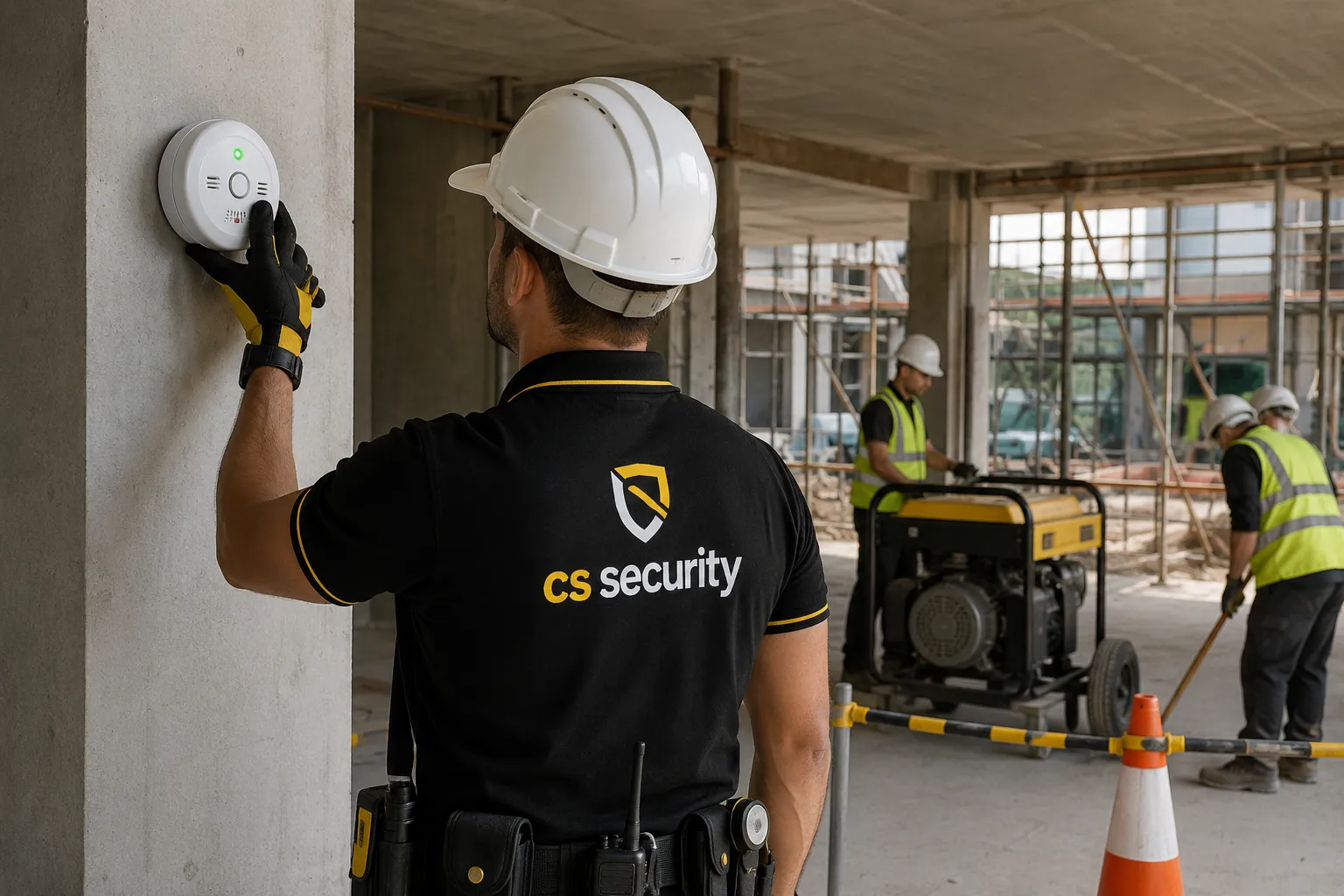
A guard patrolling a construction site security route near Leduc heard a CO alarm sounding from a parkade area where a generator had been running to power space heaters overnight. He evacuated the enclosed level immediately, called 911 from outside, and kept the crew out until fire crews confirmed the air was safe.
Carbon monoxide is invisible and completely odorless, which is exactly why a guard's response has to follow a fixed protocol rather than judgment calls made in the moment under pressure. Getting this wrong, even by a few minutes, is the difference between a close call and a genuine medical emergency.
This guide covers what actually causes carbon monoxide buildup on a construction site, the exact protocol a licensed guard follows the moment an alarm triggers, and what falls outside a guard's authority during the emergency itself.
|
FEATURED SNIPPET -- DIRECT ANSWER If a carbon monoxide alarm triggers at a construction site, evacuate the affected area immediately, move everyone to fresh air, and call 911. Do not re-enter to investigate the source yourself. Once the area is confirmed safe by fire crews, a licensed guard secures the site until work resumes safely. |
A Carbon Monoxide Alarm Means an Invisible, Odorless Gas Is Building Up
Carbon monoxide is a colorless, odorless gas produced whenever fuel burns incompletely, which makes a construction site, full of engines, generators, and heaters, one of the more common places for it to accumulate to dangerous levels.
Unlike smoke or an obvious gas leak, there is no smell, no visible sign, and no warning beyond the alarm itself. Workers can be affected well before anyone notices symptoms, which is why the alarm has to trigger an immediate, non-negotiable response rather than a wait-and-see approach.
|
AMBER -- REAL INCIDENT A 2018 carbon monoxide leak at a Calgary construction site, traced to a heater inside a temporary structure in the parkade, sent five people to hospital and required evacuating dozens of workers after readings hit 400 parts per million, a level considered a significant, dangerous exposure. |
That is exactly the scenario a guard protocol exists to prevent from becoming worse. The alarm gives you the only warning you are going to get, and how the next few minutes are handled determines the outcome.
Industrial sites near Nisku and Acheson, where diesel equipment and enclosed fabrication spaces are common, see this risk more consistently than a typical downtown Edmonton renovation project, simply because more fuel-burning equipment runs closer to enclosed work areas.
This is also why a CO alarm should never be dismissed as a false alarm without confirmation. Unlike a motion sensor picking up a stray animal, a carbon monoxide detector triggering has a physical cause behind it every time, even if that cause turns out to be minor.
What Causes Carbon Monoxide Buildup on a Construction Site
The most common sources are idling vehicles or equipment running in an enclosed or partially enclosed space, temporary propane or diesel heaters used during Edmonton's cold months, generators positioned too close to occupied areas, and gas-powered tools used without adequate ventilation.
Under Alberta's Occupational Health and Safety Code, the 8-hour occupational exposure limit (OEL) for carbon monoxide is 25 ppm. Exposure at that level typically produces a carboxyhemoglobin (COHb) blood level of 3-4 percent, while levels above 25 percent COHb are considered dangerous for healthy workers, and far lower for workers with existing heart conditions, according to Alberta's official carbon monoxide guidance.
Carbon monoxide is also a WHMIS-controlled hazard, which means every worker on site is entitled to training on its risks and safe-work procedures, and every employer is required to assess ventilation needs and provide respirators where levels cannot otherwise be controlled.

Parkades, excavations, and partially enclosed lower levels are the highest-risk locations on most sites, since exhaust has nowhere to disperse the way it would in open air. Winter construction adds another layer, since enclosed heated work areas are exactly where portable heaters and idling equipment both concentrate.
None of these sources are unusual or negligent on their own. Heaters and idling equipment are standard on almost every active winter build; the risk comes specifically from running them in a space without a documented ventilation plan behind the decision.
Site managers who walk through this reasoning with their crew tend to see fewer alarms overall, not because the equipment changes, but because placement and ventilation decisions get made more deliberately once the actual risk is understood rather than assumed away.
The Guard Protocol When a CO Alarm Triggers
The sequence below is the same regardless of which piece of equipment or which area triggered the alarm.
1. Evacuate the affected area immediately, moving everyone to fresh air outside the building or enclosed structure.
2. Call 911 as soon as the area is clear; carbon monoxide response is a fire and emergency medical matter, not something to assess alone.
3. Do not re-enter the area to investigate, ventilate, or shut off equipment, even briefly, until emergency responders confirm it is safe.
4. Account for everyone who was in or near the affected area, and report anyone experiencing symptoms like headache, dizziness, or nausea to responders immediately.
5. Secure the perimeter of the affected area once evacuated, so no one re-enters before responders arrive and clear it.
6. Document the incident, including the time the alarm triggered, the reading if visible on the panel, and every action taken, for the site's safety record.
None of these steps require diagnosing the source. That is intentional; a guard's job during a CO alarm is evacuation and notification, not troubleshooting equipment inside a space that may still be dangerous.
|
GREEN -- KEY INSIGHT Guards on Canadian Shield Security's construction site rotations are briefed on each site's specific hazard communication plan before their first shift, so the response above is never improvised in the moment. |
A documented, time-stamped response also matters for the site's OHS record afterward. Regulators and insurers reviewing an incident want to see that the protocol was followed correctly, not just that the outcome was fine.
Crews sometimes worry that evacuating for what turns out to be a minor issue looks like an overreaction. It is the opposite. A guard who evacuates every time, without exception, is the reason a genuine emergency never gets treated as routine.
Carbon Monoxide Levels and What They Mean
Understanding what a reading actually means helps put the urgency of any alarm into context. The table below reflects commonly referenced carbon monoxide exposure levels.
Carbon Monoxide Levels and General Health Effects
|
CO Level |
General Significance |
|
25 ppm |
Alberta's 8-hour occupational exposure limit (OEL) |
|
50-100 ppm |
Headache and reduced alertness possible with prolonged exposure |
|
200-400 ppm |
Considered a significant, dangerous leak requiring evacuation (as seen in past Alberta incidents) |
|
Above 400 ppm |
Life-threatening; immediate evacuation and emergency response required |
These figures are for general awareness only, not diagnosis. Any triggered alarm should be treated as an emergency regardless of the displayed number, since panel readings can lag behind actual conditions in the affected space. A free site assessment can confirm whether your site's current hazard plan and guard briefing reflect this properly.
What Security Guards Can and Cannot Do During a CO Emergency
A security guard can evacuate an area, call 911, account for personnel, secure the perimeter, and document the incident. These are the same core skills used across every emergency response scenario a guard is trained for.
|
AMBER -- TRUST / LIMITATION A security guard cannot test air quality, diagnose the source, repair or shut down equipment inside a potentially hazardous space, or provide medical treatment beyond basic first aid. That work belongs to fire crews, gas technicians, and paramedics. |
Canadian Shield Security's SSIA-licensed guards are trained to recognize and respond to a hazard alarm, not to resolve the hazard itself. Pairing construction site guard coverage with fire watch security makes sense for sites already managing multiple overlapping hazard risks.
This division of responsibility is not a limitation to work around; it is exactly why the protocol actually works. A guard who tries to be a gas technician on top of a security officer introduces more risk rather than removing it.
Preventing CO Buildup on Edmonton Construction Sites
Prevention starts with equipment placement. Generators and idling vehicles should run in open air whenever possible, and any enclosed or partially enclosed space with fuel-burning equipment needs a documented ventilation plan, not an assumption that it will be fine.
Regular CO detector testing matters as much as the equipment itself. A detector with a dead battery or an expired sensor provides no protection at all, which is why mobile patrol checks on unoccupied sites often include a basic detector status check as part of the routine walkthrough.

Edmonton winters make this a recurring risk rather than a one-time concern. Every cold snap brings more heaters, more idling equipment, and more enclosed, heated work areas, which is exactly why sites in the Leduc and Acheson industrial corridor often increase patrol frequency through the coldest months.
Training matters just as much as equipment does. A crew that genuinely understands why a heater cannot run unattended in a closed trailer overnight is a crew far less likely to trigger the alarm in the first place, which is the outcome every prevention measure is actually working toward achieving.
Conclusion
A carbon monoxide alarm at a construction site is never a judgment call left up to whoever happens to be nearby. The protocol is simple and non-negotiable: evacuate immediately, call 911, do not re-enter, and let trained responders confirm the space is genuinely safe.
Canadian Shield Security briefs every construction site guard on the site's specific hazard plan before their first shift. Call 1 (800) 326-7879 to review your site's protocol or add guard coverage before the next shift starts.
|
Canadian Shield Security serves Edmonton 24/7. Free consultation -- no hidden fees. Call 1 (800) 326-7879. |
Frequently Asked Questions
Are construction site guards trained to respond to a carbon monoxide alarm?
Yes. Canadian Shield Security guards assigned to construction sites are briefed on the site's hazard communication plan, including carbon monoxide sources, and trained to evacuate the area, ventilate if safe to do so, and call 911 immediately rather than attempting to diagnose or fix the source themselves.
Does construction site security cost more with CO alarm protocols included?
Construction site security with CO alarm awareness is included in standard site coverage rather than priced as a separate add-on. Canadian Shield Security offers a free site assessment to review your specific hazard plan and confirm pricing, typically $32-$48 per hour for on-site guard coverage, with no hidden fees.
Does Canadian Shield Security cover construction sites near Leduc?
Yes. Canadian Shield Security covers construction sites across the Edmonton area, including Leduc, Nisku, and Acheson. Our SSIA-licensed guards follow the same evacuation and 911 protocol at every site, and our GPS dispatch system keeps response consistent whether your project sits downtown or near an industrial corridor.
What is a dangerous carbon monoxide level on a construction site?
Alberta's Occupational Health and Safety Code sets an 8-hour occupational exposure limit of 25 ppm for carbon monoxide. Levels above that require ventilation, respirators, or evacuation depending on severity, and readings in the hundreds of ppm, as seen in past Alberta construction incidents, are considered a serious emergency.
What causes carbon monoxide buildup on a construction site?
Carbon monoxide on a construction site typically comes from idling vehicles or equipment in enclosed or partially enclosed areas, temporary heaters used in cold weather, generators running near occupied spaces, and gas-powered tools operated without adequate ventilation, especially inside parkades or excavations.
