
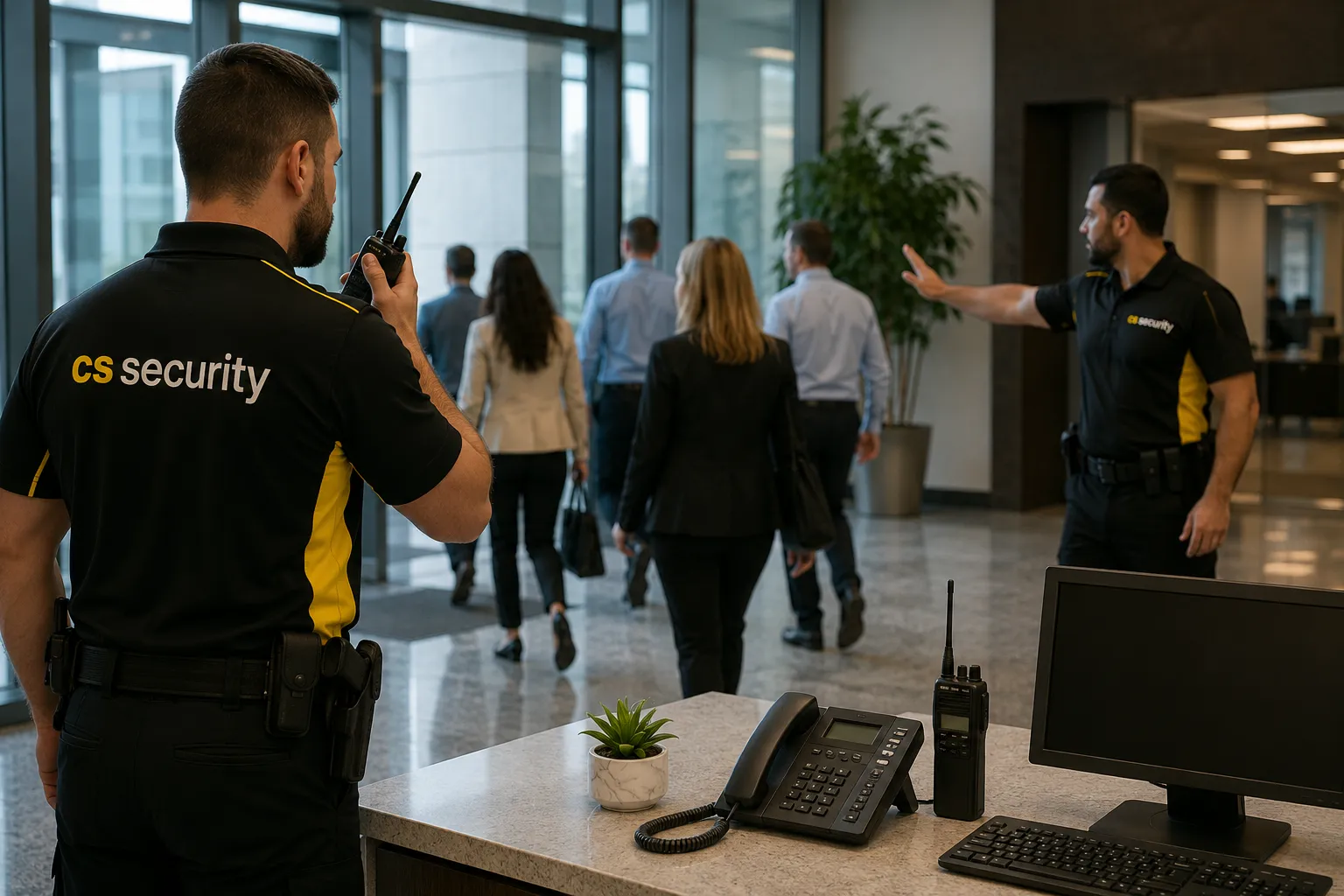
A security manager at a Downtown Edmonton (T5J) office tower once received a threat call during a normal Tuesday shift. Because the building had a written protocol and trained on-site guard coverage, the receptionist kept the caller talking, signalled a colleague to call police, and the guard team began quietly preparing evacuation routes, all before the call even ended.
That calm, practiced response is only possible with a protocol built in advance, not one improvised in the moment under real pressure. A bomb threat is genuinely rare, but the businesses that handle one well are always the ones that already knew exactly what to do before the phone ever rang.
This guide covers exactly what to do the moment a bomb threat is received, who is genuinely responsible for each step, and how a licensed guard supports the overall response without ever stepping outside their defined role.
|
FEATURED SNIPPET -- DIRECT ANSWER If your Edmonton business receives a bomb threat, stay calm, keep the caller on the line, and note as much detail as possible without ever hanging up. Signal a colleague to call 911. Do not touch or move any suspicious item you find. Evacuation decisions should follow police guidance, not immediate assumption. |
A Bomb Threat Can Arrive by Phone, Email, Note, or Social Media
Most bomb threats still arrive by phone, but written notes, emails, and social media messages are all increasingly common today. The response principle stays the same regardless of the exact format the threat happens to arrive in.
A threat should always be taken seriously and reported to police right away, whether or not it seems credible at first. Determining credibility is a police and, where relevant, RCMP responsibility, not a judgment call for front-line staff to make on their own in the moment.
|
AMBER -- REAL INCIDENT CONTEXT In December 2018, businesses across Canada, including Winnipeg, received a wave of extortion-linked bomb threats sent by email demanding payment. Similar coordinated threat campaigns have targeted Canadian businesses since, which is exactly why every business, regardless of size, benefits from having a protocol ready rather than improvising one during an actual incident. |
Whatever form a threat takes, the goal in the first few minutes is the same: stay calm, gather as much information as possible without escalating the situation, and get that information to police quickly.
South Edmonton (T6H) retail and office properties, along with businesses closer to Downtown Edmonton (T5J), both fall under the same general protocol regardless of location, since a threat call does not distinguish between property type or neighbourhood.
Why Every Business Needs a Written Protocol Before One Happens
The Canadian Centre for Occupational Health and Safety (CCOHS) advises that employers develop a complete emergency response procedure for bomb threats in consultation with local police authorities, communicate it to all employees, and run periodic drills, consistent with the general duty under Alberta's OHS Act to plan for foreseeable workplace emergencies. You can review CCOHS's official bomb threat guidance directly.
A protocol built during an actual crisis is rarely a good one. Decisions about who calls police, who holds evacuation authority, and how staff communicate without alerting a potential threat need to be settled calmly and clearly in advance, not improvised while someone is still on the phone with a threat caller.
Documented drills matter too. Staff who have practiced the sequence, even briefly, respond with noticeably less panic than staff encountering the protocol for the first time during a real threat.

This is also where a licensed security provider adds real value beyond day-to-day patrol or guard coverage: helping a business actually build and rehearse this protocol before it is ever needed.
None of this requires a large security budget to get right. A small business with a handful of staff benefits from the same basic planning as a large office tower, since the core sequence, keep calm, gather information, notify police, does not scale with company size.
Larger organizations with multiple departments benefit from designating a backup coordinator as well, since the primary decision-maker may not always be reachable the moment a threat comes in during business hours.
What to Do the Moment a Bomb Threat Is Received
The sequence below reflects the structure used in the RCMP's own bomb threat telephone procedure checklist, adapted for a general business setting.
1. Stay calm and remain courteous with the caller; do not interrupt, argue, or hang up, since every extra second on the line is useful information.
2. Signal a colleague, without alerting the caller, to call 911 and notify police while you keep the caller talking.
3. Listen for background noise, accents, or anything distinctive about the caller's voice, and note the exact time the call started and ended.
4. Ask calm, direct questions such as when and where, without demanding details in a way that could escalate the caller.
5. Do not use radios or cell phones near any suspicious item once you become aware of one, since certain signals have been linked to triggering devices in rare cases.
6. Report everything to police immediately once the call ends, and preserve any caller ID information or written threat exactly as received.
None of these steps require personally assessing whether the threat is real or credible. That determination belongs entirely to police and, where relevant, RCMP, not to the individual staff member who happened to answer the phone that day.
|
GREEN -- KEY INSIGHT If the threat arrives in writing or by email, do not forward, delete, or alter the message. Preserve it exactly as received and hand it directly to police, since the original format can carry information investigators need. |
A written incident log, even a brief one, showing exactly when the threat was received and what steps were taken supports both the police investigation and your business's own emergency management record afterward.
Staff should also know in advance that reporting a threat, even one that turns out to be a hoax, is never an overreaction. The cost of taking a false alarm seriously is minutes of disruption; the cost of dismissing a real one is immeasurably higher.
Bomb Threat Response Roles: Who Does What
Clear roles prevent confusion in the moment something actually happens. The table below reflects a typical division of responsibility for an Edmonton business with security coverage already in place.
Bomb Threat Response: Roles and Responsibilities
|
Role |
Responsibility |
|
Employee who receives the threat |
Keep caller talking, note details, signal a colleague to call police |
|
Designated emergency coordinator |
Decide on evacuation timing in consultation with police once notified |
|
On-site security guard |
Assist evacuation, secure routes, coordinate directly with responding police |
|
Police / RCMP |
Assess credibility, search coordination, any item handling or disposal |
A consultation planning session with a licensed security provider is the most effective way to assign these roles clearly before an actual threat forces the question.
Confusion about roles during an actual threat almost always traces back to a plan that was never written down clearly, or was written once and never reviewed again as staff changed over time.
What Security Guards Can and Cannot Do During a Bomb Threat
A security guard can assist with evacuation, keep routes clear, help account for all staff and visitors, and coordinate directly with responding police as their designated point of contact on site throughout the incident.
|
AMBER -- TRUST / LIMITATION A security guard cannot, and should never attempt to, search for, identify, touch, or move any suspicious item at all. That responsibility belongs exclusively to police and specialized explosive disposal units, never to security staff, no matter how experienced they may be. |
Canadian Shield Security's SSIA-licensed guards are trained in evacuation coordination and calm crowd management, the same skills used across other emergency scenarios, paired with mobile patrol support for properties that need a wider security presence during an active threat.
This boundary exists to keep everyone safer, including the guard. A security officer's value during a bomb threat is calm coordination, not technical assessment they are neither trained nor equipped to perform.
This is the same principle that governs every other emergency scenario a guard responds to, from a carbon monoxide alarm to a medical emergency: recognize, secure, notify, and support trained specialists, rather than attempting to perform their job in addition to your own.
Building Your Business's Bomb Threat Protocol in Advance
Start with a written document, not a verbal understanding. Every staff member who might answer a phone or open mail should know the basic sequence, even if they never expect to use it.
Post the key steps somewhere accessible near every phone that might reasonably receive an outside call, rather than filing the full protocol away in a folder no one remembers exists until the moment it is actually needed.
A free consultation with Canadian Shield Security can help build this protocol specifically for your building layout, staff structure, and existing security coverage, rather than relying on a generic template that does not reflect your actual property.

Review the protocol annually, and after any staff turnover in key roles like the emergency coordinator position. A plan that lists someone who left the company two years ago is not a plan anyone can actually follow under pressure.
Consider a brief tabletop exercise once a year, walking through the protocol verbally with key staff rather than a full physical drill every time. Even this lighter version keeps the sequence fresh enough that it does not have to be relearned from scratch during an actual threat.
Conclusion
A bomb threat is genuinely rare, but the businesses that handle one well are always, without exception, the ones that built a calm, clear, written protocol long before they ever actually needed it in practice.
Canadian Shield Security helps Edmonton businesses build and rehearse a bomb threat protocol as part of a broader emergency plan. Call 1 (800) 326-7879 for a free consultation before you need one.
|
Canadian Shield Security serves Edmonton 24/7. Free consultation -- no hidden fees. Call 1 (800) 326-7879. |
Frequently Asked Questions
Are Canadian Shield Security guards trained to handle a bomb threat?
Yes. Canadian Shield Security guards are SSIA licensed and trained to support a bomb threat response, including securing evacuation routes, assisting with crowd control, and coordinating with RCMP or Edmonton Police on arrival. Guards do not search for or handle any suspicious item themselves; that responsibility belongs entirely to police and trained explosive disposal specialists.
Does bomb threat response cost extra with our security contract?
Bomb threat response support is included in standard on-site guard and consultation planning services rather than billed as a separate emergency fee. Canadian Shield Security offers a free consultation to build a written bomb threat protocol for your business, typically starting around $32-$48 per hour for on-site guard coverage during an actual incident.
Does Canadian Shield Security support bomb threat response outside Edmonton?
Yes. Canadian Shield Security supports bomb threat response protocols for businesses across Edmonton and surrounding communities, including Sherwood Park, St. Albert, Leduc, and Nisku. Our consultation planning service helps any business in the region build a written protocol in advance, regardless of how far the property sits from downtown Edmonton.
Should employees search for a suspicious device themselves?
No. Employees who are not trained explosive disposal technicians should never search for, touch, or move a suspicious item. Individual employees may check their own immediate work area for anything unfamiliar, but a full building search and any item assessment belongs to police and specialized bomb disposal units, never staff or security guards.
Who decides whether to evacuate during a bomb threat?
The decision to evacuate is typically made by senior management or the designated emergency coordinator, in consultation with police once they are notified. Waiting for police guidance, rather than evacuating immediately in every case, is standard practice, since a poorly timed evacuation can sometimes move people toward rather than away from risk.
