
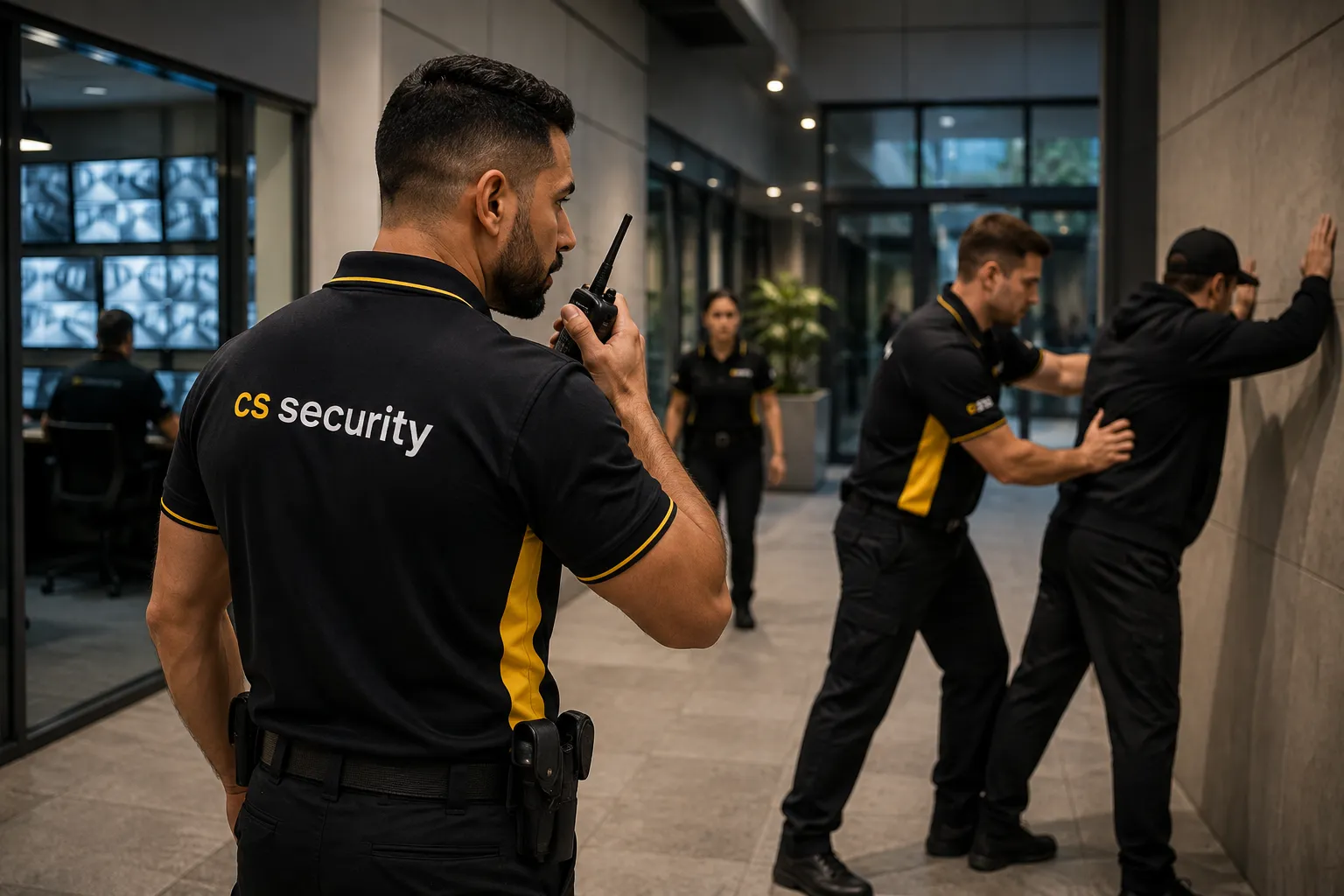
A property manager overseeing a downtown Edmonton office tower near Jasper Avenue once faced a frantic call about a man threatening staff in the lobby. Within ninety seconds, the on-site guard locked down the entrance and had Edmonton Police Service on the line. No one was hurt, and the tenant renewed its lease the following year.
That outcome was training, not luck. Every guard Canadian Shield Security assigns to an Edmonton property completes active threat response training covering detection, alert protocols, and lockdown procedures, on top of the licence required under the Security Services and Investigators Act (Alberta). See our on-site guard services for full details.
This guide breaks down what security guards are trained to do during an active threat, what they are legally allowed to do under Alberta law, and where the line sits between a guard's role and a police officer's role. Edmonton business owners need this clarity before an incident, not during one.
|
FEATURED SNIPPET Security guards trained in active threat response follow four core steps: detect the threat early, alert occupants and call police immediately, guide people into lockdown or evacuation, and maintain a safe perimeter until Edmonton Police Service or RCMP arrive. SSIA-licensed guards use only reasonable, defensive force and never attempt to engage an armed individual directly. |
What Is an Active Threat and Why Does It Matter for Edmonton Businesses
An active threat is any situation where a person is actively causing or credibly threatening serious harm to people on a property. This includes armed intruders, violent workplace disputes, and attacks in progress. Edmonton businesses face this risk in office towers, retail centres, healthcare facilities, and event venues alike.
Unlike routine trespassing or theft, an active threat demands an immediate shift in guard behaviour. Post orders for a typical shift focus on access control and patrol. Active threat protocols override those orders the moment a credible threat is identified, prioritizing life safety above property protection.
Canadian Shield Security builds active threat response into every SSIA-licensed guard's training, regardless of site type, because the first ninety seconds of an incident often determine the outcome.

Property managers in Downtown Edmonton (T5J) and South Edmonton (T6H) commercial corridors face particular exposure, since high foot traffic and shared lobbies make early detection harder. A guard who already knows a building's layout responds faster than one seeing the floor plan for the first time during an incident.
Event venues carry a different version of this risk. A venue the size of Rogers Place, with a capacity of 18,000, requires a security plan that accounts for crowd density, limited exit points, and coordination between guard teams and Edmonton Police Service well before doors open.
What Training Do Security Guards Receive for Active Threats in Alberta
Guards licensed under the Security Services and Investigators Act (Alberta) complete mandatory basic training approved by Alberta Justice and Solicitor General, which includes emergency response fundamentals. Canadian Shield Security adds site-specific active threat drills on top of that baseline.
Training covers threat recognition, communication protocols, lockdown execution, evacuation routing, and Use of Force (UoF) limits. Guards also train on first aid and CPR, since medical response often follows an active threat incident once the scene is secured.
Table 1 below summarizes the training layers every Canadian Shield Security guard completes before working an Edmonton active threat post.
Refresher training happens on a recurring schedule, not just at hiring. Alberta's licensing framework requires renewal, and Canadian Shield Security layers additional site-specific drills on top of that renewal cycle so guards stay current on the exact building or campus they are assigned to protect.
Employers also carry obligations here. Under Alberta's Occupational Health and Safety Act, workplaces must assess violence risks and prepare a response plan, which is why many Edmonton businesses pair Canadian Shield Security's guard training with their own internal OHS documentation.
|
Training Layer |
What It Covers |
Who Requires It |
|
SSIA Basic Training |
Licensing, code of conduct, legal authority |
All licensed guards |
|
Use of Force (UoF) |
Defensive-only force limits under Alberta law |
All licensed guards |
|
Active Threat Drills |
Detection, alert, lockdown, evacuation |
Commercial and event sites |
|
First Aid / CPR |
Medical response after scene is secured |
All deployed guards |
|
Police Liaison Protocol |
Radio and phone coordination with EPS/RCMP |
Site supervisors |
How Guards Detect and Alert During an Active Threat
Detection starts with situational awareness built into every patrol and post order, not just a formal alarm. Guards are trained to notice behavioural red flags, unusual access attempts, and reports from staff or the public before an incident escalates.
Once a threat is identified, the guard's first action is alert, not confrontation. That means triggering the site's mass notification system, calling 911, and communicating directly with property management and Canadian Shield Security's dispatch. GPS-connected mobile patrol units can also be redirected instantly to support an affected site.
Edmonton winters add a layer to this: guards working outdoor posts or parking structures during -40C conditions still maintain radio contact and mobility, since cold weather cannot be allowed to delay an alert.
Every alert follows a fixed chain: guard to dispatch, dispatch to 911, dispatch to property management, and guard to any nearby mobile patrol unit. Removing guesswork from that chain is what keeps response times measured in seconds rather than minutes.
Guards also document the incident in real time using digital incident reporting, timestamped to the second. That record supports the police investigation afterward and gives property management an accurate account for insurance and liability purposes.
How to Respond to an Active Threat in Edmonton, Step by Step
1. Identify the threat and confirm it is credible, not a false alarm.
2. Call 911 immediately and provide location, description, and current status.
3. Trigger lockdown or evacuation, depending on the safest option for occupants.
4. Direct people away from the threat, never toward it.
5. Maintain a safe perimeter and relay updates to arriving officers.
6. Support first aid response once police confirm the scene is secure.
This sequence mirrors the internationally recognized Run-Hide-Fight framework, adapted for Alberta's legal use-of-force limits and Canadian Shield Security's site-specific protocols.
Every Canadian Shield Security guard practices this sequence in scenario-based drills, not just classroom review. Repetition matters because real incidents rarely unfold the way training slides describe them, and hesitation in the first minute costs the most.
Supervisors run these drills quarterly at higher-risk commercial and healthcare sites, and annually at lower-risk residential and office postings, so the sequence stays automatic regardless of how often a guard actually faces a real incident.
What Security Guards Are Not Authorized to Do
SSIA-licensed guards are trained to observe, report, and support evacuation, not to act as police officers. Alberta's use-of-force rules restrict guards to reasonable, defensive action only, and guards are never authorized to pursue, disarm, or physically engage an armed individual as a first response.
|
TRUST & SAFETY LIMITATION For active criminal incidents, always contact Edmonton Police Service first. SSIA-licensed security guards are trained to observe and report; they do not replace police authority or emergency services. |
This limitation is intentional. For active criminal incidents, always contact Edmonton Police Service first. SSIA-licensed security guards are trained to observe and report; they do not replace police authority or emergency services, and treating them as a substitute for law enforcement puts everyone at greater risk.
Business owners sometimes assume a security guard functions like an armed responder. Under the Security Services and Investigators Act (Alberta), that assumption is incorrect, and Canadian Shield Security sets that expectation clearly with every client during the initial site assessment.
This distinction also protects the business itself. A guard who exceeds their legal authority during an incident can expose the property owner to liability, which is another reason Canadian Shield Security trains defensive, observe-and-report behaviour rather than confrontation.
When to Call a Professional Security Company in Edmonton
Any Edmonton business with public foot traffic, high-value assets, or a history of workplace conflict should have active threat protocols in place before an incident, not after. A professional security provider builds these protocols into post orders, staff training, and guard deployment from day one.
Canadian Shield Security's on-site guards and mobile patrol officers bring active threat response training to commercial towers, retail centres, and healthcare facilities across Edmonton, including sites near the Royal Alexandra Hospital corridor and Downtown T5J towers.

Healthcare facility administrators face a distinct version of this risk, since de-escalation often comes before any lockdown decision. Canadian Shield Security's healthcare-focused guards train specifically on calm, clinical de-escalation as the first response layer before active threat protocols engage.
Industrial and construction sites around Nisku and Leduc face a different profile again, with remote access points and heavy equipment adding complexity to any lockdown or evacuation plan. Guard teams at these sites train on the same core protocol, adapted for the physical layout of a work camp or yard.
How to Maintain Active Threat Readiness Ongoing
Readiness is not a one-time training session. Canadian Shield Security schedules refresher drills, updates post orders after any incident, and reviews lockdown routes whenever a client's floor plan or occupancy changes.
Property managers should pair guard training with their own staff drills, clear signage for evacuation routes, and a direct line to their assigned Canadian Shield Security supervisor. Our mobile patrol security and on-site guard services both include this ongoing review as standard practice.
A short annual review meeting between property management and the assigned site supervisor is usually enough to catch gaps, such as a new tenant, a changed floor plan, or a lockdown route that no longer matches the building's current layout.
Conclusion
Active threat response is not about guards acting like police. It is about trained, SSIA-licensed professionals detecting danger early, alerting the right people fast, and keeping occupants safe until Edmonton Police Service or RCMP take over.
Canadian Shield Security builds this training into every guard assigned to an Edmonton property, at no extra cost to the client. If your site does not have an active threat protocol in place yet, now is the time to build one, before an incident forces the question.
|
Canadian Shield Security serves Edmonton 24/7. Free consultation -- no hidden fees. Call 1 (800) 326-7879. |
Frequently Asked Questions
Are security guards in Edmonton required to be licensed?
Yes. Every security guard working in Edmonton must hold a valid licence under the Security Services and Investigators Act (Alberta). Licensing requires background checks, mandatory basic training, and ongoing compliance. Canadian Shield Security confirms every officer's SSIA licence before deployment, including guards trained specifically for active threat and emergency response duties on client sites.
How much does active threat response training cost in Edmonton?
Active threat response training and coverage are built into standard on-site guard and mobile patrol contracts, so there is no separate line-item fee. Pricing depends on site size, shift length, and risk level, typically ranging from $28 to $45 per hour. Canadian Shield Security provides a free consultation and custom quote for every Edmonton property.
Does Canadian Shield Security cover suburbs near Edmonton?
Yes. Canadian Shield Security provides active threat response coverage across Edmonton and surrounding areas, including Sherwood Park, St. Albert, Leduc, Beaumont, Nisku, and Spruce Grove. Every guard assigned to these locations holds a valid SSIA licence and completes the same emergency response and use-of-force training required for Edmonton properties.
What is the difference between an active threat and routine trespassing?
An active threat is any situation where a person is actively causing or threatening serious harm, such as an armed intruder, violent altercation, or workplace attack. It differs from routine trespassing or vandalism because of the immediate danger to life, requiring guards to shift straight into alert, lockdown, and evacuation protocols instead of standard patrol response.
Can a security guard confront an armed person during an active threat?
No. SSIA-licensed guards are trained to observe, alert, and support evacuation or lockdown procedures, not to confront an armed individual. Alberta's use-of-force rules limit guards to reasonable, defensive action only. Guards are trained to contact Edmonton Police Service or RCMP immediately and guide occupants to safety until officers arrive.
